|
Green Paper on Electronic Commerce for South Africa - for public discussion |
The transition of the global economy from an industrial focus to one based on knowledge and information presents numerous opportunities and challenges to countries, especially those in the developing world. This new paradigm has a significant impact on the way people lead their lives. It is enabled by the use of Information and Communications Technologies (ICTs) which have led to the compression of time and space. However, lack of infrastructure, prohibitive costs of access to infrastructure where it is available, poor quality of infrastructure, shortage of relevant skills, low levels of literacy and inadequate investment in technological development are hindering progress toward exploiting the new generation of ICTs in developing countries
Underpinning the importance of ICTs is digitisation. This has enabled the convergence of telecommunications, broadcasting, information technology and publishing. The increasing pace of technological innovations, such as the rapid integration of the Internet and other telecommunications based activities into nearly every sphere of business has given rise to new ways of communicating, learning and conducting business. The Internet has facilitated the establishment of a “borderless” environment for communications and the electronic delivery of certain services. Enter electronic commerce also known as e-commerce
Convergence of technologies is the major driving factor that contributes to the exponential growth of electronic commerce. Convergence goes beyond the use of technology to develop new products and services and is seen as a vehicle to improve the quality of life of society in South Africa and other developing countries. Convergence will open new opportunities for all as everyone gains equal access to information and the global markets. Small business will be able to compete on an equal footing with big business.
What is needed is an environment that is conducive to conducting business and sharing information with confidence. Government will provide support by setting policy and regulatory frameworks that are appropriate to the information communications technology sector while taking cognisance of the pervasive nature of e-commerce and the challenges pertaining to legal and security matters.
Electronic commerce can be defined broadly as :
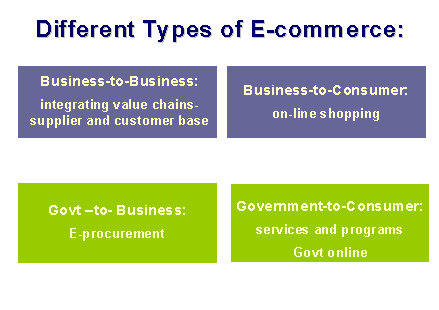
“The use of electronic networks to exchange information, products, services and payments for commercial and communication purposes between individuals (consumers) and businesses, between businesses themselves, between individuals themselves, within government or between the public and government and, last, between business and government”
This definition encompasses the many kinds of business activities that are being conducted electronically, and conveys the notion that electronic commerce is much more comprehensive than simply the purchasing goods and services electronically.
E-commerce is transforming the global marketplace and its impact is being felt across the full range of business and government. E-commerce requires an open, predictable and transparent trading environment, which operates across territorial borders and jurisdictions. To foster such an environment and to realise its full economic potential necessitates international co-operation, which will be instrumental in developing the enabling conditions for its growth.
Countries have to work together to remove barriers or impediments to the free flow of electronic products and services across jurisdictions and by resolving problems that may arise due to its borderless character. Government is shown to be the appropriate vehicle to ensure that this is possible.
The main benefits of e-commerce are demonstrable by the following achievements:
The development of the Green Paper and, subsequently, e-commerce policy in South Africa is based upon the following set of underlying principles:
The Green Paper is intended to provide a platform from which to translate topical issues around e-commerce into government policy. The Green paper itself is not a policy document nor an academic paper, but is essentially a consultative document designed to raise questions on issues that need to be addressed by the Government policy formulation process.
Several policy issues arise as a result of the proliferation of e-commerce. These include development and access to the ICTs; taxation; security and privacy; protection of intellectual property; content development and regulation; electronic payment systems; standards and interoperability.
Transacting over the Internet can mean, for example, that a purchaser and vendor are located at different sides of the world; a scenario, which has prompted concerns for consumer protection and the right to redress. One of the main concerns generated by e-commerce is the priority that must be accorded to issues such as privacy of personal information to safeguard public interest. Any regulatory regime that South Africa adopts must be consistent and compatible with international frameworks.
The policy formulation process entails the creating of the following documents:
The Green Paper will be used to:
Responses or submissions to the Green Paper are not limited to questions raised in the Green Paper; inputs on related activities and how they affect or contribute to the development of e-commerce are also welcome.
The process is expected to be complete in the third or fourth quarter of 2001 with the enactment of the necessary legislation and establishment of the necessary organisational framework or structures.
Government´s role will be instrumental in developing the enabling conditions for growth of e-commerce by preventing and removing barriers. To foster a stable environment and to realise the full economic potential of e-commerce requires government participation. Challenges for government specifically revolve around:
As with many other countries the challenge is for South Africa to develop a policy framework and strategy that will optimise and exploit the benefits of e-commerce. South Africa has to move quickly to strategically position itself and develop competitive edge within this new economy, based on its own particular political, social, cultural, economic and technological conditions. Government is committed to providing a supportive and responsive domestic environment for e-commerce.
In the light of the above, the resulting e-commerce policy framework should:
E-commerce is being debated in various forums such as the OECD, APEC and WTO, WIPO, ITU, UNCTAD, World Bank, UNCITRAL. National governments are also moving to explore implications of e-commerce. The work of these organisations in the area of e-commerce is summarised as follows:
Organisation for Economic Co-operation and Development (OECD)
Representing the largest volume and amounts of transaction (about 90%) the OECD has been by far the leader in the development of an e-commerce framework.
International Telecommunication Union (ITU)
Currently busy with the development of practical handbooks for telecommunications policy makers and regulators covering issues related to e-commerce in conjunction with the World Bank. The ITU will also seek to raise awareness of the role of telecommunications reform in the development of e-commerce with special emphasis on developing countries in terms of infrastructural development, market liberalisation and the proliferation of electronic services.
United Nations Commission of International Trade Law (UNCITRAL)
Has developed and adopted model law on e-commerce in 1996, which offers national legislators a set of internationally acceptable rules as to how a number of legal obstacles to the communications of legally significant information in the form of electronic communications can be dealt with. Most member countries, irrespective of their sovereign privacy laws have largely ratified the UNCITRAL model law.
United Nations Conference of Trade And Development (UNCTAD)
Has published a set of documents, prevalent being electronic commerce: legal considerations." The document proposes joint collaborative efforts with UNCITRAL. UNCTAD proposes to further work jointly with the World Intellectual Property Organisation (WIPO), and the International Chamber of Commerce.
World Intellectual Property Organisation (WIPO)
The WIPO arbitration and mediation centre has established an internet based, online dispute resolution system that can provide a neutral, speedy and inexpensive means of resolving disputes without the physical movement of persons and things. WIPO further provides a legal framework to deal with issues of Intellectual Property and e-commerce.
World Bank
Provides financial and other resource assistance in the development of e-commerce policies and applications. The World Bank further provides advocacy in building proper tax legislation including issues of taxation related to e-commerce.
World Trade Organisation (WTO)
The GATS provides a legal framework for all trade in electronic goods and services. TRIPS provides a framework for trade related aspects of Intellectual property rights and e-commerce.
International Labour Organisation (ILO)
Ongoing monitoring of the impact of digitisation on the protection of the rights performances works and remuneration of performers, journalists and the labour force in the electronic communications arena.
What is important to notice is that there is a great drive towards coherency and condensation of selective developments in international forums. Specific views and activities by each organisation on various areas of e-commerce will be dealt with throughout the paper.
The report prepared by UNCTAD “Building Confidence: Electronic Commerce and Development” has analysed the current status of Africa´s readiness for e-commerce and identified possible strategies for improvement. According to the report there are over 550,000 dial-up Internet accounts for the over 750 million people in Africa. The Internet has numerous obstacles affecting its diffusion in Africa, namely, a shortage of telephone lines, lack of power supply, lack of access to computers, prices charged for access, slow speed and quality of service, content and language, etc.
Although so far participation by African nations in many of global forums and treaty organisations (as listed above) has been limited, some African countries and regional formations are already showing interest in the adoption of e-commerce and have initiated e-commerce-related activities. Africa´s infrastructure initiatives/ strategies for e-commerce include:
The African continent, SADC region in particular, will have to work on a coherent e-commerce strategy that would help the region to leapfrog not only the infrastructure, but also the implementation of e-commerce.
Contents | Executive Summary | Chapter 1 | Chapter 2 | Chapter 3 | Chapter 4 | Chapter 5 | Chapter 6
Chapter 7 | Chapter 8 | Chapter 9 | Chapter 10 | Chapter 11 | Chapter 12 | Chapter 13 | Glossary and References