Qualifications, learning programmes, curriculum and quality assurance
This chapter addresses the diverse needs of learners and the different contexts of learning. The work of SAQA in developing the NQF forms the basis upon which the curriculum, programmes and qualifications for FET will be built. The framework accords with the recommendation of the NCFE that learning programmes should span a continuum from GET, through vocational education, to community and personal development programmes. The new framework is designed to meet the needs of those who have already passed through the current system or will do so in the next five to six years, as well as those who will enter FET after Curriculum 2005 is fully implemented.
1. Introduction - the agenda
1.1 The key to the successful integration of education and training lies within the FET band. The developmental task for FET is to design, implement, monitor and continuously improve an integrated approach to learning, in school and out of school, in FET colleges, in the workplace, in other institutions of learning, and in private study.
1.2 Global changes in the industrial and service sectors of the economy place a premium on knowledge and skills, and give rise to the concept of the `knowledge society'. The rise of the knowledge society leads to the requirement that all learning programmes and qualifications incorporate underpinning knowledge, skills and values that are transferable to different work and learning contexts.
1.3 This approach will require a shift away from the traditional divides between academic and applied learning, theory and practice, knowledge and skills, and head and hand. It will require a move away from programmes which are narrowly defined in terms of `education' and `training', towards a new and balanced curriculum which will provide flexible access to further and lifelong learning, to HE, and to productive employment in a range of occupational contexts.
1.4 The requirements of redress, and the goals of lifelong learning, nation-building, and the nurturing of a responsible citizenship grounded in democratic values, will place their own demands upon the curriculum and qualifications structure of a new FET system. A new emphasis will be placed on access, flexibility, the provision of counselling and advisory services, the recognition of prior learning and experience, remediation, quality learning resources and materials, job readiness, articulation, and common standards and transferability of credits.
1.5 The Report of the Ministerial Committee for Development Work on the NQF, Lifelong Learning through a National Qualifications Framework (February 1996), coupled with wide-ranging consultations undertaken by the DoE, has led to the identification and adoption of seven critical outcomes and five lifelong learning developmental outcomes as the basis for the development of learning programmes, curricula and qualifications.
1.6 As defined by SAQA, learning outcomes are the contextually demonstrated end-products of the learning process. Outcomes include knowledge, skills and values that are recognised to be critical to the future success of learners and of our society in the 21ST Century. The Ministry believes that these learning outcomes are relevant throughout life, not simply in employment and further learning. Accordingly, the Ministry believes that it is these learning outcomes which should form the basis for the development of the curriculum, learning programmes and qualifications frameworks for FET.
1.7 The critical and developmental outcomes are depicted in the following diagram:
| CRITICAL OUTCOMES | DEVELOPMENTAL OUTCOMES |
| PROBLEM-SOLVING SKILLS (1) Identifying and solving problems in which responses display that responsible decisions using critical and creative thinking have been made TEAMSHIP SELF-RESPONSIBILITY SKILLS RESEARCH SKILLS COMMUNICATION SKILLS TECHNOLOGICAL AND ENVIRONMENTAL LITERACY DEVELOPING MACROVISION (7) Demonstrating an understanding of the world as a set of related systems by recognising that problem-solving contexts do not exist in isolation |
LEARNING SKILLS Reflecting on and exploring a variety
CITIZENSHIP
CULTURAL AND AESTHETIC UNDERSTANDING
EMPLOYMENT SEEKING SKILLS
ENTREPRENEURSHIP |
1.8 SAQA has identified 12 organising fields within the NQF. These organising fields are based on the integration of fundamental disciplines and areas of study, and on the identification of key occupational clusters. The Ministry recognises these 12 organising fields as the basis for the development of curricula, learning programmes, unit standards and qualifications for FET. The 12 fields are set out below.
1.9 Through the introduction of the new curriculum framework, the Ministry seeks to set the agenda for the medium-term transformation of the existing system. However, the Ministry is also acutely aware of, and deeply concerned about the large numbers of young learners who will exit FET before this transformation is complete. Most will have only general qualifications, such as a Senior Certificate, and will join hundreds of thousands of others in the labour market with similar or no qualifications, and with little hope of productive employment, self-employment or further and higher learning. To meet the needs of these learners, the Ministry will undertake a number of `rehabilitation' initiatives, focusing on academic remediation and the development of job-entry and entrepreneurial skills. The Ministry will link the National Youth Colleges Programme to the learnerships proposed by the Ministry of Labour, so that young adult learners can undergo meaningful learning programmes and obtain useful qualifications. Other "crash" programmes and services will be initiated in conjunction with the Ministry of Labour. These will be addressed further in Section 5 of this chapter.
1.10 The DoE has already begun a review of existing learning programmes, curricula and qualifications. The changes that will be implemented following this review will be aimed at ensuring that, prior to the full-scale implementation of Curriculum 2005, learners who exit the FET system at Level 4 on the NQF, with a Senior Certificate or a National Senior Certificate, will be better equipped to access higher learning and to enter productive employment or self- employment.
1.11 The agenda outlined here has important implications for qualifications, learning programmes and curricula, and points to the following imperatives:
It is these imperatives which must foreground the development of qualifications, learning programmes and curricula.
2. The breadth and depth of learning programmes and qualifications
2.1 The present system of FET qualifications and programmes offered by schools, colleges, industry and private providers does not prepare learners adequately for success in further learning and for productive employment. FET programmes provided by schools are too constrained by narrow educational concerns and too general, offering little or no specialisation. On the other hand, programmes offered by the present technical colleges are too narrow and specialised, and do not equip learners adequately for the social, economic and cultural changes they will face in the course of their lives.
2.2 The Ministry supports the view of SAQA that a qualification shall:
2.3 FET must offer a diversity of learning programmes and qualifications. Learners who choose to specialise early may do so with the understanding that specialisation is neither too narrow, nor deficient with respect to underpinning knowledge and values. Learners who choose to specialise later may take longer to attain a qualification that holds currency. The key external test to be applied to all qualifications is whether they articulate with further and higher learning, and with work.
2.4 These concerns lead the Ministry to believe that the current provision of learning programmes and qualifications, and the rigid identification of certain types of programmes and qualifications with particular institutions, is inappropriate and must change. Learners must be given access to a wide range of learning programmes through the development of institutional partnerships and linkages. Distance education and resource-based learning have a crucial role to play here.
3. SAQA requirements on breadth and depth of qualifications
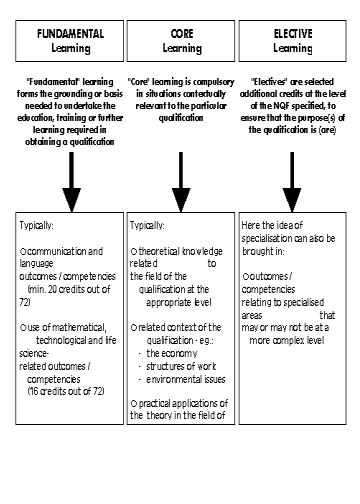
SAQA has defined a qualification as comprising three components, viz., fundamental, core and elective learning. These can be illustrated as follows:
3.1 Fundamental learning
3.1.1 SAQA has determined that, by the year 2002, all qualifications offered at Levels 2 to 4 on the NQF must include a minimum of 16 credits in Mathematical Literacy, as part of the fundamental learning component.
3.1.2 The Ministry supports this position, as a reflection of the importance of mathematical literacy, and of science and technology, in all modern societies.
3.1.3 However, learning programmes and qualifications that are currently provided within the FET band, do not include a compulsory Mathematical Literacy requirement. Mathematical Literacy deals with qualitative and quantitative relationships of space and time. The Ministry will therefore review and upgrade the mathematical literacy components of existing learning programmes and subjects offered in schools and technical colleges, in order to fulfil the SAQA requirement. Learning programmes and subjects to be reviewed will include Economics, Business Economics, Home Economics, Accountancy, Physical Sciences, Biology, Geography, Technical Drawing, and Engineering and Business Studies. The training and supply of appropriately qualified teachers will also be addressed.
3.1.4 The SAQA requirement of a minimum of 20 credits (out of a maximum of 72 credits) in Communication Studies and Language, as part of fundamental learning, is welcomed by the Ministry. Language, literacy and communication are intrinsic to human development and central to lifelong learning. Language and communication empower human beings to make and negotiate meaning, access knowledge and information, express their thoughts and emotions logically, critically and creatively, respond to others, and participate in the social, political, economic, cultural and spiritual life of society. In addition, multi-lingualism affords learners the opportunity both to develop their own language and culture and to share in the language and culture of others. This is increasingly important in a multi-cultural and multi-lingual society such as ours, and in an increasingly inter-dependent, multi-cultural world.
3.2 Core learning
3.2.1 Core learning involves learning experiences in situations contextually relevant to the particular qualification. For example, in the field of Business, Commerce and Management Studies, the principles of business planning and practice, and organisational and human resource development would be included as part of core learning. Practical applications might include researching and developing a business plan for a small business or designing a training plan or a benefits package for a simulated or real group of employees.
3.3 Elective learning
3.3.1 Elective learning entails a selection of specialised, additional credits to ensure that the purposes of the qualification are achieved. Elective learning includes learning programmes that provide for a range of possible career and occupational directions. For example, a specialisation in marketing might be added to the core program of a student pursuing business administration.
3.3.2 Relatedly, elective learning may include learning programmes outside of the core that provide an understanding of alternative career and occupational opportunities. Thus, a Business Studies student might take a credit in economic history, or in contemporary political issues or an introductory learning programme in industry-related environmental concerns. Such elective learning programmes provide the learner with an expanded scope of possibilities and deeper understanding with respect to a field of interest.
3.3.3 The offering of work-related experience, as required in modern learnerships, should be accommodated within the elective learning component of learning programmes and qualifications. Work-based credits will help to smooth the transition from school or college to work. Both the structured learning and work components of learnerships will need to be registered on the NQF.
Proposals for FET qualifications
FUNDAMENTAL |
CORE | ELECTIVE |
| COMMUNICATION MATHEMATICAL LITERACY |
12 FIELDS OF LEARNING | Subjects/instructional offerings which broaden the core or fall outside the core |
| SELECT 2-3 SUBJECTS \INSTRUCTIONAL OFFERINGS |
SELECT 2-3 SUBJECTS \INSTRUCTIONAL OFFERINGS |
SELECT 2-3 SUBJECTS \INSTRUCTIONAL OFFERINGS |
| COMPLY WITH HIGHER EDUCATION ADMISSION REQUIREMENTS | ||
This diagram has been adapted from that of SAQA
4. Career guidance and support services
4.1 Assisting learners to make informed career choices, and informed choices with respect to their elective learning, is a critical aspect of service in the FET band. Career guidance and support services must provide information on learning programmes, providers, qualifications and jobs. A comprehensive and up-to-date database of relevant information must be developed.
4.2 Labour market information, indicating skills shortages, career opportunities, and trends in the job market, is essential. Access to such information could be facilitated through a range of career guidance services offered within or outside of the school or college.
4.3 Other support services, including guidance, counselling, health and welfare services, as well as access to learning resource centres and psychological services, should in principle be available to all learners. Special provision should be made for learners with special education needs. These services and facilities need to be made progressively available.
5. The structure of learning programmes and qualifications
5.1 It will be in the combinations of fundamental, core and elective learning, and therefore in the structure of qualifications and learning programmes, that the question of the breadth and depth of learning programmes will be resolved.
5.2 A more flexible and less restrictive approach is needed to the constitution of learning programmes and qualifications. Learner choice should only be limited by the need for coherence, adequate depth of learning, and the requirements of further and higher learning, and work. To achieve this balance, the fundamental learning component of a qualification will need to be closely regulated, with greater flexibility allowed with respect to core and elective learning.
5.3 This flexible approach, with the proviso noted above, will require the establishment of partnerships between and among schools, FET colleges, industry-based training programmes, providers of social and developmental training programmes and providers of training programmes for small, medium and micro enterprises.
5.4 An initiative directed at enhancing the relevance of FET programmes to work and self-employment would be an important contribution to economic, social, urban and rural renewal and development. Such an initiative could benefit by being located within the rural and urban development projects of ESKOM, TELKOM, the DoL, the Departments of Public Works, Water Affairs and Forestry, Transport, Public Service and Administration, the local government programmes of the Departments of Constitutional Development and Trade and Industry and the Ntsika Enterprises Promotion Agency, industry training boards and their successor bodies, and social developmental projects of religious organisations, local communities and non-governmental organisations (NGOs).
6. HE learning programmes and qualifications offered by FET colleges
6.1 The White Paper on Higher Education specifies that programmes and qualifications which fall within the HE band should be offered within the framework of programme accreditation, institutional auditing and quality promotion laid down by the Council on Higher Education (CHE), through its Higher Education Quality Committee (HEQC). Accordingly, HE programmes and qualifications offered by FET colleges will need to comply with the requirements and regulations of the CHE. The Ministry will where necessary ensure the amendment of legislation relating to technical colleges, to bring the provision of HE programmes by FET institutions in line with the requirements of the White Paper on Higher Education and the Higher Education Act, (Act 101 of 1997).
6.2 The Ministry believes that the core business of FET colleges should be the offering of intermediate to high level skills programmes within the FET band. FET colleges that offer programmes and qualifications which fall within the HE band may continue to do so, on an interim basis, until the CHE, in consultation with the NBFET, has put in place an appropriate policy framework, and developed procedures, for regulating this matter. The Ministry will request the CHE to undertake a review of the HE learning programmes and qualifications offered by FET institutions, with a view to making a decision whether to terminate, re-orient to the FET band or bring them fully within the framework and development trajectory of HE.
6.3 HE programmes and qualifications offered by FET colleges will have greater currency and be more appropriate when they are based upon institutional partnerships such as franchise agreements, joint delivery of learning programmes and qualifications, and articulation and transfer agreements.
6.4 It is the view of the Ministry that the need to open up career paths and to afford access to HE and training, while holding capital and other costs in check, far outweighs the traditional territorial interests of institutions. The pressing need to expand HE opportunities for graduates of FET offsets the charge of "mission drift" that is sometimes made against FET colleges. In short, current preconceptions regarding institutional roles must be critically re-examined, and new relationships must be created between FET and HE providers which will meet the needs our people. The Ministry, accordingly, will initiate a review of existing FET institutions, programmes and capacity, with a view to ensuring the optimal utilisation of, in the first instance, the country's FET colleges.
6.5 HE institutions have the experience and skills that could assist FET institutions to meet the challenge of providing adequate and appropriate FET programmes and opportunities.
6.6 The CHE will advise the Minister on the development and planning of HE. That advice should include due consideration of the role of FET colleges.
7. Distance education and resource-based learning
7.1 Flexible, open learning programmes, through distance education and resource-based learning, should be fully utilised and expanded, as a significant means of broadening access to FET.
7.2 Improving the quality of distance education and resource-based learning will make it easier for learners to access FET and to succeed. Open learning approaches allow for multiple entry and exit points and the use of different sites of learning. They allow the learner to determine the pace and place of learning using a variety of media and of learning and teaching approaches.
7.3 Over time, it is desirable that schools be encouraged to enable learners to access learning programmes through self-study or within other learning institutions and provide the necessary learner support. Schools will be encouraged to enter into formal partnerships with FET colleges, industry training boards and their successor bodies and private providers of contact and distance education.
7.4 Distance education and resource-based learning are particularly appropriate for employed learners. Many of these learners will possess prior learning and experience, and distance education and resource-based providers are ideally placed to pioneer the recognition of prior learning and experience in order to increase access to FET.
7.5 Distance education should not be seen as a second-best option. Instead, quality and effectiveness should be improved and assured through the application of the frameworks outlined in A Distance Education Quality Standards Framework for South Africa (DoE, December 1996), the Technology Enhanced Learning Investigation in South Africa: A Discussion Document (DoE, July 1996) and the Technology Enhanced Learning Initiative in South Africa: A Strategic Plan (DoE, April-May, 1997).
7.6 Within these frameworks the DoE, in collaboration with provincial Departments of Education, will undertake a review of existing distance institutions such as Technisa.
7.7 The DoE will, together with the Department of Communications and the South African Broadcasting Corporation, conduct a review of existing educational broadcast programmes, and develop a proposal for an educational channel. Meanwhile there is a need to expand existing educational broadcasting services and plan for the establishment of an Open School.
8. Developing qualifications, learning programmes and curricula
8.1 The development of FET qualifications, learning programmes and curricula involves two processes: the development and registration of qualifications and unit standards, and the development of curriculum frameworks, learning programmes and learning materials.
8.2 The development and registration of qualifications and unit standards involves the participation of SAQA-accredited National Standards Bodies (NSBs) and Standards Generating Bodies (SGBs). The latter will develop qualifications and their component unit standards. In line with the integrated approach to education and training, SGBs will comprise stakeholders representing the state, organised business and labour, and social sectoral organisations, all of whom will have a national constituency and interest. Once the adoption of a White Paper on Further Education and Training and the DoL's Skills Development Strategy has taken place, and the supporting legislation passed, the development of unit standards and qualifications will proceed with urgency. The DoE and DoL have an important role in this process.
8.3 The development of curriculum frameworks, learning programmes and materials will follow from this process. Curriculum development committees will undertake this work for the DoE and provincial Education Departments.
8.4 Currently, separate policies on qualifications, curriculum frameworks and learning programmes are in place for public schools and colleges. As described in Section 1, this situation is under review. The Ministry has two objectives in mind: to give effect to the integrated approach to education and training outlined here; and, to develop relevant qualifications, unit standards, learning programmes and curricula consistent with the outcomes-based approach. A Ministerial Task Team on Qualifications, Unit Standards, Learning Programmes and Curriculum has been established to advise on how to achieve these two objectives. (see ch.7, point 3.)
9. A quality assurance system for FET
9.1 Quality assurance is of fundamental importance for the development of a relevant, cost-effective and responsive FET system.
9.2 The primary responsibility for quality assurance rests with FET institutions. International and local experience shows that quality is driven from within organisations and institutions.
9.3 The management of quality is multi-faceted, involving the setting and management of standards with respect to qualifications, learning, teaching and training, assessment, management and leadership, and educational resourcing. An important aspect of the management of quality is continuous improvement - a process that is internalised by the staff and institutionalised through strategic planning and local policy setting.
9.4 Globalisation and the internationalisation of vocations and professions place additional requirements on quality, especially in the areas of qualifications and assessment. South African qualifications should measure up to global standards through the application of benchmarking processes.
9.5 Accordingly, there is an important role for a national FET umbrella authority with responsibility for quality promotion and quality assurance, the accreditation of providers, certification of learners, monitoring of provision, facilitation of moderation and the auditing of providers' quality management systems. Such a body should collaborate with the Sector Education and Training Authorities (SETAs) anticipated in the Skills Development Bill, in carrying out quality assurance and quality promotion across the FET system.
9.6 The Ministry believes that a Further Education and Training Quality Assurance Body (FETQA) should be located within the national DoE. Its governing body could be constituted as a committee of the NBFET. The DoE could perform some or all of the functions of the quality assurance body in collaboration with appropriate non-governmental service providers.
9.7 The HEQC will be responsible for the quality assurance function for qualifications and unit standards which fall within the HE band. It has been argued that the FETQA body should undertake the quality assurance function for all learning programmes offered by FET providers, including FET college programmes which fall within the HE band. The Ministry believes however, that the goal of developing a single, co-ordinated HE system, and the interests of learners in the FET band, would best be served by limiting the role of the FET quality assurance body to qualifications and unit standards which fall below and within the FET band - that is, Levels 1-4 on the NQF.
9.8 This approach will facilitate the development of a coherent quality assurance agenda for FET. Further, it will avert the danger of overlapping functions and potentially conflicting approaches by the FETQA and the HEQC.
10. Assessment
10.1 Assessment has a direct and at times distorting influence on learning and teaching. The current assessment paradigm, which is based primarily on cognitive learning and which compares one learner with another (referred to by educators as "norm referenced evaluation") is unsuited to the challenges presented by new policies which are aimed at the transformation and integration of education and training. Inconsistencies in assessment lead to concerns about fairness and to perceptions of varying standards and quality across different parts of the FET system. In the new approach, learners will be assessed in relation to the learning outcomes of the unit standards they are to achieve (referred to as "criterion or outcomes referenced evaluation").
10.2 Assessment has two distinct, but related objectives. First, at the macro-level, assessment must provide reliable and valid information regarding learner achievement and competency, to ensure the legitimacy and currency of qualifications with employers and with HE institutions. Traditionally, assessment at the FET level has been distorted by the role of FET qualifications in selection to higher, particularly university education. Second, at the micro-level, assessment must be developmental and formative, to provide guidance to learners through appropriate evaluation and feedback.
10.3 In the current school system, continuous assessment takes place in Grades 10 and 11. This includes mid-year examinations, and examinations at the end of each year. Examination papers are set and scripts marked internally by teachers. Continuous assessment relies largely on the competence and professionalism of the teachers. Assessment in Grade 12 is conducted through external provincial examinations. In these public examinations all learners in a province write the same externally moderated examination paper in each subject. Examination scripts are marked and moderated by a staff comprising a chief examiner, examiners and an external moderator.
10.4 In the case of the technical colleges, all examinations, from N1 through to N6, are set by the national DoE, which administers the examinations on behalf of the provincial departments of education. In some cases, however, the national examinations are marked internally by college staff, using a national marking scheme. The Ministry believes, in the interests of consistency, that the latter approach should apply to all technical college instructional offerings at N2, N4 and N5 levels, until such time as existing technical college programmes are replaced by new curricula, learning programmes, qualifications and assessment policies.
10.5 Under the new outcomes-based approach a student's FET learning programme will consist of a particular set of unit standards. Each unit standard will clearly state the specific outcomes to be assessed and the assessment criteria. Students will know what they are expected to show or demonstrate and how their knowledge and skill will be assessed. Their learning activities will be designed so that they can master the required outcomes to the required assessment standard. The public examination will sample the competencies acquired at the assessment levels indicated in the unit standards. This will be recorded as a performance measure that indicates to both the student and society that the standards have been met and the degree to which they have been met. The negative and stereotypical concept of `failure' will be replaced with the positive notion of progress towards the achievement of standardised outcomes, where the student will be regarded as `in progress' or `partially complete'. Nonetheless, learners will be given credit for those outcomes that they have attained. Common standards and fairness will be ensured through the marking of scripts by the learner's lecturer or teacher, according to a provincial or national marking scheme.
10.6 In the case of schools, assessment measures would have to be improved to provide reliable and valid information and to ensure the appropriate progression of learners. This could include a form of external assessment in support of school-based continuous assessment. This could be done either through an external examination which is marked by teachers according to a common marking scheme, and which is externally moderated, or through an annual national or provincial examination in all or some learning areas.
11. Efficiency, repetition and admission policy
11.1 The Ministry is considering the adoption of a national policy and regulations regarding the number of times learners may repeat grades, subjects, learning programmes and whole qualifications at public cost. This arises in the context of the inefficiency of the FET system as reflected in low retention and high repetition rates in schools and colleges.
11.2 International research has so far failed to demonstrate convincingly the benefits for learners of repeating grades, learning programmes, subjects or whole qualifications. Moreover, the cost of such repeats, especially within the school sector, is extremely high, and the burden that repeaters place on schools contributes to a steady decline in the quality of learning.
11.3 Additionally, the Ministry believes that schools are not the appropriate environment for the successful pursuit of learning by young adults in their early twenties. Colleges can provide more relevant and flexible opportunities, and more appropriate learning environments, for such learners.
What this chapter means in practice
The development of new learning programmes, curricula and qualifications for FET, within the NQF, will be given priority. The emphasis will be on high quality programmes and internationally recognised qualifications which integrate education and training, preparing learners both for work and higher learning. Lifelong learning, with appropriate support services, will be an important goal. The new framework will be based on articulation between programmes, a sound assessment system, and the recognition of prior learning. It will be predicated on the notion that learning outcomes are more important than where learning takes place. To achieve these objectives, the development of new partnerships, together with a programme of institutional and staff development, will be essential.
Contents
| Chapter1 | Chapter 2 | Chapter 3 | Chapter 4
Chapter 5 | Chapter 6 | Chapter 7 | Appendicies