Background
This chapter makes the point that
Further Education and Training (FET) is crucial to South Africa's development. It sketches
the process that has led up to the publication of this Green Paper and sets the scene for
the policy proposals that follow.
1. Introduction
1. 1 The Constitution of the Republic of South Africa (Act 108 of 1996) (Section 29 (1)) states clearly that everyone has the right:
1. 2 It is in pursuit of this right, and in fulfilment of government's obligations under the Constitution to make further education progressively available, that this Green Paper puts forward a new framework for Further Education and Training (FET).
1.2.1 The measures outlined here are aimed at the development of a vibrant, innovative and responsive FET system, through which the people of South Africa can develop their full human potential and contribute to the building of a just, democratic and prosperous society.
1.2.2 The importance of FET is widely recognised internationally. When broadly conceptualised, FET contributes to social cohesion, to the social and cultural life of society and to economic growth and prosperity.
1.2.3 In the South African context, FET has a key role to play in developing the skills through which the basic needs of our people can be met and the foundations laid for growth and democracy.
1.2.4 Moreover, as we approach the 21st century, FET is fast becoming an important strategic force, in a context where a country's ability to compete effectively in the global economy increasingly depends on the knowledge and skills of its people. The pace of scientific and technological advancement, and the challenges and opportunities of the information age, mean that high quality education and training, and lifelong learning, are essential if South Africa is to keep abreast of changes in the nature of knowledge and in methods of production.
1.2.5 If FET is to fulfil its key role in promoting lifelong learning, personal development, economic growth, nation-building and the creation of a just and equitable society, it must be transformed. This Green Paper is an important step forward in that transformation process.
2. The Green Paper process
2.1 The Green Paper builds upon an extensive process of research and consultation, which culminated in August 1997 in the Report of the National Committee on Further Education (NCFE). The NCFE Report raised important issues and made a number of significant recommendations and proposals. These recommendations have informed the Ministry's views as put forward in this Green Paper.
2.2 A major challenge which has faced the writers and contributors to this Green Paper is the fact that the FET system has only recently been defined as a specific band, located between general education and training (GET) and higher education (HE), and inclusive of all education and training programmes between levels 2 and 4 on the new National Qualifications Framework (NQF). The FET band brings into one conceptual framework widely diverse groups of learners and stakeholders, including pre-employed, unemployed and employed youth and adults. A variety of institutions, agencies, government departments and stakeholders, including millions of current and potential learners, have direct but often divergent interests in the provision of FET or in accessing FET. It is this very diversity and fragmentation, and the need to adopt a coherent approach to the development of this critical middle band of the education and training system, which lay behind the establishment of the NCFE, and which have informed the development of this Green Paper.
3. A definition of FET
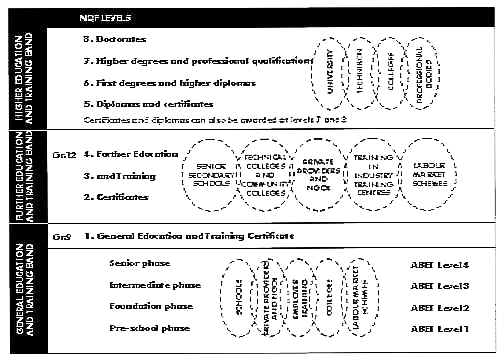
3.1 FET consists of all learning and training programmes from NQF Levels 2 to 4, or the equivalent of Grades 10 to 12 in the school system. It is the band within the NQF which follows directly on GET and precedes HE. Learners enter FET after the completion of the compulsory phase of education at Grade 9 or Level 1 of the NQF.
3.2 FET is not compulsory education. By definition, it has no age limit. Its goal is to promote lifelong learning and education on-the-job.
Below is a graphic representation of the FET band and its relationship to the GET and HE bands within the NQF...
This diagram has been adapted from that of SAQA.
4. The provision of FET
4.1 FET is provided directly or through distance education by:
4.2 In keeping with the Report of the NCFE, the Ministry's vision of a future FET system is as follows:
FET will be an open learning system, responsive to the needs of individuals and communities, and contributing to the development of the country's human resources. It will make flexible, relevant, accessible, high quality FET programmes progressively available to all eligible citizens who are capable of benefiting from them. In so doing, it will promote the development of human talents and abilities, the redress of past inequalities, and the building of a just, democratic and prosperous society.
4.3 The mission of FET is to foster intermediate to high level skills, lay the foundation for HE, facilitate the transition from school to work, develop well-educated, autonomous citizens and provide opportunities for lifelong learning through the articulation of learning programmes.
4.4 The NCFE Report notes that, after GET, FET is the largest phase of learning, costing the country over R10 billion annually and encompassing some 3 million learners and 8000 providers, excluding companies.
4.5 FET is also the most complex and diverse phase of education and training, comprising 13 types of providers, categorised into four main sectors: secondary schools, publicly funded colleges, private off-the-job providers and work-based education and training. Responsibility for FET largely falls to the national and provincial departments of education, but the Department of Labour (DoL), other government departments and private providers including companies, are also important role players.
5. The commitment of the Ministry to the transformation of FET
5.1 The FET band is situated at the intersection of a wide range of government policies which are critical to the new information-based economy. These include macro-economic, industrial, labour market and human resource development policies. Government co-ordination across these domains is key to their success and to the development of a policy framework which will promote the development of the human capacities, knowledge and skills of our people.
5.2 Transforming FET to meet the challenges of the present and the future will not be an easy task. It will entail changing public perceptions and attitudes regarding the FET band. It will require rethinking and reinterpreting the dominant positions which both GET and HE currently occupy in the political economy of educational reconstruction. Some of the country's best minds, resources and funds will need to be redirected to the FET sector.
5.3 We need transformation on a major scale. Such an intervention cannot come from the state alone but must involve all stakeholders and interest groups. Transformation will require more effective state co-ordination, greater private sector investment and involvement, and greater community and individual initiative. The transformation of FET is a project which must succeed, and to which we must all be committed.
6. A developmental approach
6.1 The Green Paper adopts a strongly developmental approach to the transformation of FET. Development is used here in two senses: first, to signal the critical role of FET in social and economic development, and second, to make the point that implementation of the Ministry's vision and strategy will require serious and systematic efforts to overcome the resource and capacity constraints which hold back the pace of change.
6.2 Our national system of FET must be increasingly responsive to the country's needs, and it will at the same time build capacity and introduce essential changes in a planned and responsible manner.
What this chapter means in practice
Believing that FET is central to South Africa's social and economic development, and to the future of our young democracy, the Ministry of Education is deeply committed to its transformation.
Transformation must involve the private sector and the community, working in partnership with government.
FET must become more relevant and responsive to the needs of its three major client-groups - the pre-employed, the employed and the unemployed. Transformation of the system to meet these needs will impact upon all providers of education and training, including schools, colleges and private providers.
Contents
| Chapter1 | Chapter 2 | Chapter 3 | Chapter 4
Chapter 5 | Chapter 6 | Chapter 7 | Appendicies