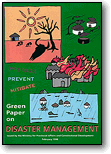
| THE GREEN PAPER ON DISASTER MANAGEMENT |
|
Throughout our history, disasters have inflicted a heavy cost in human, material and physical resources, and damage to the environment. They represent a potentially significant obstacle to economic growth and development. A disaster is an event which disrupts the daily life of the population of a community or country and can result in substantial loss of life and social upheaval, leading to many persons becoming homeless, helpless and hungry. The situation is further aggravated by the disruption, dislocation or loss of vital economic production and national infrastructure, including water and power supplies, communications and transportation. Disasters occur when hazards impact on a community to the extent that available resources cannot cope with the problem effectively. The community itself needs support and assistance to prevent and cope with disasters and their effects. Adequate procedures to deal with disaster situations and relief measures must be planned prior to the event, with strong legislation to empower those responsible to carry out the tasks. Regular training must be conducted covering all aspects of disaster management. Careful planning must be in place to coordinate the effective use of resources, both human and physical, for the saving of lives and property, limiting damage to the environment, and the return to a normal life style as soon as possible. The development of disaster-management strategies must be undertaken before the event. Disaster management requires effective community-based strategies which will include programmes and measures to: Measures must also be in place to request and receive assistance from outside the country. Many authorities and organisations are routinely involved in dealing with incidents and disasters which arise when natural or technological hazards impact on our communities. An active partnership between national provincial and local governments, statutory and voluntary organisations and communities is needed in order to develop and implement effective disaster-management strategies. The role of national government is to provide guidance and support to the provincial and local governments in developing their capacity for dealing with disasters, and to provide physical assistance if requested. The aim of the Green Paper on disaster management is to ensure that an effective disaster-management system is realised and implemented by way of national policy which will be reflected in the White Paper. The Green Paper on disaster management is presented to you for your comments and recommendations. We therefore invite you to respond to ensure that the views of all South Africans are reflected in the White Paper. I take this opportunity to thank everyone who has contributed in the Green Paper process up to now and those from whom comments are awaited. A special word of appreciation is conveyed to Ms Janet Love (MP) who was willing to take on the responsibility of coordinating the Green Paper process. |
CHAIRPERSON
SECRETARIAT
DRAFTER OF GREEN PAPER
DRAFTING TEAM National departments:
Parastatals
Others
|
AIDS Acquired immune deficiency syndrome |
Why a Green Paper?
Who was involved in the writing of the Green Paper?
What happens after the Green Paper?
|
The Green Paper is designed to present the broad framework and principles that will give an indication of the direction government policy on disaster management is likely to take. The Green Paper does not go into too much detail about the specific options and choices. It is intended that stakeholders who are concerned about risk reduction and disaster-management issues in the country will point out gaps and suggest ways forward. The Green Paper process encourages vigorous debate about the direction(s) that are being proposed. Visit the discussion forum on this site to participate in an online debate on the Green Paper. In certain sections of the document, specific questions and points of debate are presented to facilitate discussion and elicit further thought and responses from the reader. This will also help to identify the main issues, nature of activities undertaken to deal with risk reduction and disaster management, and new ways of dealing with disasters. Chapter 1: Introduction
Chapter 2: Key principles
Chapter 3: Different approaches to disaster management
Chapters 4 and 5: The current situation, and ensuring that a system of disaster management is in place
Chapter 6: Cooperation and coordination
Chapter 7: Glossary
Green Paper on Disater Management Index | Top of page General | 1. Introduction | 2. Key principles for a Disaster Management policy | 3. Different approaches to Disaster Management | 4. Current situation in managing diasaters | 5. Ensuring that a system for Disaster Management is in place | 6. Intergovernmental and civil society co-operation and co-ordination | 7. Glossary | Contents
|