|
3.1. General approaches to the management of disasters
Introduction
What measures can be taken to manage and possibly reduce the negative
impacts of disasters? Disasters are not welcome events and usually
when they occur, every effort is made to reduce the impact of
such events.
Disaster management should include administrative decisions and
operational activities that involve prevention, preparedness,
response, recovery and rehabilitation at all levels of government.
Disaster management does not only involve official bodies - non-governmental
organisations and community-based organisations also play a vital
role.
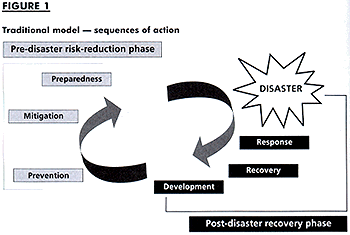
Disaster management can be viewed in a number of ways. The more
traditional approach has been to regard disaster management as
a number of phased sequences of action - or a continuum - as you
can see in the following illustration (Figure 1):
In the more traditional model shown in Figure 1, disaster management
occurs in stages which follow each other in a sequence. That is
to say, mitigation and preparedness precede a disaster. While
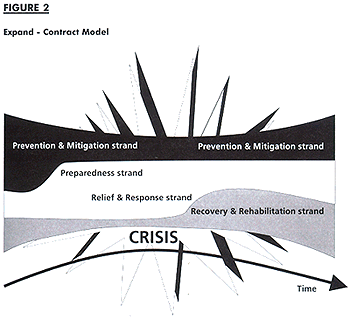
this may well be the case, it is also often observed that the
sequences of action occur simultaneously - as you can see in the
illustration of the expand-contract model below (Figure 2).
A new model for disaster management
In this alternative view of disaster management - the expand-contract
model - disaster management is seen as a continuous process. Disasters
are managed in a parallel series of activities rather than in
a sequence of actions. The different strands of activities or
actions continue side by side, expanding or contracting as needed.
For example, immediately after a disaster event - such as a flood
- the "relief and response" strand will expand to cope with the
immediate effects of the disaster. But as time passes, the "recovery
and rehabilitation" strand - including prevention to mitigate
against possible future disasters - will expand to address the
rehabilitation needs of the affected community. The relative weighting
of the different strands will also vary depending on the relationship
between the hazard event and the vulnerability of the community
involved.
This approach acknowledges that disaster management usually includes
a number of interventions and actions that may be occurring simultaneously
(at the same time) and not always in phased succession (one after
the other). In the case of droughts, for example, drought relief,
recovery and mitigation may often occur at the same time.
Despite the existence of different approaches to disaster management,
disasters are often managed haphazardly. The approach taken to
disasters may thus be as costly (or even more costly) than the
event itself. People are unprepared, and when the event occurs
(even slow-onset disasters) it usually triggers haphazard reactions,
which often result in crisis management. Awareness of disasters
and of one's vulnerability to such events can, however, reduce
the impacts of such events.
Community involvement must always be part of the disaster management
approach. The importance of community involvement can best be
described with an example.
Awareness and mitigation can reduce disaster impacts
Community awareness of disasters can greatly reduce the overall
costs of such events. In Laingsburg in 1981 people had not previously
experienced severe flooding and were therefore completely unprepared
when a severe flood hit the town. As a result of this unpreparedness,
104 lives were lost during the flood.
By contrast, the floods which struck Ladysmith in 1994 caused
relatively little loss of life. This was largely because the low-lying
areas around Ladysmith are frequently flooded and the risk of
disasters is higher. The communty is therefore better prepared
for the disaster and better able to limit its effects.
Note that awareness includes all the people concerned and not
merely officials. Community awareness and effective mitigation
are therefore a critical element of disaster management.
3.2. Key elements of disaster management
Examples of disaster management strategies are provided below.
These are not the only ways that disasters can be managed and
are only meant to prompt institutions dealing with disasters to
become better prepared for disasters.
Prevention
Government departments and municipalities can better prevent a
disaster by conducting certain activities before a disaster occurs.
These can include constructing a dam or levee to control flood
waters; or control burning-off programmes in a veld fire area,
and ensuring that there is proper socio-economic development and
active ownership and participation of communities along the disaster
management continuum (all the phases of the disaster management
cycle).
Mitigation
Disaster mitigation refers to measures that can be taken to minimise
destructive and disruptive effects of hazards and thus lessen
the scale of a possible disaster. Disaster mitigation can occur
at any time.
A disaster plan and structure (e.g., disaster committee at the
local level) should be established. Each plan will be site or
local specific and as such must be tailored for the municipalities
concerned. For example, coastal towns may develop a series of
building codes so as to reduce losses in the event of heavy rains
and strong winds associated with a cyclone. Rural towns may have
to plan for veld fires, droughts and improved water management.
Disaster mitigation can be achieved through proper engineering,
spatial planning, municipal management and conflict resolution.
Preparedness
Preparedness measures such as the maintenance of inventories of
resources and the training of personnel to manage disasters are
other essential components of managing a disaster. Furthermore,
this should be an ongoing, regular function of local government
departments. These measures can be described as logistical readiness
to deal with disasters and can be enhanced by having response
mechanisms and procedures, rehearsals, developing long-term and
short-term strategies, public education and building early warning
systems.
Risk assessments (identifying those areas and people that may
be at risk of a disaster before a disaster occurs) are also essential
and may complement development strategies in local areas. The
development of "suitable" housing for those living in urban, flood-prone
areas cannot be undertaken without a risk assessment for development
(and flood-reduction) planning. Efforts do not therefore have
to be doubled and the two (development and disaster reduction)
can occur simultaneously.
Preparedness can also take the form of ensuring that strategic
reserves of food, equipment, water, medicines and other essential
material are maintained in cases of national or local catastrophes.
Response and relief
If a disaster does occur then response and relief have to take
place immediately; there can be no delays. Delays will occur if
government departments and municipalities have no clear plans
to manage such events. It is therefore important to have contingency
plans in place. Imagine the following scenario:
A flood has occurred in an area and there are also strong winds.
Fear and chaos break out. Members of the public are swamping emergency
services with pleas for help and the mayor's reputation is on
the line.
A well-managed team of government and local players should be
prepared and know where to go, what to do... If the situation
is managed in a crisis way, then people rush off in all directions,
waste valuable time, and even make serious mistakes as a result
of their actions.
Search and rescue plans need to be clear and all roleplayers need
to know their role and function in such activities. Basic needs
such as shelter, water, food and medical care also have to be
provided and a plan needs to be in place (outlining who is responsible
for such activities, etc.)
Rehabilitation
Interventions are also needed after a disaster occurs. In many
ways this is the most difficult period for the victims. Job-producing
activities, construction works and public works programmes may
be needed to name but a few. The victims cannot be forgotten once
the immediate disaster has passed.
Disaster management, as shown by these examples, requires effort
and commitment by the various role players. The capacity must
be built to handle such events, and training programmes are essential.
Duplication of efforts should be minimised and financial resources
appropriately controlled. In certain cases, the "expand and contract"
model is best, with local government personnel conducting disaster
management in their everyday activities and then "expanding" these
when needed. It is important to note that disasters are non-routine
events that require non-routine response. Governments cannot rely
on normal procedures to implement appropriate responses - they
will need to learn special skills, techniques and attitudes in
dealing with disasters.
The key elements of disaster management listed above are important
in providing governments with the capacity to deal with disaster
management at various stages. This is not an exhaustive list of
areas, simply the most important ones. A new system needs to incorporate
some of these key elements into its management plans.
Green Paper on Disater Management Index | Top of page
General | 1. Introduction | 2. Key principles for a Disaster Management policy | 3. Different approaches to Disaster Management | 4. Current situation in managing diasaters | 5. Ensuring that a system for Disaster Management is in place | 6. Intergovernmental and civil society co-operation and co-ordination | 7. Glossary | Contents
|