DIVISION OF REVENUE
The intergovernmental budget process
Introduction
The 1998 Budget tabled by the Minister of Finance included three-year allocations for the national government, the nine provinces and local government. These allocations reflected the outcome of a lengthy consultative process among stakeholders and the application of an objective, demographically based formula in determining the provincial equitable shares.
The revised allocations set out here are lower than those originally announced in March 1998. The decreases are largely due to changes in the economic outlook, explained in chapter 2. The allocations to each of the nine provinces also reflect the impact of using the final, rather than the preliminary, results of the 1996 census in the provincial equitable shares formula.
Intergovernmental Fiscal Relations Act
The intergovernmental budget process is guided by the Intergovernmental Fiscal Relations Act, which took effect on 1 January 1998. The Act establishes a formal process for considering intergovernmental budget issues and is designed to facilitate consultation and promote a budget-making process that is fair and equitable. It provides a legislative basis for co-operative governance through the Budget Council, which brings together the Finance Minister and provincial Finance MECs, and the Budget Forum, which, in addition includes organised local government.
Co-operative governance
During 1998, the Budget Council met regularly to discuss budget issues and co-ordinate the budget preparation process. In addition, the Budget Council met with its counterpart intergovernmental bodies in Education, Health and Welfare. These joint meetings of national Ministers and provincial MECs gave important direction to the formulation and content of the budgets of the three social services that make up about 85 per cent of provincial expenditure.
Division of revenue
The Minister of Finance is required to table a Division of Revenue Bill alongside the national Budget. It must be accompanied by a memorandum linking the allocations to relevant Constitutional requirements and the recommendations of the Financial and Fiscal Commission.
The introduction of the MTEF process has improved intergovernmental coordination and led to several new initiatives in the budget process. National departments, provinces and local governments came together to play a much more crucial role in the development of sectoral policy, particularly in the areas of education, health, welfare and personnel expenditure.
Improved financial planning
These developments will further improve the link between policy planning and financial planning, which has been lacking in government programmes in the past. The co-operative governance framework that is evolving signals a more mature approach to governance, integrating both national priorities and provincial and local autonomy.
The focus of intergovernmental relations now extends beyond financial co-ordination, towards a greater role for various spheres of government in the policy arena. This will help bring funding and policy considerations in line with the new intergovernmental framework and the Constitution.
Resources available
Equitable shares
The Constitution provides that each sphere of government - national, provincial and local - is entitled to an equitable share of revenue raised nationally to enable it to provide basic services and perform the functions allocated to it. The equitable division of revenue takes into account the functions assigned to each sphere and the capacity of each government to pay for these functions through own receipts and revenues.
The equitable share is an unconditional allocation. Provincial and local governments, being distinct spheres of government, determine the priorities for these funds and are directly accountable for how they are spent. However, provincial and local government spending is largely assigned to functions in which national legislation sets norms and standards.
Conditional grants
In addition to their equitable share, provinces and local governments may also receive other allocations from the national share to which the national government may attach conditions. In the 1998 Budget, provinces and local governments received approximately R9,0 billion in conditional allocations from the national share of revenue. A further R4,2 billion was assigned to provincial agencies responsible for implementing specific policies and programmes on behalf of national departments.
Resources to share
In addition to collecting revenue, government currently borrows to meet its expenditure requirements. It is the balance of national revenue plus borrowing, less debt obligations, which represents the total pool of resources available for sharing. Government has also set aside a contingency reserve for each of the MTEF years. The purpose of this reserve is to cushion public expenditure from unforeseen events, such as a deterioration of economic performance or a natural disaster.
Own revenues
Provincial and local government own-revenues are not included in the calculation of equitable shares. The Constitution places limitations on the types of own revenue that provincial and local government have access to, and indicates that any additional revenue raised by a province or municipality cannot be deducted from its equitable share.
Borrowing powers
The Constitution provides for national legislation to govern the power of provinces and local government to borrow. Subject to national oversight, loans may be raised for capital expenditure and to bridge temporary revenue shortfalls. At present, none of the provinces has borrowed on the capital market. Their borrowing has been confined to overdrafts to cover short-term shortfalls.
The vertical division
A choice based on priorities
Government does not use a formula to divide the funds between the spheres of government. The so-called vertical division is done by considering the factors listed in Section 214 of the Constitution and in consultation with the FFC and provincial governments. The vertical division is a policy judgement that reflects the relative priority of functions assigned to each sphere of government. It is a judgement that cannot be captured in a formula.
In considering this division, Government takes into account the economic and social impact of services; the effectiveness with which extra funds can be spent; the scope for savings within budgets; and the short-term impact of fluctuations in allocations.
The division of functions
National government is largely responsible for economic services, the criminal justice system, defence, infrastructure investment and public administration. Both the criminal justice system and infrastructure are priorities for government. At the provincial level, the main services delivered are education, health and welfare, together with provincial roads and regional development. Government has clearly identified the three social service functions as key priorities.
Protection of social services
Government recognises that in times of economic slowdown, its spending priorities should be protected. In arriving at the vertical division for the coming year, Government sought to protect the delivery of social services. All three spheres will receive allocations less than initially expected over the MTEF period, but the burden of the adjustment is placed more on national departments in 1999/00. Thereafter, the reductions are shared in proportion to each sphere’s allocation.
Table 5.1: The vertical division
| R million | 1998/99 |
1999/00 |
2000/01 |
2001/02 |
| National share | 77 176 |
79 608 |
81 338 |
84 898 |
| Conditional grants to provinces1 | 7 891 |
7 671 |
7 529 |
7 324 |
| Grants for local government | 1 132 |
9502 |
0 |
0 |
| Provincial share | 82 862 |
86 946 |
92 743 |
97 522 |
| Local government share | 1 024 |
1 366 |
2 4803 |
2 5803 |
| Total expenditure to be shared | 161 062 |
167 920 |
176 560 |
185 000 |
| National share (excluding conditional grants) | 42, 3% |
42, 3% |
41, 8% |
41, 9% |
| Provincial share (including conditional grants) | 56, 3% |
56, 3% |
56, 8% |
56, 7% |
| Local share | 1, 3% |
1, 4% |
1, 4% |
1, 4% |
National government spending over the next three years amounts to approximately 42 per cent of the total, while provinces will receive around 57 per cent. Part of the provincial and local government allocations are assigned on the national budget as conditional grants. These are included in the national share for the purposes of the Division of Revenue Act.
Improvements in remuneration
Improvements in conditions of service are distributed to provinces as conditional grants from national revenue after the division of revenue is done. The amounts depend on the outcome of the annual salary negotiations conducted in the Public Sector Consolidated Bargaining Chamber. The table above includes preliminary allocations for improvement in conditions of service distributed between the national and provincial shares in proportion to the current distribution of personnel spending.
Horizontal division – equity between provinces
Definition
An explicit revenue sharing formula is used to divide the provincial equitable share between the nine provinces – this is called the horizontal division. It directs funds to provinces based on their demographic and economic profiles, as these provide an indication of the demand for basic services within the provinces.
The equitable share formula was introduced in the 1997 Medium Term Budget Policy Statement and explained in detail in the 1998 Budget Review. The formula used the preliminary 1996 census results. It was noted then that allocations might be adjusted once the final census results became available.
Increase in population estimates
The final census results will have a significant impact on the allocations to provinces since the distribution of the population (shown in table 4.1) diverges from the preliminary distribution. Although a majority of the country’s population live in urban areas, poorer provinces emerged with both a larger population and a larger share of the total population than was originally estimated.
The final census results gives the Free State, Gauteng, Western Cape and Mpumalanga smaller shares of the population than preliminary census, while the other five provinces increase their shares. The provinces with smaller shares of the population will receive smaller shares of the provincial equitable share than originally announced in the 1998 Budget.
Formula elements
Following deliberation in the Budget Council and consultations with the Financial and Fiscal Commission and relevant national departments, a number of refinements to the formula are introduced this year. The formula will be updated each year as new data becomes available. Refinements of the formula will in due course become infrequent. There is a growing understanding of how to measure the service needs of each province.
A notable change to the formula this year is the introduction of a backlog component. Several provinces and national departments have indicated an interest in highlighting backlogs within the equitable share formula.
The equitable share formula is comprised of the following seven components:
Components of the equitable division
Table 5.2 sets out the contributions of the components of the formula to each province’s equitable share of revenue.
Table 5.2: Components of the equitable shares formula
Education |
Health |
Social security |
Basic share |
Backlogs |
Economic output |
Institutional |
Weighted average |
|
| Weight | 40% |
18% |
17% |
9% |
3% |
8% |
5% |
100% |
| Eastern Cape | 18,5 |
17,0 |
19,6 |
15,5 |
20.7 |
5,9 |
11,1 |
16,8 |
| Free State | 6,3 |
6,5 |
7,1 |
6,5 |
5.6 |
5,1 |
11,1 |
6,6 |
| Gauteng | 12,3 |
14,7 |
13,9 |
18,1 |
5.0 |
43,2 |
11,1 |
15,7 |
| Kwazulu-Natal | 22,1 |
21,7 |
19,6 |
20,7 |
23.0 |
18,9 |
11,1 |
20,7 |
| Mpumalanga | 7,3 |
7,2 |
6,5 |
6,9 |
8.5 |
4,7 |
11,1 |
7,1 |
| Northern Cape | 1,9 |
2,0 |
2,2 |
2,1 |
1.3 |
1,6 |
11,1 |
2,4 |
| Northern Province | 15,7 |
13,3 |
13,7 |
12,1 |
22.9 |
1,7 |
11,1 |
13,5 |
| North West | 8,0 |
8,6 |
8,7 |
8,3 |
9.5 |
5,1 |
11,1 |
8,2 |
| Western Cape | 7,9 |
8,9 |
8,8 |
9,7 |
3.6 |
13,7 |
11,1 |
8,9 |
| Total | 100,0 |
100,0 |
100,0 |
100,0 |
100,0 |
100,0 |
100,0 |
100,0 |
The elements of the equitable division formula are not indicative budgets. The education, health or social security shares are unconditional allocations. Provinces budget for these functions within their overall resource constraints, informed by their own processes of prioritising spending within the context of national policies.
Phasing
Government policy reflects the Financial and Fiscal Commission recommendation that the equitable shares be phased in over time to allow provinces to adjust to changes in their relative funding levels. The changes to the allocations brought about by the new census and other amendments to the formula will accordingly be phased in over five years. This will consolidate the progress already made in moving towards a more equitable division of resources.
Redistribution of resources
By relying on provinces’ demographic and economic profiles, the revenue sharing formula represents a sharp break from historical funding patterns. The result is a significant redistribution of resources to reflect an equitable provision for services provided by provinces.
The 1996 census results suggest that the distribution of people between provinces is shifting in favour of the Western Cape and Gauteng. Elderly people, women and children are still disproportionately resident in provinces with large rural populations, such as the Eastern Cape, the Northern Province and KwaZulu-Natal. These are factors that impact directly on the provincial revenue shares.
Table 5.3: Impact of equitable shares formula
1998/99 |
2003/04 |
Percent change |
|
| Eastern Cape | 17,8% |
16,8% |
-5,5% |
| Free State | 6,9% |
6,6% |
-3,6% |
| Gauteng | 14,8% |
15,7% |
6,4% |
| KwaZulu-Natal | 19,6% |
20,7% |
5,6% |
| Mpumalanga | 6,6% |
7,1% |
8,2% |
| Northern Cape | 2,5% |
2,4% |
-2,0% |
| Northern Province | 13,2% |
13,5% |
1,9% |
| North-West | 8,6% |
8,2% |
-4,6% |
| Western Cape | 10,1% |
8,9% |
-11,4% |
| Total | 100,0% |
100,0% |
Formula to be phased-in over five years. The "equitable shares" exclude other unconditional and conditional grants to the provinces from the national share.
Table 5.3 illustrates the impact on provincial equitable allocations of the revenue sharing formula. Shifts between provinces reflect:
Table 5.4: Provincial equitable shares
| R million | 1999/00 |
2000/01 |
2001/02 |
| Eastern Cape | 15 292 |
16 131 |
16 773 |
| Free State | 5 942 |
6 291 |
6 567 |
| Gauteng | 13 008 |
14 049 |
14 956 |
| KwaZulu-Natal | 17 238 |
18 591 |
19 764 |
| Mpumalanga | 5 820 |
6 308 |
6 738 |
| Northern Cape | 2 136 |
2 269 |
2 377 |
| Northern Province | 11 538 |
12 353 |
13 038 |
| North West | 7 433 |
7 854 |
8 181 |
| Western Cape | 8 539 |
8 895 |
9 129 |
| Total | 86 946 |
92 743 |
97 522 |
Note: These equitable share allocations exclude all conditional grants but include preliminary improvements in conditions of service.
Per capita shares
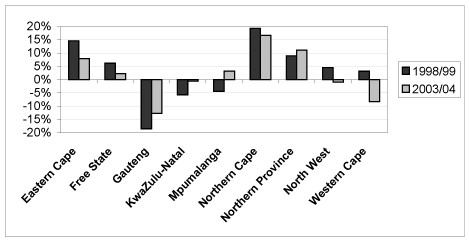
Deviations above or below the national average in per capita allocations of the equitable shares are illustrated in figure 5.1 for both 1998/99 and the target year 2003/04.
Figure 5.1: Deviation of equitable share per capita from national average
Conditional grants
Principal grant programmes
The 1998 Budget included several conditional grants for provinces and local government. Preliminary allocations for 1999/00-2001/02 of the conditional grants assigned to provincial revenue are set out in table 5.5. These exclude various agency payments and certain other transfers from national departments to provinces that remain unallocated at this stage.
Table 5.5: Conditional grants to provinces
| R million | 1999/00 |
2000/01 |
2001/02 |
| Health | |||
| Central hospitals | 3 075 |
3 112 |
3 221 |
| Training and research | 1 118 |
1 174 |
1 215 |
|
Redistribution of specialised services Durban Academic Hospital Umtata Regional Hospital |
112 |
176 |
182 |
| Primary school nutrition programme | 555 |
582 |
603 |
| Finance supplementary allocations | 2 500 |
2 212 |
2 000 |
| Total | 7 671 |
7 529 |
7 324 |
Other programmes on national votes that involve conditional transfers or agency payments to provinces include:
The amounts and allocation of these conditional grants and agency payments are determined along with other budget decisions relating to national departments, in consultation with the provincial authorities.
Local government share
Transfers to local Government
Total intergovernmental transfers to local governments in 1997/98 exceeded R5,9 billion. During 1998/99, based on recommendations of the Financial and Fiscal Commission, a new local government funding system was introduced.
A formula-based equitable allocation of operating grants to local government was set out in the 1997 framework document ‘An Equitable Share of Nationally Collected Revenue for Local Government’. Capital transfers to local government, such as the consolidated municipal infrastructure programme and the rural water supply and sanitation programme, will continue to be financed from the national share.
Equitable share
During 1999/00, R1 366 million will be allocated to local governments via the new equitable share formula (R342 million more than the 1998/99 year). The horizontal division of the equitable share between local governments using the formula system is managed by the Department of Constitutional Development. The local government equitable share is projected to grow to R2 580 million in 2001/02.
Transitional measures
Six provincial governments continue to provide personnel and services in R293 towns of the former homelands. In 1998/99 provincial governments received a conditional grant of R951 million to provide both personnel and services in R293 towns. In 1998, Parliament passed the Transfer of Municipal Staff Act to allow provincial governments to transfer staff who perform municipal functions to municipalities. This process is at this stage incomplete. In 1999/00, therefore, provinces will continue to receive a conditional grant to cover the R293 staff currently employed. For the next three years, grants for R293 non-personnel service functions will be allocated directly to the appropriate municipalities. Once this transition is complete, all allocations will be made through the equitable share formula.
Table 5.6: Allocations to local government
| R million | 1999/00 |
2000/01 |
2001/02 |
| Equitable share (excluding R293 transfers) | 1 366 |
1 889 |
1 989 |
| R293 towns staff | 359 |
0 |
0 |
| R293 towns functions | 591 |
591 |
591 |
| Total | 2 316 |
2 480 |
2 580 |
| Other grants | |||
| Municipal infrastructure programme | 701 |
793 |
780 |
| Other grants | 626 |
542 |
544 |
Capital transfers
The main capital transfer to local governments is the consolidated municipal infrastructure programme. In 1999/00, the allocation to the programme is expected to be R701 million (R117 million more than in 1998/99). Other implicit capital transfers include allocations for community water services made by the Department of Water Affairs and Forestry.
Other allocations
In addition to their equitable share allocation, R293 transfers and the municipal infrastructure programme, local governments will receive other allocations amounting to a projected R626 million in 1999/00. These include special Presidential projects and operating subsidies for water services. Local governments also receive allocations for commuter bus subsidies. Operating subsidies for local government services managed by the Departments of Water Affairs and Forestry and Land Affairs will be incorporated into the local government equitable share over an agreed four-year phasing-in period.
Growth limits
For macroeconomic and fiscal reasons, local governments must ensure that their budgets fall within the limits set by the Minister of Finance. For the 1998/99 fiscal year, a growth rate of 6 per cent was determined for both the operating and capital expenditure. The Department projects that the growth rate for both these components for the 1999/00 fiscal year will be 5 per cent. Capital expenditure funded by grants and subsidies from the municipal infrastructure programme and other national government programmes are excluded from this limit.
Uniform standards
The Department of Finance has initiated a project to develop uniform standards, formats and classifications for local government budgets. Uniform budgeting will bring local governments in line with international reporting standards and will facilitate easier comparison of data across different-sized local governments, and with provincial and national governments. Multi-year budgeting for local governments will also be introduced.
Municipal borrowing
The Department of Finance commissioned an investigation into the borrowing powers of local governments and their relationship with creditors. The draft policy framework will be completed in 1998, and legislation relating to this will be tabled during 1999.
Further consultation
Details of the horizontal division of the local government equitable share between municipalities are currently being finalised by the Department of Constitutional Development in consultation with the Department of Finance, using the latest census results. The horizontal division will be made public early in 1999.
| Contents | Next |