RECONSTRUCTION, DEVELOPMENT AND THE BUDGET
Reconstruction and development priorities
Shared commitments
Reconstruction and development are aimed at a better life for all South Africans. This is the foundation of the partnership between government and the people that underpins our medium term policies and priorities. The Foreword to the 1997 Medium Term Budget Policy Statement summarised our shared commitments as:
Social and development policies budget
This chapter reviews key social and developmental policies reflected and the in South Africa’s medium term budget trends. It reflects the contribution of the fiscus to Government’s reconstruction and development initiatives, and highlights the impact of new policies and programmes on the structure and distribution of government spending.
Since 1994, the policies and programmes of Government have been subject to extensive consultation, publication of discussion documents, White Papers and wide-ranging legislative or regulatory reforms. The medium term expenditure framework reflects the spending implications of these transformation initiatives, within a sustainable overall budget framework.
MTEF reviews
Focused reviews of six spending functions – education, health, welfare and social security, infrastructure investment, the integrated justice sector and personnel spending – were conducted as part of this year’s budget programme. The discussion below summarises many of the findings and recommendations of these reviews.
Demographic trends
1996 census results
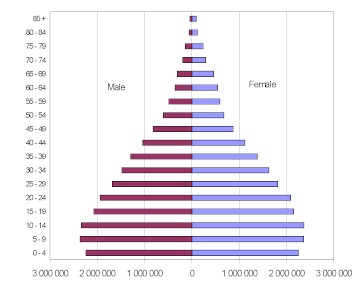
The final results of the 1996 census have now been published. The estimated age distribution reflected in the 1996 census is illustrated below and the population distribution by province is set out in table 4.1.
Although the revised estimates reflect a larger total population than the preliminary census results published last year, they confirm that fertility rates have declined over the past two decades and migration from rural to urban areas is proceeding steadily.
Figure 4.1: Age distribution of the 1996 population
Population growth trends
Population trends with implications for longer term budgetary planning include the following:
Table 4.1: Population by province – 1996 census estimates
Male |
Female |
Urban |
Rural |
Provincial population |
||
Percentage of provincial population |
% of total |
|||||
| Eastern Cape | 46,1% |
53,9% |
36,6% |
63,4% |
6 303 000 |
15,5% |
| Free State | 49,3% |
50,7% |
68,6% |
31,4% |
2 634 000 |
6,5% |
| Gauteng | 51,0% |
49,0% |
97,0% |
3,0% |
7 348 000 |
18,1% |
| KwaZulu-Natal | 46,9% |
53,1% |
43,1% |
56,9% |
8 417 000 |
20,7% |
| Mpumalanga | 48,6% |
51,4% |
39,1% |
60,9% |
2 801 000 |
6,9% |
| Northern Cape | 49,1% |
50,9% |
70,1% |
29,9% |
840 000 |
2,1% |
| Northern Province | 45,7% |
54,3% |
11,0% |
89,0% |
4 929 000 |
12,1% |
| North West | 49,2% |
50,8% |
34,9% |
65,1% |
3 355 000 |
8,3% |
| Western Cape | 48,9% |
51,1% |
88,9% |
11,1% |
3 957 000 |
9,7% |
| Total (’000s) | 19 521 |
21 063 |
21 782 |
18 802 |
40 584 000 |
100,0% |
| Percentage | 48,1% |
51,9% |
53,7% |
46,3% |
100,0% |
|
Employment and unemployment
The census results indicate that total employment in the economy is 9 114 000, of which about 1 800 000 are informal job opportunities. About 22 per cent of the economically active population is unemployed, numbering some 2 000 000 work seekers. A further 2 200 000 people would like to work but no longer actively seek employment.
Growing youth unemployment remains a major challenge, impacting on crime trends and threatening the integrity of family and community structures. The census confirms that the unemployment burden falls disproportionately on black men and women under the age of 35, and is particularly severe in rural areas.
The employment challenge has been the focus of concerted deliberations of government, business, labour and community representatives over the past months. Key elements of Government’s contribution to meeting this challenge are summarised below.
Creating jobs
A joint, broad-based approach
Government and the constituencies of civil society represented in NEDLAC have agreed to act in concert to create jobs and stable employment, as part of our broader strategy for providing a better life, with improvement over time, for all our people.
The understanding reached between participants in the Presidential Jobs Summit held on 30 October 1998 recognises that we will have to combine our efforts, in new and innovative ways, to increase the number of jobs created in the South African economy. The Jobs Summit process has focused on a broad range of policy commitments:
Special employment programmes
The national budget includes about R5 billion allocated to special employment projects and labour-intensive infrastructure programmes. These exclude ongoing capital and maintenance expenditure by government and public corporations on roads, telecommunications, regional water networks and electrification, several of which are expanding and have significant employment impacts.
Employment-intensive programmes include:
Focus on women and children
Several of these programmes focus on infrastructural services that strongly benefit women and children – rural water supplies and social development projects targeted at unemployed women with dependent children, for example. Rural projects provide jobs for women without other sources of income.
Cost per job opportunity
Special employment programmes create a "person-year" of work at a cost of about R15 000. These initiatives currently account for about 300 000 jobs, and will add another 100 000 jobs over the next three years.
Government recognises that public spending channelled to employment-intensive activities can contribute to job creation, although this cannot address the entire shortfall in the labour market. Policies aimed at strengthening job creation in the private sector take time to bear fruit, but market-related employment has the advantage of being self-sustaining.
Employment and development
Government has adopted a mix of special employment initiatives that are integrally bound up with key development initiatives. These may involve temporary or short-term projects, but they are elements of a broad-based sustainable reconstruction of the South African economy. Further programmes under consideration include targeted investment in tourism-related infrastructure and a "clean cities" campaign. It is recognised that more work is required to ensure that job creation and training opportunities are maximised in these programmes and progress in this regard will be closely monitored.
Government’s employment creation projects have explicit training components, are aimed at strengthening small businesses and community organisations and will make lasting contributions to local infrastructure. This is a strategy for employment linked to local economic development.
Infrastructure investment
Benefits of infrastructure
Government recognises the importance of strengthening infrastructure investment over the medium term. Energy, transport, communications and social infrastructure bring significant benefits to poor people, and underpin an improved performance of the economy.
Expansion of public sector investment spending
Electrification, investment in airports, construction of toll roads and more recently the investment of Telkom in expanding telecommunication infrastructure have contributed to the recovery of public sector investment spending in recent years. The tariff policies set out in the National Water Policy will over time strengthen the financing of water resource maintenance and construction. The Development Bank of Southern Africa is playing an expanding role in financing infrastructure.
The 1999 Budget and medium term spending projections will give added impetus to Government’s contribution to infrastructure investment. Planned capital spending includes:
MTEF infrastructure investment review
The 1998 MTEF review of infrastructure investment draws two main conclusions:
Maintenance and rehabilitation backlogs
Economic infrastructure spending is about 20 per cent of gross domestic fixed investment (GDFI) and has increased since 1994, mainly because of the electrification programme. The infrastructure report notes the projected strengthening of telecommunications spending in coming years, which will have wide-ranging benefits for the operational efficiency of the economy. South Africa has about 9 telephone lines per 100 people, compared with 30 for East Asian middle-income economies. The report notes the growing maintenance and rehabilitation backlog of the roads system and railways rolling stock. Inadequate maintenance of infrastructure is currently depleting the nation’s national water supply capacity.
Low social infrastructure spending
Social infrastructure spending is now little more than 2 per cent of GDFI. Although audits of backlogs in the hospital and college sectors have been undertaken, rehabilitation programmes are not yet in progress.
Housing delivery has gathered considerable momentum. It is recognised that infrastructure spending has to maintain an appropriate balance between the housing strategy and municipal infrastructure provision, water services, schools and other facilities.
Key policy issues
The report identifies several key policy issues:
Integrated justice sector
Increased spending on the justice sector
Justice, Police and Correctional Services have increased their share of the national budget from 7 per cent in 1986/87 to nearly 10 per cent today. Nonetheless, the three departments have frequently exceeded their budgeted allocations. Personnel spending has grown particularly rapidly.
Adjusted allocations to these budget votes in recent years now put the integrated justice sector on a sound footing. Projects are underway to update the information technology in use in the justice system and to enhance the efficiency of the courts. High risk prisoners are being held in more secure facilities and substantial improvements have been effected in 18 prisons. Modernisation and streamlining of the SA Police Service has been identified as a critical priority.
Performance of the justice system
The 1998 MTEF review team on the integrated justice sector devoted considerable effort to analysing relevant indicators of performance in control of crime and prosecution of justice. In recent years the proportion of cases successfully completed by the police and in turn taken through the justice system has declined. One outcome is that the prisons now house 43 103 awaiting trial prisoners, up from 24 265 in 1995. More effective and more streamlined administration of justice needs to be sought.
Cost pressures in the justice system
The MTEF review notes that average real remuneration has increased sharply in the justice sector since 1994, taking up the available increases in resources. Other sources of increased spending include the provision for legal aid, commissions and other rights-related agencies on the Justice budget and the phasing in of higher standards of accommodation and rehabilitation in prisons.
Government recognises that to improve performance in controlling crime, several key choices have to be made:
Education
Focus on enhancing quality
Following last year's emphasis on improved financial management and quality enhancement, the 1998 education review team focused on a range of possible solutions geared towards improving quality in the classroom.
This year’s national Education budget includes R200 million set aside for supporting provincial education. The greater part of the funds are assigned to strengthening district management of the school system and teacher development programmes. This will continue to be a priority allocation in the national budget.
Reforming provincial education spending
Against the background of significant budget over-runs in provincial education departments, the 1998 MTEF review explored several options for reforming provincial education spending. With overall spending already some R40 billion a year, this is a function in which improved and extended services have largely to be achieved within the present real resource limits. To achieve the desired redistribution and quality enhancement in schooling, the review proposes that Government:
The Minister of Education has recently published policy to regulate admissions and repetition in public schools.
Skills development and further education
Legislation giving effect to Government’s skills development strategy was introduced to Parliament in 1998. The strategy envisages the introduction of a wide range of "learnerships" within the context of the South African Qualifications Framework, providing a bridge between formal education and the workplace, strengthening industrial training and creating learning opportunities for the unemployed. Consistent with the broadening of the overall tax base, the skills development strategy will be financed by levies on payroll at a rate of 1 per cent.
A White Paper and Bill on further education have been introduced this year. In line with the new policies the 1998 MTEF education report proposes a "fast-track" approach to introducing innovative vocationally oriented projects in colleges or senior secondary schools, in association with industry training bodies, employers and employees. In the longer term, a new funding framework is needed for further education and training institutions, comprising formula funding of programmes, earmarked funding for specified priorities and capacity building, student financial aid and greater recovery of income from students and employers.
Higher education
Government funding of higher education has increased strongly in recent years, accommodating both rising student numbers and a new student financial assistance programme. Work is in progress on a new approach to subsidising universities and technikons. A key step in the new approach was taken this year as all higher education institutions have been required to submit three-year plans to the national Department.
Health services
MTEF review of health
This year's review of health expenditure included an evaluation of provincial health spending trends, a discussion of revenue retention, cross boundary billing and hospital rehabilitation, an assessment of the health conditional grants and a review of personnel issues.
Hospital construction and maintenance
The construction of a new academic hospital at Cato Manor to relieve pressure on existing Durban hospitals is progressing well. Following the nationwide health facilities audit, funds have been set aside in the national Health vote for a nationwide hospital rehabilitation programme. This will gather momentum over the next three years. Government recognises the importance of strengthening hospital administration along with improved maintenance of facilities.
Hospital revenue
The 1998 review included an examination of options for improving revenue collection by public hospitals and updating tariff levels. The report includes several specific recommendations on cross-border billing where patients are officially referred for services other than central hospital services, and where provincial health departments provide services on behalf of other departments.
Health conditional grants
It was agreed that the conditional grants for health services should be retained for the 1999/00 to 2001/02 years, and that an expert group should be formed to explore further refinement of the grants.
Consideration should also be given to integrating the primary school nutrition grant into a broader nutrition programme in future.
Welfare and social security
Broad range of support for the poor
South Africa provides social grants to over 3 million beneficiaries, representing income support to a large proportion of poor households. Welfare services comprise a wide range of developmental and community-based functions, including support for the non-governmental welfare sector.
The key challenge for the welfare sector is to manage growth of expenditure on social security entitlement programmes while strengthening the funding of discretionary and developmental welfare services. The aim is to increase the share of spending allocated to developmental welfare services, currently less than 10 per cent of welfare and social security expenditure. A critical focus is ensuring an efficient management and delivery of social assistance grants, thereby contributing savings within the welfare budget.
Refocusing of programmes
Refocusing of financial and programme resources is in progress, including support for developmental income-generating programmes, re-prioritising towards more effective programmes, an emphasis on early intervention and prevention rather than residential care and promotion of family-centred and community-based programmes for children, youth and people with disabilities.
Further savings in welfare will result from integrating targeted welfare services with aspects of social security.
Improved financial management
This year's budget includes R100 million to improve financial management. There have already been significant gains from improved data management and other measures aimed at countering fraud and abuse of the social security system.
MTEF review of welfare
The 1998 MTEF review of welfare recommended that the Department of Welfare should investigate a more integrated and comprehensive social security policy, in collaboration with other role-players. The report recommends that provinces should have separate health and welfare departments.
It is noted that Welfare departments support several other departments’ activities. This needs to be examined further with a view to possible budgeting reforms, focusing on developmental needs and integrated service delivery.
Personnel spending
Personnel expenditure trends
Personnel spending fell as a share of the budget in 1995/96, and has increased in subsequent years. A marked increase in average remuneration levels in 1996 has contributed to spending over-runs and pressure on budgets, particularly in provinces.
It appears that budgets for personnel expenditure frequently do not adequately take into account:
Personnel budgeting
The 1998 personnel spending review drew attention to the importance of budgeting procedures in the more decentralised personnel management system that is evolving. The Department of Public Service and Administration is responsible for taking the lead in developing a new remuneration policy, including:
Personnel policy will also need to create the flexibility needed to enable departments to introduce new policies without incurring undue personnel costs. This will require fair and affordable redundancy and redeployment instruments and less reliance on traditional approaches such as freezes on recruitment or cuts in funded vacancies.
The budget process will need to adapt to the new policy framework, including greater transparency and clearer reporting of personnel spending and appropriate controls over pay progression.
Redundancy management
The report makes several proposals relating to redundancy management, aimed at assisting the downsizing of some government activities while minimising the negative impact on employees affected. It is noted that medium term planning and budgeting can assist in managing staffing levels without undue disruption and that more effective redeployment procedures need to be developed.
Financing development
Public-private partnerships
The Government aims to extend the range of infrastructure projects and services that make use of private sector participation. Programmes such as electrification and telecommunications are self-financing, recovering costs from users and able to draw on capital market finance. Private finance and management have been brought into airports and roads. A unit has been established to support the development of business partnerships between municipalities and private service providers. Pilot projects include water, sanitation, refuse collection and transport initiatives.
Innovative projects bringing private support to local police services have recently been developed. Hospital construction and management, further education and welfare services are other areas in which productive opportunities for cooperation between government and the private sector exist.
Umsobomvu Trust
The Umsobomvu Trust will shortly come into being, as announced in the March 1998 budget speech. This fund will receive the proceeds of a charge levied on the demutualisation of Sanlam this year and Old Mutual in early 1999. A Board of Trustees will be established with responsibility for the fund’s management and the disbursement of project funding to support the stimulation of employment creation and skills upgrading amongst young people.
National Development Agency
Following extensive consultation and the passage of enabling legislation, the National Development Agency will be established shortly to support developmental civil society organisations, building on the work of the Transitional National Development Trust.
The Agency will channel government funds to organisations for programmes aimed at meeting the development needs of the poor and to strengthen their institutional capacity. It will also serve to facilitate the flow of donor funding set aside for development agencies. This initiative represents an important bridge between Government and civil society partners in meeting our shared reconstruction and development challenges.
| Contents | Next |