GREEN PAPER ON NATIONAL YOUTH SERVICE |
Chapter Three
PROGRAMMES AND INCENTIVES
This chapter examines the programmes that would broadly fall within the National Youth Service. It distinguishes between programmes that will be accredited by the National Youth Service and those which are not likely to be accredited, and proposes a number of criteria that could inform this prioritisation. The chapter goes on to outline what form the accredited programmes may take for each target group and explores incentives for participants in terms of the possible benefits which would accrue from national youth service programmes. The chapter concludes by outlining a process by means of which the discussion about youth service programmes could be taken forward.
1 Conceptualising programmes that form part of the National Youth Service
Different target groupings have varied needs and abilities. The needs and context of each
target group will thus impact on the type of service that is possible, as well as the
nature of the programme - for example whether there is an emphasis on the education and
training components, what type of incentives will be provided, and what type of life
skills will be required. Within each target group there will also be differences among
different categories - for example, within the unemployed group there will be unemployed
graduate and unemployed out-of-school youth.
However, within these differences it is crucial to define what makes a programme part
of the National Youth Service. A key objective of the National Youth Service is to create,
and to encourage a culture of service amongst young people in South Africa and to develop
in them a spirit of patriotism and nation building. A further objective is to change the
perceptions that many people have about young people. For this reason it is critical that
the National Youth Service support all initiatives that involve young people in providing
a >needed= service to the community. The implication of this is that the National Youth
Service could draw together a broad range of programmes that involve young people in
providing a service to the community. Examples of the diversity of programmes include the
following:
There is thus a very wide range of service programmes in which young people could be involved that would fall within the bounds of a national youth service. The key characteristic that brings these programmes together is the concept of service, as discussed in Chapter Two. All of these service initiatives are important and worthy activities, and as such would need to be encouraged and supported by the National Youth Service.
1.1 Accreditation of particular programmes under the National Youth Service
Because the National Youth Service is likely to have limited resources available to it, a
mechanism must be established whereby particular youth service programmes are prioritised
and given additional support. The process of identifying and prioritising the programmes
should be called accreditation. Used in this way, the term refers to recognising
certain types of service programmes which then become eligible for support from the
National Youth Service, and authorising them to conduct their activities according to
certain benchmarks.
The programmes would have to be accredited against clear criteria. Accredited programmes would be eligible for specific types of support from the National Youth Service or from government departments working in partnership with the National Youth Service. They may also be able to receive certain other benefits or incentives, once defined.
2 Criteria for programme accreditation
In line with the definitions of youth service cited in Chapter Two, it is recommended that
all national youth service programmes ensure that youth are involved in providing a needed
service to the community which is in line with national development objectives.
All programmes will be evaluated for accreditation against three sets of criteria:
2.1 Criteria for programme components
Programmes accredited by the National Youth Service should incorporate the following
components:
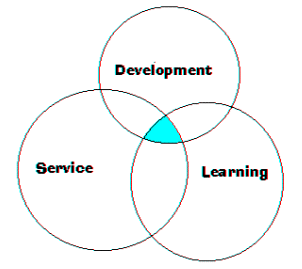
These elements are inter-related, and while they will differ in terms of the extent that they are developed within programmes for different target groups, they will need to be built into all programmes. Thus the shaded area represents programmes that will be accredited by the National Youth Service.
Emphasis will be reflected in the weighting given to each of the programme components. While the detail of this still needs to be developed, the principles that will guide such weighting are listed below. The implications for programme design are further explored below, as are some of the issues pertaining to each of the sectors.
2.2 Criteria regarding the nature of the service
For a service programme to be accredited by the National Youth Service, it will be
measured against two yardsticks:
This approach avoids the accreditation of programmes that are selected because they are easy for the youth to achieve, yet do not improve people=s lives in any real way. However, this aspect will need to be explored further since measuring the specific contribution of service to development will depend on the type of service rendered - for example, the provision of infrastructure such as building a community centre versus tutoring disadvantaged learners in school.
2.3 Criteria regarding duration of service
A minimum number of hours of service will have to be stipulated in each programme. This
remains an issue that will require further development. However, at this stage, it is
recommended that:
2.4 The development and application of the criteria as applied to each of the target groups
2.4.1 Young people in higher education
The Joint Education Trust study states that:
The threefold mission of higher education teaching, research and service B has
traditionally been understood as charging institutions with the responsibility for
developing public citizens as well as individuals with the appropriate professional skills
required by a changing economy. In much of the literature this role is defined as one
which strengthens moral and civic values, and which prepares individuals to take an active
part in a democratic society.
This understanding represents the cornerstone of the argument as to why it is important
to involve students in higher education in service activities and is supported by this
Green Paper. Through their involvement in service to the community, higher education
students will be able to develop a sense of democratic citizenship in a range of ways:
Another aspect to this argument is the acknowledgement that government, and therefore the community, have made a large contribution (in part through the university subsidy) to ensure that students have access to higher education. The service component provides opportunities for youth to respond to this by making a meaningful contribution to community development.
The implication is that in the case of higher education students, the emphasis will primarily be on ensuring that young people provide the community with service by drawing on their experience, knowledge and skills gained through higher education.
While the focus of the programmes will primarily be on service and experiential learning, these programmes should also ensure that they provide opportunities for learning, and for students to be sensitised to the needs of those communities that have been disadvantaged in the past. This could be achieved through the incorporation of a reflective component into the programme where students can critically analyse what they have learned through the process.
Educational institutions should take responsibility for assisting students to make the linkages between the formal curricula and their experiences in the community. As the Joint Education Trust study notes, benefits to students and institutions depend on the Anature of the programme, programme structure and supervision@.
2.3.2 Young people in further education and training
Students in further education and training institutions are similar to those in higher
education in that they are also involved in a structured and accredited learning process.
In further education and training there is a need to develop both a breadth and depth of
knowledge and skills. The requirements of the further education and training
qualifications demand that fundamental and core skills as well as the more
specialised electives should underpin all FET programmes.
The White Paper on Further Education and Training states that:
A successful further education and training system will provide diversified programmes offering knowledge, skills, attitudes and values South African require as individuals and citizens, as lifelong learners, and as economically productive members of society. It will provide the vital intermediate to higher level skills and competencies the country needs, to chart its own course in the global competitive world of the 21st century.
It acknowledges that while many students who exit from the further education and training band will still wish to access further or higher education institutions, others will want to enter the world of work. However, across these differences is the recognition that there is a need to ensure that young people leaving further education and training have a wide range of options open to them.
The introduction of an emphasis on service into further education and training provides
an opportunity to develop the civic values and attitudes required by individuals for
active participation in a democracy, including a greater appreciation for a culture of
service (voluntarism), community development, and inter-generational understanding. This
latter point refers to the need to develop better communication patterns and relations
between young people in the community with their parents and grandparents - that is, the
elder generation. The programme for the further education and training target group will
be designed with the following emphasis:
To illustrate this, students could be required to perform 75 hours of community service and to write a report on what they have learned from the experience. Students could also be assigned to apply classroom knowledge to particular service projects. As examples, chemistry students regularly check air and water pollution levels and publicise the results; or history students visit elderly residents of nursing homes and record their impressions of wars and depressions and other events of half a century ago. The White Paper on FET recognises inherent implications for curriculum changes and the role of educators.
2.3.3 Unemployed youth
The A Growing Up Tough@ baseline youth survey by JEP/CASE (1992) identified unemployment
as a critical indicator in establishing whether a young person is engaging in society. The
CASE/National Youth Commission status report on youth in 1996 estimates that 43% of young
people in South Africa were unemployed. Unemployment makes young people particularly
vulnerable to a range of anti-social behaviour as they struggle to generate income, and
many young people experience significant levels of anger and depression.
In the category of unemployed young people, two broad sectors are defined. The first sector includes those youth that have not completed their education to the level initially planned. The second sector includes those young people who have acquired a specialised skill but are unable to access employment. This particularly refers to graduates of higher education, but could also include some young people that have attained a more occupationally related further education and training certificate.
The emphasis of service programmes for unemployed youth needs to provide a
comprehensive way of engaging unemployed young people in a programme, which gives them a
way of achieving dignity within their families and communities, as well as providing these
young people with access to education and training or practical experience. This should
enable these young people to develop skills to withstand an increasingly fatalistic youth
culture and gives them tangible means of generating an income which will allow them to
become economically independent. Programmes for the unemployed target groups will be
designed with the following emphasis:
The programme for unemployed youth will need to both provide a service to the community, as well as ensure that participants develop knowledge and skills that will assist them to be employable. Given this, it is critical that programmes will ensure that youth are equipped to provide the service, that a life skills component is included. Career counselling is also central to the success of the programme and should be offered to young people prior to their participation on the programme, as well as before they complete the programme.
For those young people that already have specialised skills, emphasis will be on practical skills for gaining work experience.
2.3.4 Youth in conflict with the law
The framework for this category can be derived from the approach adopted by the Department
of Justice, as well as the South African Law Commission. The Law Commission states that:
Restorative justice relies on reconciliation rather than punishment, on offenders accepting responsibility for their behaviour@, ... and the need to introduce these principles and practices to Afacilitate the reintegration of the offender back into society, drawing on community-based and indigenous models of dispute resolution@ (South African Law Commission, Issue Paper 9).
This category includes those young people that have committed an offence and are required to undertake community service as an alternative to entering the criminal justice system. Rather than go to court and enter the criminal justice system, they instead agree to officers of the court to undertake community service. This category also includes those young people that are sentenced to undertake community service as a condition of suspension or postponement of sentence. Also, those who have completed their sentences and then select to undertake community service as a means of reintegrating into the community could be given an opportunity through such a programme.
The approach Afocuses on repairing harm done to the victim or to society, rather than on retribution by the state@, and on ensuring that the perpetrator takes responsibility for his/her actions and pays back his/her debt to society and the victim. Some of the options available to the court (in terms of section 297), and which are relevant to a national youth service, include the possibility of:
Rendering to the person aggrieved of some specific benefit or service in lieu of compensation for damage or pecuniary loss;
Performance without remuneration and outside the prison of some service for the benefit of the community under the supervision or control of an organisation or institution (ie community service).
Complications include differences within age cohorts. For the purposes of the National Youth Service young people that fall between the ages of 15 and 35 are included. However, the law defines a child as up to and including 17 years of age. This category is part of the juvenile justice system, and there is a strong move to ensure that they do not form part of the main criminal justice system. In the case of this category, it may be possible to develop guidelines which can be utilised in the family and children=s courts. The usage of these guidelines could be assisted by the proposal to train personnel in matters pertaining to juvenile justice. This includes the need for an appropriately trained special public defender.
However, youth that are older than 17 years of age will form part of the main criminal
justice system and for these youth the possibility of corrective supervision exists. The
concept of correctional supervision refers to a wide range of measures, which have in
common that they are all applied outside of prison. While the law, as illustrated above,
allows for corrective supervision, there is currently no policy in place to guide this
process and it is at the discretion of the courts to decide in which cases corrective
supervision will be used as an alternative to sentencing. Programmes for youth in conflict
with the law will be designed with the following emphasis:
Programmes that are to be accredited by the National Youth Service will be guided by the criteria discussed above. The emphasis of individual programmes will thus differ, depending on the nature of the programmes and the needs of the target groups. Each target group will require distinct programmes.
3 Programme principles and guidelines
While criteria will be used to determine which programmes can be accredited by the
National Youth Service, it is important to develop also a broad set of principles or
guidelines that can assist service programmes. These potentially apply to all service
programmes. However, in the case of accredited programmes, it may be necessary for the
National Youth Service to evaluate whether the programmes require additional capacity and
support in order to realise key aspects of what could be considered "best
practice". In some cases, the guidelines overlap with the criteria in that they both
constitute "best practice" models as well as defining criteria.
These guidelines include the following:
3.1 Strong organisation
3.2 Excellent national service projects
3.3 Quality of experience for participants
The programme must provide a high quality experience for participants. This includes a
clear structure in which to work, sufficient training and learning, and good support.
Participants are able to express their expectations clearly, prior to the commencement of
the project. Likewise, the programme clearly articulates the expectations it has of the
participants. This could take the form of written contracts. A spirit of commitment is
developed among the participants B to national service, the community and to each other.
This will develop participants sense of themselves as actors with an ability to assist the
community. Respect for diversity and cooperation is developed amongst the project
participants. Learning is built into all programmes. The programme helps each participant
to prepare for and make the transition to his or her next endeavour, whether education or
work. Effective preparation for participants includes teaching project-related skills and
leadership, and enables participants to understand the value of service, the nature of
citizenship, and the national needs which their service will address. Effective training
balances the complementary goals of project skills development and personal development,
enabling both to happen. Training is an on-going activity; it does not end with
orientation. Participants, where required, are linked to essential support services. This
implies that the programme has a strong referral network. The programme develops personal
and social skills, including self-discipline, independence and competence. Staff should
preferably have competence in basic counselling, crisis intervention and referral to
services.
3.4 Partnerships
The basis for the partnership is that national service can meet critical community needs
to the mutual benefit of participants and communities. All partners make a strong
commitment to support the success of the programme. Effective channels exist to foster
communication between the partners.
3.5 Evaluation
4 Incentives
The provision of incentives or benefits to participants in national youth service
programmes need to be balanced with the overall objectives of the National Youth Service.
There is a recognition of the need for the service to inculcate a spirit of service and
commitment to the development of South Africa. Further, the service needs to ensure that
communities remain key beneficiaries of the service. However, particularly with certain
target groups, such as the unemployed and those young people in conflict with the law, it
is also important to ensure that national youth service programmes enable participants to
access opportunities once the service has been completed. This is central to the
longer-term success of these programmes.
In order to promote such a concept, it is important to outline what benefits the National Youth Service may hold for various stakeholders by balancing the importance of developing the values of service and nation-building with the need to ensure that it is possible for young people to participate in these programmes, and that the programmes open up opportunities for them.
4.1 Participant benefits during an accredited service programme
Depending on the target group and the nature of the programme there may be a range of
incentives and benefits during a national youth service programme. These will vary greatly
depending on the nature of the target group. For example, they could include a stipend,
travel allowance, and/or lunch. Youth may also receive access to accredited quality
education and training which could provide an incentive for those who are unemployed and
those young people in conflict with the law. This factor is influenced by developments
within the National Qualifications Framework, as discussed earlier. In the interim,
however, it is proposed that education and training programmes should be accredited either
by an Industry Training Board or a recognised educational institution. Other benefits may
derive from the experience that young people gain through their participation in the
service, access to learning processes, as well as their increased ability to access a
range of services, such as counselling.
Young people are likely to benefit from their participation if they can gain knowledge and skills which include practical experience. Their participation in the programme can also lead to the enhancement of learning, to the development of analytical skills and, as documented in the Joint Education Trust study, to the development of new values and attitudes towards different groupings in society through their exposure to community needs and problems.
4.2 Participant benefits upon completion of an accredited service programme
On condition that participants complete a programme they may receive additional benefits,
these differ across target groups, and may include:
4.3 Criteria for participants to enable them to access these benefits
Young people must have completed all the hours of service or will require permission if
they miss any aspect of the programme. This will be based on a set minimum number of hours
that young people have to complete in order to qualify for certain opportunities.
4.4 Benefits that youth in non-accredited service programmes will receive
This area needs to be explored, as it is important to encourage young people to
participate in these programmes as well as in accredited programmes. A possible benefit
could include preferential access to accredited national youth service programmes, as
there are likely to be more applicants than opportunities. These young people will also
benefit from the practical experience that they gain through their participation in these
programmes.
4.5 Benefits for institutions of learning
An issue that requires some discussion is the benefit that accrues to the learning
institutions through their participation in the National Youth Service. The Joint
Education Trust study cites a number of benefits to higher education gained though their
participation in service activities. They include:
In addition and complementary to the above, these programmes can benefit the education and training institution for a number of reasons. Firstly, the National Qualifications Framework and the requirement that unit standards include both knowledge and skills, require that institutions provide their learners with opportunities for practical application. These programmes provide one mechanism for learners to attain both knowledge and the applied skills. Secondly, funding that supports these programmes can assist institutions to develop their capacity to provide innovative programmes, including the possibility of more open learning, as required by the Further Education and Training Bill.
4.6 Benefits to the community
This section will not go into this issue in any depth as it has been covered in Chapter
Two as well as in the criteria relating to service. However it would be incomplete to
consider the benefits of the programme and not to include a mention of the community at
this point. It is clear that if these programmes are to achieve their objectives, the
service must address real needs and create direct and demonstrable results. The results
should be identifiable by members of the community, and members of the community should
feel that they have benefited through the programme.
4.7 Benefits to staff at institutions
Considerable investments would need to be made in building the capacity of staff if they
are to acquire the skills required to make youth service programmes a success.
Furthermore, while institutions may benefit from these programmes, a key aspect that needs
to be considered is the manner in which staff will benefit through their participation in
these programmes. Neither further education and training nor higher education institutions
currently recognise these type of activities when considering promotion or remuneration
for staff. If staff are to participate actively in these programmes, this issue will need
to explored in greater detail. This aspect will need careful consideration and will have
to be negotiated with staff so they willing participants in these programmes.
5 National youth service support to all programmes
All programmes that involve young people in service will qualify for broad support from
the National Youth Service. The National Youth Service will support these programmes by
creating an enabling environment for youth service programmes. A media strategy on the
contributions made by youth service will be undertaken. Awards will be given to youth in
the different categories as a method of popularising the work that is done as well as
providing recognition for the youth.
The above is particularly important in ensuring that all role players in society
understand the goals of youth service, and are committed to these goals. This has a number
of important benefits, which include:
5.1 Support for programmes that are accredited by the National Youth Service
Programmes that are accredited by the National Youth Service will qualify for financial
support. Once guidelines have been adopted by government possible support funding
mechanisms will be designed. For example, as discussed earlier, where the programmes in
further education and training and higher education relate to the curricula it may be
possible to change (in the case of higher education) or develop (in the case of further
education and training) the funding formulae to assist institutions to support these
programmes. Another example is an immunisation programme supported by the Department of
Health. Grant will differ depending on the target group and the nature of the programme.
6 Illustrative programmes
The final section of this chapter provides illustrative programmes that relate to the four
target groups. The programme elements described are not intended to be prescriptive, but
illustrate how programmes can be designed for the different target groups and how they
meet the criteria in each case. This analysis assumes that, besides the accredited
programmes, there are likely to be a wide range of other youth programmes in operation
which are important in several respects, but which may not be accredited national youth
service programmes.
6.1 Higher education
This target group has been well documented in the Joint Education Trust studies which
provided different categories of programmes:
The 1998 Joint Education Trust study categorises these programmes into a continuum that moves from programmes in which students use the knowledge gained in their professional studies, to programmes which do not require specialist knowledge for participation. The study notes that the programmes differ in their duration and have a range of different objectives. They include programmes that are post-degree as well as those that take place during the degree.
6.2 Further education and training
Programmes that have been run include the following:
6.3 Programmes for unemployed youth
There are three examples of the types of programmes which might fall into this category:
6.4 Youth in conflict with the law
Current programmes being run for this target group include the following:
7 Summary of recommendations
7.1 The National Youth Service will support all initiatives that involve young people in providing a needed service to the community and which qualify in terms of the stated criteria outlined in this chapter.
7.2 Programmes will be evaluated for accreditation against three sets of criteria:
7.3 All programmes accredited by the National Youth Service should incorporate the
following components:
7.4 Programmes for the higher education target group should be designed with the
following emphasis:
7.5 Programmes for the further education and training target group should be designed
with the following emphasis:
7.6 Programmes for the unemployed target groups should be designed with the following
emphasis:
7.7 Programmes for youth in conflict with the law should be designed with the following
emphasis:
7.8 The service must meet a need which is both an expressed community need as well as being within the framework of national development objectives and the service programme must have a positive impact on the community.
7.9 A minimum number of hours of service will have to be stipulated in each programme.
This remains an issue that will require further development. However, at this stage, it is
recommended that
7.10 During an accredited service programme there should be benefits, or incentives, for young people that participate in the programmes, but these would need to be balanced within the overall objectives of a national youth service programme. Depending on the target group and the nature of the programme there may be a range of incentives and benefits.
7.11 Upon completion of an accredited service programme participants could receive reference letters, a qualification or part thereof, educational awards or loans for small businesses, or education credits.
Call for
Submissions Preamble Executive Summary Chapter 1
Chapter 2 Chapter
3
Chapter 4 Chapter 5
Chapter 6 Chapter 7
Chapter 8 Chapter
9 Appendicies