This Second Draft White Paper is presented
to the general public for discussion
Written comments can be submitted until 15 July 1997 to:
Director-General: Transport
Private Bag X193
Pretoria 0001
PREFACE
The Multilateral Motor Vehicle Accidents Fund (MMF) is the successor to the Motor Vehicle Accidents Fund and its counterparts in the erstwhile TBVC States, and came into effect on 1 May 1989 by virtue of the provisions of the Multilateral Motor Vehicle Accidents Fund Act 93 of 1989 and similar legislation in the TBVC States. The Road Accident Fund Act, 1996 recently served before Parliament and comes into operation on 1 May 1997. That Act recognises that the MMF is no longer founded on a multilateral agreement between five Member States and consequently changes the name of the MMF to the Road Accident Fund (RAF). The purpose of the RAF and its predecessors is to compensate victims of motor vehicle accidents (MVAs) on the terms and conditions as provided for in the various acts governing such compensation.
The RAF is the result of a long historical development spanning some fifty years, commencing with the introduction of compulsory MVA insurance in 1942 and culminating in the present system of victim compensation. Over the years the system of compensation of MVA victims has been subjected to numerous commissions of inquiry (an approximate average of one commission of inquiry every seven years), the latest of which was the Melamet Commission in 1992. There have been many amendments to the governing acts. Despite the implementation of the recommendations of the various commissions of inquiry and regular amendments of the governing acts, the financial condition of the system has progressively deteriorated.
This Second Draft White Paper as did the First, published in May 1996 seeks to identify and analyse the causes of such deterioration anew and to suggest effective and lasting solutions to the problems facing the compensation system, including measures to facilitate and simplify the system and to maximise the proportion of the available resources which reaches the victims by way of compensation. The First Draft was exposed extensively and elicited voluminous oral and written criticism and some counter-proposals. These have been taken into account in the drafting of this Second Draft, and the Minister of Transport will continue discussion of the revised proposals with the various interested parties.
1 OVERVIEW OF CONTENTS
1.1 By way of introduction to the subject, this Chapter gives brief legal and financial histories of motor vehicle accident (MVA) compensation.
1.2 Chapter II analyses in some detail the financial results in recent years, casting light on the causes and magnitude of many of the problems.
1.3 In Chapter III all these problems are discussed in greater detail, and solutions are advanced to make the delivery of MVA compensation more efficient, effective, and understandable for the general public, and to bring the RAF to a sound financial condition.
2 LEGAL HISTORY
2.1 The 1942 Act came into effect only in 1946 due to the Second World War. Its legal basis was the law of delict as modified in certain respects. Perhaps the most important dimension was the introduction of compulsory insurance in order to ensure that victims of MVAs would recover the damages the wrongdoers had caused them.
2.2 The most notable amendment of the 1942 Act came with the establishment in 1965 of the MVA Fund. Certain insurance companies undertaking the compulsory insurance business had insufficient income to cover claims, resulting in their liquidation; while other insurers had engaged in certain malpractices to the detriment of the public. The MVA Fund would henceforth underwrite this business by way of 100% reinsurance of a consortium of companies doing this business, i.e. the Fund was the effective risk carrier whilst the consortium played only an administrative role.
2.3 The 1972 Act essentially re-enacted the 1942 Act, with a few amendments.
2.4 The financial statements of the MVA Fund reflected operating losses of R82,6 million and R217 million for the years 1982/3 and 1983/4 respectively, and indicated that premiums would have had to be increased by 200% - 300%. This was considered politically unacceptable and Government changed the funding system from individual premiums to fuel levies collected at the point of sale. The consortium of insurance companies (agents) continued to handle the claims underwritten by the MVA Fund. This and other changes were brought about by the 1986 Act, but the legal basis of claims remained essentially unaltered.
2.5 The main purpose of the 1989 Act (and similar legislation in the then TBVC States) was to create a uniform compensation system for the entire area. In terms of an agreement the Multilateral Motor Vehicle Accidents Fund (MMF) was established, receiving fuel levies and paying claims on a standard basis throughout the jurisdiction of the five Member States.
2.6 The 1996 Act recognises the re-incorporation of the TBVC States into the RSA, and accordingly changes the name of the MMF to RAF.
3 CURRENT LEGAL FRAMEWORK
3.1 The present MVA compensation system indemnifies the driver of a motor vehicle against the liability incurred as a result of loss or damage caused to a "third party" (i.e. the victim). The common law principles of delictual liability are incorporated in the legislation, and the RAF is generally speaking liable only to the extent that such driver was negligent. Acts such as the Apportionment of Damages Act 34 of 1956, the Assessment of Damages Act 9 of 1969 and certain principles of insurance law form part of the systems legal base.
3.2 Although the provisions of the RAF Act 1996 are essentially still the same as those enacted in the 1942 Act, the legislation has been amended on some 20 occasions over this period. This has resulted in a complex framework of rules and exceptions qualified by intricate definitions and interpretations which makes the whole system extremely legalistic and quite incomprehensible to the person in the street.
3.3 With each claim the following need to be ascertained:
3.4 The burden of proof is onerous, requiring extensive documentation and investigation. This exacts a high price in terms of time, effort, and expense, and causes inconvenience and hardship in many cases.
The following are examples of the more striking effects:
3.5 The RAF Act lays down procedural requirements with which a claimant has to comply in order to lodge a valid claim. These requirements are extensive and complicated, but nevertheless necessary in the context of current legislation: they combat fraud, and contain the levels of cost, time spent, and litigation below those which would otherwise be the case.
4 FINANCIAL HISTORY
4.1 The current financial aspects of the compensation system will be discussed in greater detail in Chapter II. In this section a brief overview is given of the financial results of the system in the recent past.
4.2 No statistics regarding the financial position of the compensation system are readily available for the period 1942 to 1965, since these statistics were kept by the individual insurance companies. The following statistics for the 5 years preceding the take-over by the MMF relate to the RSA as constituted at the time, excluding the TBVC countries which had their own individual compensation systems.
Period preceding the establishment of MMF : 1984 1989
| Financial Year ending 30 April (R million) |
1985 |
1986 |
1987 |
1988 |
1989 |
| Income
Less - Claims Paid & Administrative Expenses |
136
160 |
131
184 |
229
209 |
281
265 |
380
285 |
| Nett Cash Flow and Depreciation
Less Increase in Provision for Outstanding Claims |
(24)
109 |
(53)
115 |
20
105 |
16
150 |
95
260 |
| Operating loss
Deficit beginning of year |
133 221 |
168 354 |
85 522 |
134 607 |
165 741 |
| Deficit end of year | 354 | 522 | 607 | 741 | 906 |
| Provision for Outstanding Claims
Less Nett Resources* |
630
276 |
745
223 |
850
243 |
1 000
259 |
1 260
354 |
| Deficit end of year | 354 | 522 | 607 | 741 | 906 |
*Assets less creditors and non-claim provisions
The financial history of the MMF/RAF
4.3 The following is a brief summary of the financial results of the MMF for the period 1.5.1989 to 30.4.96, starting with the deficit of R966 million which the MMF inherited from its five predecessors on 1 May 1989 (the RSA contributing a deficit of R906 million and the TBVC states a total deficit of R60 million):
| Financial Year ending 30 April (Rmillion) | 1990 | 1991 | 1992 | 1993 | 1994 | 1995 | 1996 |
| Income
Less Claims Paid & Admin. Expenses |
457
391 |
480
511 |
526
671 |
791
727 |
1 157
855 |
1 217
1 016 |
1 333
1 147 |
| Nett Cash Flow & Depreciation
Less Increase in Prov. for Outstanding Claims |
66
369 |
(31)
803 |
(145)
750 |
64
200 |
302
950 |
201
600 |
185
2 350 |
| Operating loss
Deficit beginning of year |
303
966 |
835
1 269 |
895
2 104 |
136
2 999 |
648
3 135 |
400
3 783 |
2 165
4 183 |
| Deficit end of year | 1 269 | 2 104 | 2 999 | 3 135 | 3 783 | 4 183 | 6 347 |
| Prov. for Outst. Claims
Less Nett Resources* |
1 695
426 |
2 500
396 |
3 250
251 |
3 450
316 |
4 400
617 |
5 000
817 |
7 350
1 003 |
| Deficit end of year. | 1 269 | 2 104 | 2 999 | 3 135 | 3 783 | 4 183 | 6 347 |
*Assets less creditors and non-claim provisions
5 HIGH ACCIDENT RATE
5.1 A major cause of the RAFs financial problems is the high road accident rate in the RSA, which is amongst the highest in the world. According to the Central Statistical Service the number of traffic collisions in RSA, and the resultant injuries and deaths, have progressed as follows over the past 7 years (up to late 1994 these figures exclude the erstwhile TBVC States):
|
COLLISIONS |
CASUALTIES |
||||||
|
Years |
Total |
Resulting in |
Property Damage |
Deaths |
Serious |
Slight |
Total |
|
1990 |
433 287 |
89 013 |
344 274 |
11 157 |
32 343 |
87 273 |
130 773 |
|
1991 |
444 541 |
91 428 |
353 681 |
11 069 |
34 765 |
90 612 |
136 446 |
|
1992 |
429 485 |
83 804 |
345 681 |
10 142 |
32 792 |
93 470 |
136 404 |
|
1993 |
433 027 |
84 368 |
348 659 |
9 443 |
33 383 |
84 914 |
127 740 |
|
1994 |
468 032 |
90 938 |
377 094 |
9 981 |
36 548 |
91 892 |
138 421 |
|
1995 |
498 93 |
93 583 |
433 496 |
10 195 |
39 510 |
96 350 |
146 055 |
|
1996 |
517 669 |
84 173 |
433 496 |
9 790 |
38 159 |
86 291 |
134 240 |
|
1942 |
27 170 |
8 881 |
18 289 |
673 |
2 111 |
7 916 |
10 700 |
Whilst there were some gratifying improvements in 1992 and 1993, there is clearly an urgent need to arrest and reverse these high statistics, generated as they are by a vehicle population of some 6½ million. A comparison with the statistics for 1942, when we had about 390 000 vehicles on the road, illustrates how road accidents have become part of everyday life since the first Act was passed. It also shows that collisions involving casualties have become more serious, the average number of casualties per such collision having increased from 1,2 to 1,6.
5.2 A comprehensive Road Traffic Management Strategy has been developed with the clear target of reducing road accident fatalities by 10% by the year 2000. A Road Traffic Safety Board, involving National and Provincial Ministers, the RAF, and other role players has been established to act as guardians of the Strategy. This Board will, amongst others, consider and approve high profile programmes and projects with a view to improving safety on our roads. This initiative will require special funding. At present the RAF Act does not permit of the application of RAF funds for that purpose, but it seems desirable and it is Governments intention that the Act be amended so to allow, provided that this "investment" be made like any other: with due care and diligence, and with a reasonable expectation of an appropriate "yield" in the shape of lower and fewer claims. It is envisaged that 2,5% of the RAFs levy income during its financial year 1997/8 - i.e. some R38 million - be made available for this purpose.
6 FUEL LEVY INCOME
6.1 Apart from investment income generated by assets held by the RAF from time to time, the RAFs sole source of income is the levy on fuel sold. It is part of the general fuel tax which is channelled specifically to the RAF. As a matter of computational convenience, it is expressed as a rate per litre of fuel sold. In recent years the rates have been pitched at the following levels:
| Date Applicable | Petrol Levy c/l | Diesel Levy c/l |
| 1 May 1989 |
3,6 |
2,1 |
| 1 April 1990 |
3,4 |
1,9 |
| 1 November 1990 |
4,0 |
2,2 |
| 1 April 1992 |
6,0 |
3,8 |
| 2 April 1993 |
9,0 |
5,8 |
| 7 August 1996 |
10,5 |
6,8 |
These rates have yielded the following levy income during the financial years indicated:
|
Year ended 30 April |
Levy Income (R million) |
|
1990 |
404 |
|
1991 |
426 |
|
1992 |
489 |
|
1993 |
763 |
|
1994 |
1 111 |
|
1995 |
1 181 |
|
1996 |
1 244 |
6.2 There is much to be said for this method of financing the RAFs liabilities:
6.3 The fuel levy system can, however, be criticised on the following grounds:
7 INVESTMENT INCOME
7.1 The contribution of investment income to total income has been relatively minor since the RAF has never been able to build up a meaningful portfolio of assets. Investment income (dividends / interest and realised gains/losses) amounted to the following in recent years:
| Year ended 30 April | Investment Income (R million) |
|
1990 |
53 |
|
1991 |
54 |
|
1992 |
37 |
|
1993 |
28 |
|
1994 |
45 |
|
1995 |
35 |
|
1996 |
89 |
As at 30 April 1996 the RAFs investments also reflected unrealised gains of some R123 million.
7.2 The investment income exhibits an erratic progression partly because the nett cash flow (i.e. new investible funds) has fluctuated wildly from R145 million in 1992 to +R302 million in 1994, and partly because of the performance of the stock exchange in that market value fluctuations influence the realised gains/losses. Regard should also be had to the unrealised gains/losses. Apart from a liquid reserve of R100 million which the RAF itself invests in the money market, the balance of the portfolio investments is managed on behalf of the RAF by 5 leading professional investment managers. At the 1996 year-end they managed assets with a market value of R833 million.
8 EXPENDITURE
8.1 On the expenditure side matters progressed as follows during the financial years ended 30 April of the years indicated:
| 1990 | 1991 | 1992 | 1993 | 1994 | 1995 | 1996 | Total | % | |
| Claims:(R million)
Paid Increase in provision for outstanding claims |
370 369 |
487
803 |
638 750 |
692 200 |
812 950 |
985 600 |
1 103 2 350 |
5 087 6 022 |
44,9 53,1 |
| Claims:(R million)
Incurred Admin Expenses |
739 22 |
1 290 24 |
1 388 34 |
892 35 |
1 762 43 |
1 585 31 |
3 453 44 |
11 109 233 |
97,9 2,1 |
| Total Expenditure | 761 | 1 314 | 1 422 | 927 | 1 805 | 1 616 | 3 497 | 11 342 | 100,0 |
These items of expenditure are analysed in turn in the following paragraphs.
9 CLAIMS PAID
"Long-tail" insurance business
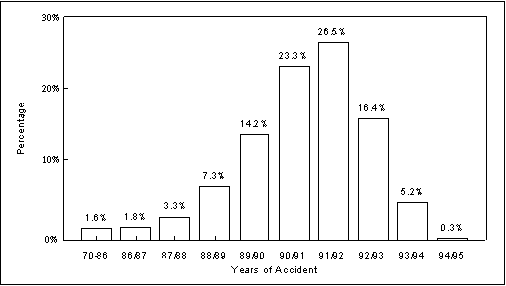
9.1 This item reflects the amount paid in claims during the relevant financial year, regardless of when the accident occurred or when the claim was lodged. Although the settlement pattern varies somewhat from year to year, the following analysis of claim amounts paid during 1994/5 according to the years in which the accidents occurred is typical.
This illustrates well the so-called "long tail" nature of this kind of insurance business: claims are settled on average 3,8 years after the accident (reckoned by amounts paid), and claims might still be outstanding 10 years or more after the accident took place.
Percentage of Claims Paid in 1994/5 relating to Years in which Accidents occurred
Skew distribution
9.2 The distribution by size of individual claim is extremely skew. The table and the four graphs hereunder typically illustrate the number of claims and the amounts paid in respect of various categories of size of individual claim. (For purposes of this exercise claim amounts include settlement costs, but the erstwhile bulk payments to Provincial Authorities in respect of medical treatment are ignored). It is noticeable that for example nearly 92% of the number of claims are smaller than R50 000, and that they account for only 39% of the total amount paid; or conversely, the highest 8% of claims occasion more than 60% of the total amount paid.
Distribution of Claim Size (per injured or deceased party) by Numbers and by Total Amounts, as finalised in financial year 1995/6
|
Number |
% |
Cumulative% |
Claim Size |
Total Amount ( Rm ) |
% |
Cumulative % |
|
9 240 11 267 8 731 4 822 2 955 1 912 1 644 991 668 487 444 1 994 737 324 178 128 85 53 52 46 189 |
19,7 24,0 18,6 10,3 6,3 4,1 3,5 2,1 1,4 1,0 0,9 4,2 1,6 0,7 0,4 0,3 0,2 0,1 0,1 0,1 0,4 |
19,7 43,7 62,3 72,6 78,8 82,9 86,4 88,5 90,0 91,0 91,9 96,2 97,8 98,4 98,8 99,1 99,3 99,4 99,5 99,6 100,0 |
0 - 1 000 1 001 - 5 000 5 001 - 10 000 10 001 - 15 000 15 001 - 20 000 20 001 - 25 000 25 001 - 30 000 30 001 - 35 000 35 001 - 40 000 40 001 - 45 000 45 001 - 50 000 50 001 - 100 000 100 001 - 150 000 150 001 - 200 000 200 001 - 250 000 250 001 - 300 000 300 001 - 350 000 350 001 - 400 000 400 001 - 450 000 450 001 - 500 000 500 001 - |
0,7 27,7 54,6 49,9 43,3 36,2 38,1 26,9 21,1 17,5 17,9 117,8 76,1 47,2 33,5 29,6 23,2 16,8 18,5 18,4 140,3 |
0,1 3,2 6,4 5,8 5,1 4,2 4,5 3,1 2,5 2,0 2,1 13,8 8,9 5,5 3,9 3,5 2,7 2,0 2,2 2,1 16,4 |
0,1 3,3 9,7 15,5 20,6 24,8 29,3 32,4 34,9 37,0 39,0 52,8 61,7 67,2 71,2 74,6 77,3 79,3 81,5 83,6 100,0 |
Claims Inflation
9.3 It is seen from the table in paragraph 8 that the amount of claims paid increased on average by 20% p.a. over the period. This high rate is due inter alia to the growing number of accidents and claims, the exceptionally high rate of inflation in medical costs, and associated higher awards by the courts.
10 SETTLEMENT COSTS
10.1 The amount of claims paid each year comprises both the compensation paid to victims and the settlement cost. These settlement costs are made up of the fees paid to external professions like attorneys, advocates, doctors, actuaries, etc., but do not include the internal administrative expenses of the RAF or its former Agents.
Over the past 7 years these amounts were made up as follows:
| R million | 1990 | 1991 | 1992 | 1993 | 1994 | 1995 | 1996 | Total |
| Compensation
Settlement Costs |
311
59 |
409
78 |
539
99 |
560
132 |
654
158 |
798
187 |
880
223 |
4 151
936 |
| Claims Paid | 370 | 487 | 638 | 692 | 812 | 985 | 1 103 | 5 087 |
10.2 It is seen that over the years settlement costs increased from some 16% to more than 20% of the claims paid. A sample analysis over the calendar year 1996 shows that the settlement costs were paid to the various parties in the following proportions:
|
Attorneys 66,9% |
Advocates 10,1% |
|
Medical Experts 15,7% |
Actuaries 1,8% |
|
Other professionals 1,6% |
Assessors 3,3% |
|
Others 0,6% |
TOTAL = 100,0% |
11 HEADS OF DAMAGES
11.1 The compensation paid to victims can be sub-divided into 5 main heads of damages as follows:
11.2 The compensation paid over the calendar year 1996 can be analysed as follows:
| % of Compensation | % of Claim | |
| Medical Costs | 23,9 | 19,0 |
| Loss of Income | 23,8 | 18,9 |
| Loss of Support | 17,1 | 13,6 |
| Funeral Costs | 0,4 | 0,3 |
| General Damages | 34,8 | 27,7 |
| Settlement Costs | 00,0 | 20,5 |
| TOTAL | 100,0 | 100,0 |
12 INCREASE IN PROVISION FOR OUTSTANDING CLAIMS
12.1 As can be seen from the graph in paragraph 9.1 only a minuscule proportion of claim payments made in a given financial year relate to accidents that occurred in that year. Nearly all claim payments relate to accidents that took place in previous years, but have only now "filtered through" and become due and payable. Between the date of accident and the date of settlement such a claim may be said to be "in the pipeline": the liability to pay the claim has already arisen, but payment thereof is still outstanding. If assets were available now to pay the claim when it becomes due and payable, such an outstanding claim could be said to be fully funded since upon settlement of the claim the nett assets would not be disturbed: both the assets and the provision would reduce by the settlement amount. In the absence of such a provision the settlement of the claim would cause an "unexpected" strain in the form of a reduction in the nett assets. This also means that the balance sheet would not have presented the financial condition fairly and fully.
12.2 It is generally accepted insurance accounting practice to create a provision for outstanding claims. In terms of the Insurance Act, 1943 insurers are also required to create such a provision and to cover it with assets.
More specifically:
Government accepts these opinions, and intends making all endeavors to finance the RAFs deficit as quickly as circumstances permit. This is discussed further in paragraph 15.
13 INADEQUACY OF CURRENT INCOME
13.1 Comparing total income with total expenditure, one obtains the following results:
| 1990 | 1991 | 1992 | 1993 | 1994 | 1995 | 1996 | |
| Income (R million)
Claims paid and expenses |
457
391 |
480
511 |
526
671 |
791
727 |
1 157
855 |
1 217
1 016 |
1 333
1 147 |
| = Nett cash flow and depreciation
Increase in provision for outstanding claims |
66
369 |
(31)
803 |
(145)
750 |
64
200 |
302
950 |
201
600 |
185
2 350 |
| = Operating Loss | 303 | 835 | 895 | 136 | 648 | 400 | 2 165 |
13.2 The following ratios are interesting:
| 1990 | 1991 | 1992 | 1993 | 1994 | 1995 | 1996 | |
| (a) Provision for outstanding claims / Claims paid and
expenses:
(b) Nett Resources / Provision for outstanding claims: |
4,3 25% |
4,9 16% |
4,8 8% |
4,7 9% |
5,1 14% |
4,9 16% |
6,4 14% |
Ratio (a) shows that the provision for outstanding claims amounts to some 5 times the most recent years cash expenditure, except for the latest year which shows a marked deterioration in the experience. This means that if the RAF should completely cease operations from a given date, it would nevertheless have to continue payments on the latest annual scale for another 6 years or so in respect of accidents which had occurred prior to that date. This again illustrates the "long tail" nature of "claims in the pipeline". Ratio (b) shows the extent to which the provision for outstanding claims is covered by existing assets, or the degree of solvency of the RAF.
13.3 It is clear from the above that the income allocated to the RAF is inadequate to meet its obligations. It is undesirable for the RAF to continue on its present course and to accumulate a growing deficit of this order of magnitude. Drastic measures have to be taken either to increase the income or to curtail the expenditure, or a meaningful combination of the two remedies should be employed in order to redress the gross imbalance between income and expenditure. Government intends employing such a combination as set out in paragraph 15.3.
14 MAIN OBJECTIVES
14.1 In reviewing the existing delivery system of MVA compensation and putting forward proposals to improve it, Government is guided by the following principles and objectives:
These considerations are discussed in turn below.
15 AFFORDABLE AND STABLE SYSTEM
15.1 Paragraph 13 dealt with the imbalance between the RAFs income and expenditure, resulting in the accumulated deficit of R6 347 million as at 30.4.96. Provisional projections indicate that the deficit will increase to some R8 000 million by 30.4.97.
15.2 The following table shows the expected claim payments during the next few financial years in respect of accidents occurring in the near future:
|
Claim Payments in Financial Year Ending 30 April (R million) |
||||||
|
Accidents occurring |
1998 |
1999 |
2000 |
2001 |
2002 |
Later |
| 1997 | 1 569 | 1 756 | 1 688 | 1 398 | 993 | 1 407 |
| 1998 | 7 | 112 | 421 | 626 | 683 | 1 467 |
| 1999 | - | 9 | 134 | 502 | 746 | 2 565 |
| TOTAL | 1 576 | 1 877 | 2 243 | 2 526 | 2 422 | 5 439 |
The accidents that (will have) occurred up to 30.4.97 give rise to a future stream of claim payments of nearly R9 billion, spread over a term of some 10 years at R1 569 million in 1997/8, R1 756 million in 1998/9, etc.. New accidents arising in 1997/8 generate further claim payments of R7 million in that year, R112 million in the next year, etc..
It is seen that
Unless the levy rates are increased, it is expected that the RAF will have a negative cash flow during 1997/8 and that it will have to draw upon the reserve of some R1 billion. Carrying on in this vein will deplete the reserve in the year 2000. At that stage the RAF will be totally bankrupt and its cheques would be dishonoured. In order to avoid this, the levy rates would then have to increase by 20,5% p.a., reaching 38,8 c/l on petrol in the year 2007. On this pay-as-you-go basis - i.e. with nothing in reserve - the accumulated deficit would amount to some R35 billion at that stage. If the aim should be to accumulate and maintain a reserve of one years expenditure, the levy rates would immediately have to increase by 14,6% p.a., reaching 41,2 c/l on petrol in the year 2007, with a deficit of R26 billion at that stage. If the aim should be to prefund the liabilities fully by the year 2007, the levy rates would immediately have to increase by 20,0% p.a., reaching 65,0 c/l on petrol at that stage.
15.3 It is clear that drastic and urgent steps have to be taken to avoid financial disaster. Government proposes a two-pronged remedy:
15.4 Regarding caps, these can be applied selectively to the current heads of damages listed in paragraph 11.1, in order to provide - within the pressing financial constraints - a humane and caring set of benefits. This is best achieved by channeling as much as possible of the finite available resources to the more seriously injured and to the poorer section of the population. The benefits proposed in paragraphs 18 and 19 are designed to that end.
15.5 Regarding fuel levy rates, indications are that the enormous demands on the fiscus make it most unlikely that these could increase by more than the rates of general inflation. Bearing in mind that claim payments have been growing at 20% p.a. (and this reflects the composite effect of a growing number of accidents/claims and the superimposed inflation of higher than normal medical expense inflation and higher court awards), whilst the fuel levy income (a composite of growth in volume of fuel sold and increases in the fuel levy rates) would come nowhere near that 20%, it is clear that the requisite caps should yield modest benefits and should be introduced as soon as possible.
15.6 The main determinants of the RAFs financial condition over the next decade are:
The two tables below show the projected accumulated surplus or deficit as at 30.4.2007, depending upon the annual increase in the fuel levy rates and upon the percentage level of savings brought about by a new benefit dispensation. The upper table illustrates the scenario on the assumption that claims will increase by 6% p.a., and the lower table if the number of claims should remain constant. This latter proposition is of course very optimistic, but hopefully the latest initiatives on road safety (see paragraph 5.2) will bring us somewhere between the two tables.
15.7 The other assumptions made for purposes of these projections are as follows:
Years after accident: 0 1 2 3 4 5 6 7 8 9 10 11
% Current benefits: 0 3 13 19 21 17 13 6 4 2 1 1
% New benefits: 25 50 25
Accumulated (Deficit) at 30.4.2007 (R billion):
Claims increasing by 6% p.a.
|
% Growth p.a. in |
Capping Savings % |
||
|
Fuel Levy Rates |
0 |
40 |
60 |
|
0 |
(71) |
(48) |
(27) |
|
3 |
(65) |
(42) |
(21) |
|
5 |
(61) |
(37) |
(16) |
|
7 |
(56) |
(32) |
(11) |
|
9 |
(50) |
(26) |
(5) |
Accumulated Surplus (Deficit) at 30.4.2007 (R billion):
Claims increasing by 0% p.a.
|
% Growth p.a. in |
Capping Savings % |
||
|
Fuel Levy Rates |
0 |
40 |
0 |
|
0 |
(43) |
(27) |
(13) |
|
3 |
(37) |
(21) |
(7) |
|
5 |
(33) |
(17) |
(2) |
|
7 |
(28) |
(12) |
3 |
|
9 |
(22) |
(6) |
9 |
15.8 It is of course most unlikely that all these assumptions will be borne out in practice over the next decade, but it does give orders of magnitude that can reasonably be expected. More importantly, it shows that - with optimistic expectations regarding the accident rate and the growth rate in fuel levy rates - a level of savings of some 60% of current claims expenditure should be wrought if we want to achieve anything near solvency in 10 years time.
16 MORE EFFICIENT SYSTEM
Delays
16.1 On average, claims are settled some 2,8 and 3,8 years after the accident, measured by number and by amounts respectively.
16.2 It is proposed to simplify and speed up the process in the following ways:
Settlement Costs
16.3 Paragraph 10 sets out the high settlement costs being incurred under the present system. Some of the reasons can be found in paragraphs 3.2 and 3.4(b) to (d).
16.4 The RAF Act requires the RAF to reimburse the claimant for his so-called "party and party costs". These costs include legal fees and disbursements, the fees being calculated in accordance with tariffs fixed and published in terms of the Rules of the Supreme Court and of the Magistrates Courts. They do not cover all the costs an attorney may charge the client. These other additional fees, called "attorney and own client costs" are recovered by the attorney directly from the client and are usually deducted by the attorney from the compensation paid by the RAF to the client. Whilst these additional costs to the claimant are not reflected in the RAFs accounts, they nevertheless constitute a further cost in the whole system.
16.5 Proposals are made to reduce this inefficiency of the system:
17 MORE EFFECTIVE SYSTEM
Acute Medical Care
17.1 As mentioned previously, the no-fault Phase I Medical Care Benefit proposed in paragraph 18.1 gives the victim of an MVA immediate access to emergency/acute medical treatment during the first few critical hours. This will improve the chances of the victims recovery to the best medical condition possible in the circumstances.
Earnings Cap
17.2 Paragraph 11.2 shows that nearly 41% of compensation under the present system is earnings related. Figures obtained from Inland Revenue indicate that in the tax year 1993/4 only 12½% of taxpayers earned in excess of the cap of R4 000 p.m. proposed for the Loss of Earnings Benefit (paragraph 18.2) and the Dependants Benefit (paragraph 19.2). At this level of income road-users should be aware of the need for private insurance to cover losses in excess of the said benefits and can afford to purchase it (if they do not already have it). Bearing in mind that some 8% of the claims at the upper end account for more than 60% of the claim payments, it is both effective and equitable to place a cap on earnings qualifying for compensation in order to conserve available resources for those who need it most.
General Damages
17.3 Paragraph 11.1 mentioned that this benefit is a financial consolation for a non-financial loss, and paragraph 11.2 indicates that this benefit currently constitutes nearly 28% of total claims paid by the RAF. In as much as the RAFs claims expenditure needs to be cut in order to achieve financial stability and a manageable deficit in 10 years time (see paragraph 15.8), and since it is more meaningful and equitable to apply the available resources in compensating real economic loss, it is proposed that explicit payment for general damages be discontinued.
Passenger Claims
17.4 Due to financial constraints the claim which a passenger can institute against the RAF as a result of the negligence of the passengers own driver is currently limited to R25 000. For any loss in excess of that amount, the passenger proceeds at common law against the owner or driver. It is very difficult for some sectors of the transport industry to secure private insurance against such claims: availability fluctuates, and it is very expensive. And a large claim could ruin an uninsured transport business. If a second vehicle is involved, the victim has an unlimited claim against the RAF. This is anomalous. It is also anomalous that a vehicle out of control should cause a passenger to have a limited claim, but the pedestrian victim an unlimited claim. It is proposed that this distinction be removed, and that passengers qualify for the same capped benefits as any other victim of an MVA - regardless of whether another vehicle was involved or not, and regardless of a fare having been paid or any other distinction.
18 PHASE I BENEFITS
Medical Care Benefit (MCB)
18.1(a) It is the intention that all victims of MVAs - regardless of fault - should have immediate access to emergency/acute medical treatment (including the requisite transport), and such further medical treatment (as contemplated in the definition of "service" in Section 1 of the Medical Schemes Act 72 of 1967) as may be necessary to achieve a "medically stable" condition. This condition might be defined as either complete recovery or as a condition that (in the words of the American Medical Association) "has become static or stabilised during a period of time sufficient to allow optimal tissue repair, and that is unlikely to change in spite of further medical or surgical therapy".
(b) Ongoing treatment beyond the medically stable condition is intended to be covered by the "Permanent Impairment Benefit" (see paragraph 19.1), as are artificial aids like wheelchairs and prostheses and other matters like attendants and home and car alterations. It is proposed that the duration of the MCB be thus limited to either attainment of a medically stable condition or a period of 18 months after the accident, whichever is the shorter.
(c) There is no monetary or time threshold, and the benefit commences immediately as mentioned above. There is also no aggregate monetary limit to the MCB, but all medical procedures will be subject to the protocols and tariffs as agreed between the RAF and the medical suppliers. The benefit covers only medical treatment received in RSA.
(d) The Exclusions (see paragraph 21) do not apply to this MCB.
Loss of Earnings Benefit (LOEB)
18.2(a) The purpose of this benefit is to provide some income to the victim regard- less of fault while receiving the medical treatment contemplated under the MCB. It is subject to the time thresholds noted below, and is payable to victims aged 16 65 years until they return to their customary work or are fit to do so.
(b) The limit of the benefit and the time threshold applicable before the benefit commences are determined by the availability of proof of income, tax documentation (where applicable), and by the victims employment status, as follows:
| Tax documentation available? |
Proof of income available? |
Employment status |
Limit | Time Threshold |
| * No | No | Any | SDG? or PDL? |
0 days? 7 days? |
| * No | Yes | self-employed | TT | 7 days |
| * No | Yes | employed | TT | 30 days |
| * Yes | Yes | self-employed | R4 000 p.m. | 7 days |
| * Yes | Yes | employed | R4 000 p.m. | 30 days |
Note:
(c) The Exclusions (see paragraph 21) apply to this benefit.
19 PHASE II BENEFITS
Permanent Impairment Benefit (PIB)
19.1(a) In the event of the victims suffering a permanent impairment, this benefit provides a Capital Value (part lump sum and part pension) towards his capital expenditure (artificial aids, home and car alterations), future medical care and rehabilitation, disability income, and general damages.
(b) The benefit is subject to apportionment of fault, and since the intention is that this PIB should commence as soon as the MCB and LOEB cease, it is important that the victim prove the percentage fault of the wrongdoer in time for that to take place.
(c) The benefit is determined as follows:
Capital Value = (A/100) x (B/100) x C x S
where
A = % Fault of wrongdoer;
B = Composite Compensation Index
(this reflects the degree of impairment for the respective
purposes of medical expenses, other expenses,
and loss of earnings/general damages);
C = 1 (age/100)
(where ages below 20 are taken as 20 and ages above 80 as
80).
S = R1,3 million? (to be discussed)
(d) Up to 20% of this Capital Value may be taken in a cash lump sum, whilst the balance is to be spread by way of published standard tables into two monthly pensions: one payable until death, the other payable up to age 65 or prior death. This latter pension may continue to be paid until the victim would have reached age 65 in the event of his prior death as a result of the accident.
(e) The degree of permanent impairment will be determined according to published standard tables of impairment.
(f) Although this PIB is subject to apportionment of fault, the Exclusions in paragraph 21 should nevertheless also apply.
Dependants Benefit (DB)
19.2(a) This benefit provides an income towards the support of the deceased victims dependants. For this purpose "dependants" are surviving spouse(s) (i.e. partners of a legal marriage and/or customary union), children (natural or legally adopted), and dependent parents of the deceased (natural or legally adoptive).
(b) The earnings of the deceased breadwinner will be allocated as to 2 parts to the deceased, 2 parts to the spouse(s) collectively, 1 part to each child, and 1 part to each dependent parent - any earnings of the surviving spouse being ignored for this purpose. For example, should the husband die and leave a wife and 2 children, the wife will qualify for a pension of 2/6 of the deceaseds former earnings, and each child for 1/6. If the wife should have died as well, the children would each qualify for 1/6 of each breadwinners former earnings.
(c) The earnings taken into account for this benefit are subject to the same amount limits set out under the Loss of Earnings Benefit in paragraph 18.2.
(d) The pensions are payable up to age 65 in the case of dependent parents, and up to age 21 in the case of children. The total amount of pension payable is subject to reduction and re-allocation as beneficiaries become disqualified as a result of age or death, and all pensions cease in any event at the time that the deceased would have reached age 65. The pensions are allocated and paid monthly according to the claimants known at the time, without retroactive adjustments when new claimants become known.
(e) The DB is subject to full apportionment of fault, i.e. if the claimant can prove e.g. only 60% fault on the part of the wrongdoer, then this benefit is likewise limited to 60% of what it otherwise would have been.
(f) The Exclusions in paragraph 21 also apply.
20 ADJUSTMENT FOR INFLATION
20.1 All the monetary amounts mentioned in the specification of the proposed new benefits have been pitched at levels considered suitable early in 1997. These may well be adjusted in the light of inflation and the finances of the RAF when the new benefits actually come into force and annually thereafter.
21 EXCLUSIONS
21.1 There are, however, certain instances where it is considered inappropriate to pay benefits from the public funds of the RAF, and where total or partial exclusions should apply:
| Circumstance | Penalised Party | Penalty |
| Unlicensed vehicle | Driver if owner | 80% |
| Unlicensed person in control of vehicle |
Offender | 100% |
| Reckless driving | Convicted offender | 100% |
| Substance abuse | Substance abuser if Driver (question of pedestrians being considered) |
100% |
| Stolen vehicle | Thief and accomplices | 100% |
| Intentional harm | Perpetrator | 100% |
| Unlawfully in RSA | Any victim | 100% |
22 COMMON LAW LIGHTS
22.1 Currently a victim has a claim at common law against the wrongdoer to the extent that the latter was at fault for loss suffered in excess of what the RAF compensated him for. The current benefits of the RAF are unlimited with one exception where a cap applies, namely the claim which a passenger can institute against his own driver. In this case the RAF is liable for a maximum of R25 000 (the cap) on behalf of the driver, and the passenger then has to proceed at common law against the driver for any balance of loss suffered. (If a second vehicle is involved, the passenger has an unlimited claim against the RAF.)
22.2 The introduction of caps on a wider field as in paragraphs 18.2, 19.1, and 19.2 therefore more pertinently raises the question of how the excess losses are to be handled. Generally speaking, these excess losses arise where the actual loss of earnings or support exceeds R4 000 p.m. (i.e. the cap under the Loss of Earnings Benefit and the Dependants Benefit), or where the Permanent Impairment Benefit does not cover the entire actual loss. Although this question has no relevance to the finances of the RAF, it is of considerable social importance.
22.3 Leaving this common law right intact has the following disadvantages:
22.4 Government therefore believes that the population at large would be better served if the common law right in this respect be abrogated. A similar situation exists in respect of injuries and diseases contracted in the course of employment (Compensation for Occupational Injuries and Diseases Act 130 of 1993).
23 TAX
23.1 Currently the RAF has to deduct PAYE instalments from the pensions it pays. It is recommended that all benefits under the new dispensation be paid free of tax, and that likewise the actual earnings used for purposes of calculating the LOEB and the DB be the earnings nett after tax. This effectively raises the earnings cap for victims or their dependants. From the RAFs point of view the nett/nett approach spares it the cost of the tax, and the administrative procedures involved in collecting PAYE instalments. From the point of view of Inland Revenue the tax forgone concomitantly reduces the need to fund the operations of the RAF out of the general fuel tax.
23.2 For the same reasons it is recommended that the RAF be enabled to reclaim from Inland Revenue the VAT which it pays on medical and other accounts constituting part of benefits. It can also be noted that the RAF is not a registered vendor for VAT purposes, and receives its fuel levy income free of VAT. There is therefore no opportunity to claim "input credits".
24 PRESCRIPTION
24.1 At present a two-tier system of prescription applies:
In the case of an ID Claim prescription does not run against minors, persons under curatorship, or patients detained in terms of mental health legislation. This means that a minors claim could remain unknown and be lodged as long as 24 years after the accident.
24.2 In paragraphs 19.1 and 19.2 it is suggested that those benefits payable by the RAF remain subject to apportionment of fault, and therefore investigation of contributory negligence is still required. It also remains necessary to establish in all instances that it was an MVA in respect of which the RAF is liable. There seems to be no reason apart from the victims being in a coma or being unable for some other good and valid reason why victims or claimants in general cannot submit (or arrange for the submission of) a "Notice of Claim" (NOC) form within 6 months of the accident in the case of injury, and 12 months in the case of death. This NOC form should be brief and easy to complete, giving personal details of the claimant and describing the accident. The purpose of such an early NOC is to establish the validity and (where applicable) the merits of the claim before the track becomes too cold, thus facilitating and speeding up the subsequent development of the claim.
24.3 It is proposed that the period of prescription be 3 years in all instances (5 years in the case of minors, persons under curatorship, and patients detained in terms of mental health legislation), but it should also be a condition precedent for the payment of benefits that the NOC form be completed in all respects and submitted within 6 or 12 months, as the case may be (24 months in the case of minors, etc.) of the accident. Prescription would thus run against minors etc. in all instances, and parents, guardians, and curators should be mindful of their responsibility to their children, wards, or charges. It is also thought that hospitals and other medical suppliers with unpaid bills are well placed to assist illiterate MVA patients with the completion of the NOC form.
25 TRIBUNAL
25.1 In order to provide claimants with speedy, easy, and inexpensive adjudication when they are dissatisfied with the administrative decisions of the RAF, it is proposed that a Tribunal financed by the RAF but operating quite independently thereof be established. It is suggested that the Minister of Justice, in consultation with the Minister of Finance (see paragraph 27.2), appoint a President to the Tribunal he or she being of sufficient standing, knowledge, and experience to command the respect required in the circumstances. This independent and impartial Tribunal will resolve disputes as a Court of first instance. It should function so as to be able to adjudicate within three months of being approached.
25.2 The said President, in consultation with the said Ministers, can appoint presiding officers in other centres, and compile a panel of experts in the various fields of law, medicine, engineering etc. to act as assessors, as the need arises.
25.3 The procedure of the Tribunal should be inquisitorial rather than adversarial. The claimant is entitled to have legal representation. It is proposed that the rulings of the Tribunal have the force of a Judge of the High Court sitting alone, but subject to the normal appeal procedures of the High Court.
25.4 The judicial status of the Tribunal needs definition, which will be attended to in due course.
26 CLAIMS PROCEDURE
26.1 One of the important aims of the proposed new delivery system of MVA compensation is to make the procedure easier and more "victim-friendly". To that end, the benefits, conditions, forms, and procedures will be simplified and standardised as far as possible. However, in order to combat fraud, the onus remains on the claimant to prove his claim and to comply with certain minimum evidential requirements. These entail the timely completion and lodgement of the "Notice of Claim" form with the RAF, reporting the MVA to the Police, providing medical reports, and submitting proof of lost earnings, the wrongdoers fault, death, dependency, ages, etc. as prescribed by Regulation.
26.2 The RAF will pay the MCB to the medical supplier direct (who therefore has an interest in assisting and co-operating with the claimant in this respect), whilst the LOEB, PIB, and DB will be paid into the nominated bank or Post Office accounts of the beneficiaries.
27 OTHER CONSIDERATIONS
Government Guarantee
27.1 It is recognised that it is politically impossible for the Government to avoid providing for the payment of claims arising from past accidents, since the road-using public have been paying for the insurance cover through a levy on fuel purchased. And there appears to be no reason to believe that such payment could be done more efficiently than through the RAF. It seems, therefore, that the issuing by the Government of an explicit guarantee to the RAF in respect of claims arising from past accidents, would not increase the effective liability of the Government in respect of such claims. On the other hand a formal guarantee of the liabilities of the RAF would make the Governments balance sheet more meaningful and would remove the recurring criticism of the RAF (e.g. by the Auditor-General) that it is trading in a state of insolvency. It is therefore Governments intention that it should assume the responsibility to enable this statutory fund to discharge its liabilities, and new legislation emanating from the White Paper should recognize this explicitly.
Responsible Ministry
27.2 Since the RAF acts as an insurer and is financed out of tax revenue, it seems more appropriate that the Minister of Finance (rather than Transport) be the responsible minister.
Property Damage
27.3 In view of the RAFs financial predicament, it would be most inopportune to extend its liability to include compensation for damage to property (usually the other vehicle) at this stage. Moreover Government does not wish to involve itself in statutory insurance more than on a socially desirable minimum level.
Hit-and-Run Accidents
27.4 There are currently some legal, evidential, and procedural differences between ID Claims and H&R Claims which produce all manner of practical difficulties, and whilst there would naturally be a greater burden of proof of validity in the case of H&R Claims, the differences should be kept to an absolute minimum in order that ID Claims and H&R Claims may be processed as far as possible in identical ways.
Insured Event and Double Compensation
27.5 Statutory provisions require compulsory insurance in respect of
There is an overlap between (a) and (b) if an employee is involved in a MVA while on duty. Good law requires that these three areas be delineated very clearly, with no gap, overlap, or right of recourse among the three areas: The present situation where the Compensation Commissioner has a right of recourse against the RAF is onerous to administer; and, having identified whether the accident falls under (a) or (b) above, the liable insurer should simply pay the benefits available in terms of the applicable legislation. This would also reduce the risk of duplicate claims. Harmonisation of the benefits under (a) and (b), and possible extension to (c), are considered long-term options that may be considered in the light of future economic conditions.
27.6 There are other instances where "double compensation" may arise:
Insured Party
27.7 The insured party under the current law (i.e. the negligent driver) has for all practical purposes become irrelevant except in so far as his testimony assists in determining the degree of the victims contributory negligence. It is therefore proposed that the victim himself should be the insured party, having a claim against the RAF direct instead of against the (insured) negligent driver. This changes the nature of the insurance from legal liability cover (in favour of the other motorist) to injury or death cover (in favour of the victim or his dependants). This makes it clearer that RAF benefits are in fact social or welfare benefits, even though some are subject to apportionment of fault and to certain exclusions.
Insurer
27.8 The Agency system has ended. The RAF itself is now handling all the claims that have been and will be instituted against it. In addition to Pretoria, branches have been esta- blished in Cape Town and in Randburg, and a branch is being planned for Durban.