DEPARTMENT
OF ENVIRONMENTAL AFFAIRS AND TOURISM |
This chapter deals with:
The starting point for developing an Integrated Pollution and Waste Management policy for South Africa is the Constitution. According to the Constitution, the legislative and executive authority of different spheres of government is set out within a framework of cooperative governance, and national and provincial governments have some concurrent and some exclusive powers in terms of the management of the environment. The Constitution also sets out how national and provincial government regulate certain functions of local government in this regard.
Functional areas of concurrent national and provincial legislative competence regarding integrated pollution and waste management are:
as well as the regulation of the following local government matters:
The functional area of exclusive provincial legislative competence regarding integrated pollution and waste management is provincial planning, as well as the regulation of the following local government matters:
6.2 Draft White Paper on Environmental Management Policy for South Africa
The White Paper on Environmental Management Policy for South Africa delineates Government’s policy on environmental management. The Integrated Pollution and Waste Management policy forms a subsidiary and supporting policy to this environmental management policy. The latter policy identifies Government as the custodian of the nation’s environment and the Department as the lead agent responsible for ensuring integrated and co-ordinated implementation of Government’s policy on environmental management.
All sectors of South African society have a role to play in integrated pollution and waste management. In its move to establish a more effective and efficient system for protecting human health and the environment, the Departments of Environmental Affairs and Tourism and of Water Affairs and Forestry cannot act in isolation. Therefore, it is the policy of the Department of Environmental Affairs and Tourism as environmental lead agent to encourage all stakeholders, i.e. other government departments, business and industry, labour, environmental and public interest groups, communities and other members of civil society to participate in the discussion, design and implementation of new policies and programmes.
6.3 Integrated Environmental Media Approach
The functional approach that will be adopted for pollution and waste management is an integrated receiving environmental media approach. There are three main functional areas which will be covered by media management, viz. source-based controls, impact management and remediation.
For the purposes of this Integrated Pollution and Waste Management policy, the need to manage water quantity and water quality as an indivisible natural asset is recognised. The Department of Water Affairs and Forestry, as the lead agent for water, is responsible for water quantity and water quality management, the latter including water pollution control and wastewater discharge to the environment, within an overall integrated system.
6.4.1 National Government
National government is structured in such a way that certain departments are media-specific (such as the Department of Environmental Affairs and Tourism and the Department of Water Affairs and Forestry) and others are sector-specific (such as the Department of Agriculture and the Department of Minerals and Energy). Each department has been charged with specific functions and powers.
The Department of Environmental Affairs and Tourism has been appointed as the lead agent for the environment and the Department of Water Affairs and Forestry, as the lead agent for water, is responsible for water quantity and quality management. As such it will provide leadership and guidance to enable other national departments, provincial environmental departments and local authorities to meet their executive obligations in respect of the environment, including integrated pollution and waste management. In performing these functions the lead agent will act in accordance with the requirements of cooperative government. The lead agent will take overall responsibility for integrated pollution and waste management in South Africa. The Department of Environmental Affairs and Tourism will execute its responsibilities by concentration and extension. Furthermore, it will establish guidelines, mechanisms and structures which ensure that activities undertaken by other media and sector managers are coordinated, uniform and effective.
It is the intention to strengthen the Department of Environmental Affairs and Tourism’s capability in the field of integrated pollution and waste management and to undertake the line functions associated with the implementation of this Integrated Pollution and Waste Management policy. To ensure coordination between the Department of Environmental Affairs and Tourism and Departments and agencies in different spheres of government exercising pollution and waste management functions, it may be appropriate to establish Interim working arrangements. These will be formulated as Memoranda of Understanding (MOU’s) to ensure that functions are exercised efficiently, without duplication and in a cooperative and mutually supportive manner. In this way it will promote institutional integration and harness the existing skills and expertise in national departments active in the field of integrated pollution and waste management.
An underlying principle in the allocation of governance functions is the devolution of responsibility to the most appropriate sphere of government. Where the allocated sphere of government does not have the resources or capability, the next sphere of government will execute the function. Furthermore, the Department of Environmental Affairs and Tourism will assist where resources and capability are lacking, as well as assist in building capacity.
Functions of the lead agent
As the lead agent the Department of Environmental Affairs and Tourism will ensure that the following integrated pollution and waste management related functions are undertaken:
Powers of the lead agent
In order to fulfil its responsibilities as lead agent, the Department of Environmental Affairs and Tourism will:
Functions of the media/sector manager
The media/sector manager will ensure that the following integrated pollution and waste management related functions are undertaken regarding its medium or sector:
Powers of the media/sector manager
In order to fulfil its responsibilities as the media/sector manager, the relevant departments will:
National Integrated Pollution and Waste Management Coordinating Committee
The Department of Environmental Affairs and Tourism will interface with the relevant national departments through a National Integrated Pollution and Waste Management Coordinating Committee. This committee will be established to deal with all relevant pollution and waste issues.
Permanent members of this committee will be:
Department of Minerals and Energy.
It should be noted that as far as land is concerned, a number of national departments are involved in the management of this medium, i.e. the Department of Agriculture, the Department of Environmental Affairs and Tourism, the Department of Water Affairs and Forestry, and the Department of Minerals and Energy.
In addition to the permanent members of the Coordinating Committee, other departments that also deal with pollution and waste issues from time to time, will be co-opted as and when appropriate. Departments falling into this category include, the Department of Labour, the Department of Health, the Department of Trade and Industry and the Department of Transport.
6.4.2 Provincial government
Provincial governments have a responsibility to implement integrated pollution and waste management programmes, conduct compliance and enforcement programmes and monitor environmental conditions. Provincial performance is fundamental to the achievement of the goals and objectives of this Draft White Paper on Integrated Pollution and Waste Management for South Africa.
In order to effect integrated pollution and waste management within the provinces, a Provincial Integrated Pollution and Waste Management Coordinating Committee will be established for each province.
Representation on this Committee may include:
In accordance with constitutional provisions, it is an underlying approach of this policy that certain integrated pollution and waste management functions must be shared with provincial Governments in order to develop effective capacity to deal with such functions.
6.4.3 Local government
Where capacity exists, certain integrated pollution and waste management functions, such as implementation, enforcement and inspection, will be delegated to local government by the Department of Environmental Affairs and Tourism. Where this capacity does not exist, the lead agent and the provinces will assist in the development of such capacity. It will also be the task of the lead agent to provide guidelines for local government to ensure a uniform approach to integrated pollution and waste regulation and enforcement.
6.4.4 Authorisation mechanisms
The current practice of issuing individual medium or activity permits will be altered to a system of multimedia authorisations, which will result in a single permit covering all aspects of integrated pollution and waste management.
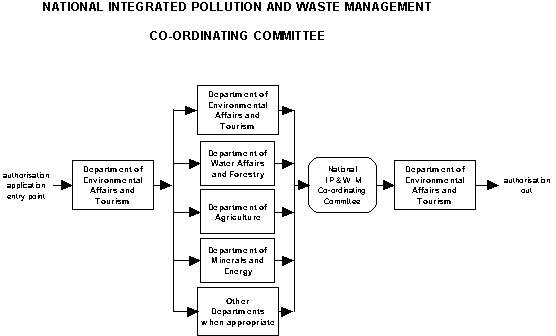
Mechanisms to give effect to this change in approach will be developed jointly by the relevant authorities. In order to expedite the evaluation of applications, a consolidated set of requirements for applications, including impact assessments, will be prepared jointly by the relevant authorities. A Coordinating Committee comprising representatives of the media/sector managing departments, either at national or provincial level as appropriate, will be established to ensure overall coordination. This Committee will be convened and administered by the Department of Environmental Affairs and Tourism, which is identified as the entry and exit point for the multimedia authorisations. Coordinating Committees will be established at provincial level in a similar manner.
In order to expedite evaluation of applications, a consolidated set of requirements for applications including impact assessments will be prepared jointly by the relevant authorities. These requirements will be incorporated in guidelines which will guide both government and applicants in the process. Impact assessments will be undertaken in accordance with relevant laws, regulations, standards and guidelines.
Evaluation of the different elements of the authorisation application against the predetermined consolidated set of requirements will take place at the appropriate level of government, depending on the department involved. National or Provincial Integrated Pollution and Waste Management Coordinating Committees will be the forums for final evaluation of authorisation applications to ensure that all environmental impacts and mitigation requirements have been covered; however, the component of the authorisation relating to the individual media remains the responsibility of the media manager (see Figure 2). The authorisation will not only include standards, but could also include, without being limited to, details of voluntary agreements, economic instruments and any other clauses and details of the frequency and method of regular review and update, or any other conditions.
The Department of Environmental Affairs and Tourism shall set standards for ambient environmental quality (except for water quality and wastewater discharges to the environment which will remain the responsibility of the Department of Water Affairs and Forestry), after consultation with media and sector managers through a National Integrated Pollution and Waste Management Coordinating Committee. The setting of source control and remediation standards, will remain the responsibility of the media/sector managers, but will be coordinated by the coordinating committees at national and provincial level. In managing water resources, the catchment area is recognised as the basis for management. Once Catchment Management Agencies have been established as envisaged in the National Water Policy, they will have to be represented on the relevant coordinating committees.
Figure 2: National Integrated Pollution and Waste Management Coordinating Committee
6.4.5 Impact management through ambient standards
Ambient standards define targets for integrated pollution and waste management and establish the permissible amount or concentration of a particular substance in or property of discharges to water, air and land.
In order to determine what source control standards (typically emission or discharge standards) are required in a given area, the intended receiving environmental quality will be determined. The characterisation of this intended quality will be reflected in ambient standards which will vary according to the nature of the receiving environment. Ambient standards will define the maximum pollution and waste levels that a particular receiving environment can tolerate without significant deterioration. The source control standards will form part of a suite of source control measures and will be geared towards impact prevention and management. Similarly, ambient standards will be defined for sites requiring remediation.
In order to provide quantifiable limits against which integrated pollution and waste management results can be measured, performance standards will aim at achieving agreed ambient environmental quality. These standards will be achieved by introducing the following measures:
The relevant laws, regulations, standards and guidelines will be used as mechanisms to obtain information on media impacts used to evaluate predicted impacts against the ambient standards. Coordination of standard setting and agreement on a consolidated set of requirements against which applications for authorisation will be evaluated, will be developed as part of the National Waste Management Strategy.
6.4.6 Monitoring
Monitoring will be media/sector based. Two areas will be addressed, viz. ambient environmental quality and compliance monitoring.
Ambient environmental quality monitoring
The achievement and maintenance of appropriate ambient environmental standards is a goal of this Integrated Pollution and Waste Management policy and will be realised through the collection of adequate information on ambient levels of pollution. Supporting information on the nature and effects of pollutants and their pathways through the environment will be needed to ensure proper management. To this end the government will:
Monitoring a specific media or a specific sector will be the responsibility of the media/sector managers with coordination being the responsibility of the lead agent.
The National Waste Management Strategy will investigate the role of civil society in pollution and waste monitoring.
Compliance monitoring
Compliance monitoring is the responsibility of the permit holder, with the government undertaking regular inspections and/or audits to ensure that the permit holder is undertaking the necessary compliance monitoring.
The National Waste Management Strategy will develop systems for:
Responsibilities of lead agent and media/sector managers
The overarching auditing function to ensure adequate ambient and compliance monitoring is the responsibility of the Lead Agent, the Department of Environmental Affairs and Tourism.
Ambient quality monitoring is the government's responsibility. The division of responsibilities between the departmental media/sector managers is the following:
Furthermore, permit holders authorised by government have to ensure that they comply with regulatory requirements through regular compliance monitoring. Multi-skilled inspectors will be employed at national or the most appropriate level, to check compliance with regulatory requirements. Monitoring will take the form of external audits conducted by the inspectors or checking of monitoring records and audit reports.
6.4.7 Management instruments
A wide range of management instruments can be used for integrated pollution and waste management. This policy is not intended to be prescriptive as to which tools will be used in which instances, but rather outlines the range of instruments available and their associated advantages and disadvantages. Those management instruments which best promote the principles, goals and objectives of this policy will be used.
The criteria for selecting a particular instrument or package of instruments are the following:
The final regulatory range of instruments will draw on direct controls and permits, economic instruments, land-use planning and controls, and voluntary agreements. These instruments will be used in an integrated manner to maximise effective integrated pollution and waste management. A thorough survey of available instruments for integrated pollution and waste management will be conducted as part of the National Waste Management Strategy.
Command-and-control instruments
Command-and-control instruments involve direct regulation and rely primarily on the application of regulatory instruments such as standards, permits, and land use controls.
Standards define environmental targets and establish the permissible amount or concentration of particular substances in discharges into air, water and on land. Standards may also include technological specifications for the performance or design of equipment and facilities and the standardisation of samples and analysis methods. Each of the various types of standards are used to provide a reference for evaluation or a target for legislative action or control.
Permits are tied to standards and are also subject to the fulfillment of specific conditions. They facilitate the enforcement of integrated pollution and waste management by including in one authorisation all pollution and waste management obligations. Permits can be withdrawn in cases of non-compliance, or changed as environmental or economic circumstances change. Similarly, should the permit holder not meet permit conditions, the permit holder can be fined or prosecuted.
Land use controls: In terms of the Development Facilitation Act, provincial and local authorities are required to formulate land development plans, which must include encouraging environmentally sustainable land development practices. The lead agent will evaluate and address these and other land use controls and guidelines relevant to integrated pollution and waste management. These controls and guidelines will be developed in collaboration with civil society and the national, provincial and local governments. Issues to be addressed include: domestic waste collection and disposal, vehicle emissions and the use of fossil fuel appliances.
Economic instruments
A shift towards a sustainable economy implies fundamental changes throughout the economy in which the close cooperation and involvement of all sectors of the economy is regarded as a crucial factor for success.
The objective of economic instruments is to change behaviour by promoting specific innovations which lead to improved environmental performance. In considering economic instruments it is important to understand the difference between a "charge" and a "tax". The main purpose of a tax is to generate revenue, while a charge is meant to recover cost, including environmental costs.
The generation of revenue is the responsibility of the Department of Finance and it is not the intention to propose a change to this arrangement. A prerequisite for the recovery of environmental costs is the ability to calculate these costs. Mechanisms to achieve this recovery of costs will be investigated as part of the National Waste Management Strategy. Other issues to be considered in determining environmental charges is the elasticity of demand as well as the supply of environmentally damaging products or services, since these influence the effectiveness of all control instruments, including economic instruments.
The primary objective of environmental resource economics is to "get prices right". Environmental assets are often not priced correctly because of one or combination of the following reasons:
Different economic instruments are designed to correct different situations. It is, therefore, important to know the cause of an environmental problem before a choice of economic instruments is made.
The types of instruments that may be considered in this category include:
Another form of economic instrument is based on the incentive approach, through which investment for example in cleaner production technologies, is promoted. This type of instrument will be investigated in collaboration with the Department of Trade and Industry and may include:
basic needs subsidies (already in place in the form of a lifeline tariff for water services).
Voluntary instruments adopted by industry have been used in many countries as an important complementary approach to pollution reduction, but seldom as a replacement for direct government control. These voluntary instruments can be used to achieve performance in excess of compliance with minimum standards and can include setting pollution reduction targets and penalties for non-compliance. An extension of the use of voluntary instruments is to use them as the basis for contracts being entered into by industry and government and civil society. Voluntary programmes which promote pollution reduction, open access to information, and the involvement of local communities in integrated pollution and waste management will be encouraged.
The introduction of mechanisms to promote and administer voluntary agreements will be investigated as part of the National Waste Management Strategy. Issues to be considered will include:
Government and civil society will be capacitated through training in integrated pollution and waste management. Emphasis will be given to the training and skills development of members of disadvantaged groups.
The government will assist people to act in an informed manner by:
Human resource development programme
The human resource development programme of the Department of Environmental Affairs and Tourism will be adjusted to focus on the new policy priorities, with a particular focus on the development of staff from disadvantaged communities.
The Department of Environmental Affairs and Tourism will establish links with tertiary education and other training institutions in order to ensure that training of pollution and waste managers, inspectors, educators and information officers, both for the Department and generally, is appropriate to the new direction contained in this Draft White Paper on Integrated Pollution and Waste Management for South Africa.
Sectoral capacity building
Integrated pollution and waste management will only be successful if personnel at all levels in the Department of Environmental Affairs and Tourism and in the provincial environmental departments, as well as in all other relevant organisations, agencies and sectors are developed. For an integrated approach to pollution and waste management to be successful, capacity will have to be built in marginalised and disadvantaged groups and in small, micro and medium enterprises. Technical expertise will also have to be promoted. Especially in rural areas, women are an important group who should be targeted by capacity building programmes.
The lead agent and all other players will be involved in partnership activities for capacity building at national, provincial and local level.
Pollution, waste management and gender
The development of women in relation to integrated pollution and waste management is important for a number of reasons. Since women are the traditional custodians of natural resources in the rural areas, they are also the people who suffer most from degradation of the natural resource base, and their wisdom in this regard should be acknowledged and utilised by government. It is through education of and communication with women that basic attitudes to integrated pollution and waste management will change.
This Integrated Pollution and Waste Management policy promotes representation by women at all levels and in all spheres of integrated pollution and waste management activities in political, technical and managerial positions.
The Convention on the Elimination of Discrimination Against Women, which has been ratified by South Africa, obliges the State to take into account the particular problems faced by rural women and the important roles they play in the economic survival of their families. It further places a duty on the State to take appropriate steps to make sure that women participate in and benefit from rural development, including the planning and implementation of development at all levels. The State must also make sure that rural women have equal access to economic opportunities and enjoy adequate and safe living conditions in relation to water supply and sanitation. The lead agent will investigate means of building the capacity of this sector of South African society in integrated pollution and waste management.
6.4.9 Information systems
A central component of the integrated pollution and waste management information system is that it will allow public access to information, based on the constitutional right to be informed. Through the National Waste Management Strategy, the government will establish:
Pollution emission information
A cornerstone of this Draft White Paper on Integrated Pollution and Waste Management for South Africa is pollution prevention and waste minimisation. In addition, the pollution management strategy rests on source controls to meet ambient environmental standards. Both these elements of this policy require sufficient information on pollution and waste releases to be carried out effectively.
In order to provide sufficient data for waste minimisation and source based pollution control, a register of pollutant releases or transfers from a variety of sources will be established. The register will include information about releases or transfers to air, water and soil. All waste handlers (collection/transport/disposal contractors) will be required to register. Mechanisms to facilitate public access to the register will be introduced.
One of the components of the National Waste Management Strategy will be the establishment of a pollutant release and waste register. This register will not be restricted to point source releases, but will also cover non-point diffuse pollution sources such as agriculture and transport. The relevant national, provincial and local authorities will also be required to publish regular statistics based on the register. Compilation and holding of this register will be a function of the lead agent, i.e. the Department of Environmental Affairs and Tourism.
There is a difference between amounts of pollutants emitted and the impacts, on health or the environment, of the emissions. Because there are so many intervening stages between the source and effects of pollution there is often uncertainty about the final impact of a pollutant. Therefore, the register, especially in its early stages, will not be expected to provide information on the impacts of pollution. The data gathered by the register will, however, provide crucial information to government regulators and to civil society which can be used to analyse pollution sources according to impact and prioritise pollution reduction activities.
In designing the register the following issues will be taken into account:
Registration of waste disposal sites
The Environment Conservation Act (No 73 of 1989) makes provision for the registration of all waste disposal sites and waste deposits; however, this Act has not been fully implemented. Although a recent survey by the Department of Water Affairs and Forestry identified the majority of waste disposal sites in the country, a register of waste disposal sites is essential if control is to be implemented. It is a requirement of this Integrated Pollution and Waste Management policy that all waste disposal site operators and owners register their waste disposal sites with the Department of Environmental Affairs and Tourism, and that a legally responsible person be appointed to be in control of the waste disposal site.
Constitutional rights to information
The constitutional right concerning access to information is central to integrated pollution and waste management. This right states that everyone has the right of access to any information held by the State and any information held by another person which is required for the exercise or protection of any rights. The Open Democracy Bill, which will give effect to this right, is in the process of being drafted and will be used as the basis for access to information in terms of this Integrated Pollution and Waste Management policy.
The Constitution recognises that the provision of information may be a financial and administrative burden on the State and that reasonable measures can be provided to relieve this burden. Mechanisms will be investigated to ensure how access to environmental information is dealt with in the Open Democracy Bill and how the administration of an information system can be established without creating too large an administrative or financial burden on the State or the private sector.
Making information accessible
In line with the management philosophy of this Integrated Pollution and Waste Management policy, the types of information that will be made available by government are:
Data will be transformed into usable information by being
made readily understandable to those without technical backgrounds and without
sophisticated information technology. Mechanisms to give effect to this approach will be
investigated as part of the National Waste Management Strategy.
In addition to pollution release and concentration data, there is a need for technological and other information to support pollution reduction efforts. The collection of information on cleaner technology, best available technologies for pollution control and other information that can assist in pollution and waste management minimisation will be undertaken by the Department of Environmental Affairs and Tourism. In light of this need, the establishment of a pollution, waste and cleaner technology information "clearing-house", or a network of such information sources, will be investigated. Models of similar bodies will be considered, as well as the financing of the structure.
6.4.10 Research and development
Policy development and decision-making on pollution and waste management need to be supported by research. This research should be directed to the development of appropriate technologies and methodologies to ensure sustainable resource use, manage impacts and achieve cleaner production. Research and development should make use of all sources of information, forms of knowledge and research methodologies, including participatory research. The government will encourage civil society to establish and participate in research programmes aimed at informing their membership on important pollution and waste management issues.
The government will support both applied and basic research to identify and prioritise issues confronting policy development and pollution and waste management. It will give particular attention to addressing environmental justice concerns, environmental sustainability and administrative efficiency in terms of integrated pollution management.
Areas requiring research include:
All members of society contribute to waste generation and should therefore be part of the solution to the problem of pollution and waste. Mechanisms to increase both the awareness and role of individuals and groups to manage waste and pollution will be explored as part of the National Waste Management Strategy. All sectors of civil society and in particular the following organised sectors have a role to play in integrated pollution and waste management:
The Minister of Environmental Affairs and Tourism will establish a specific advisory body to deal with integrated pollution and waste management to advise him. This advisory body will be established as a subordinate body to the proposed National Advisory Committee for Environmental Management (Figure 3). Similar structures will be established to advise the Members of the Executive Council (MECs) at provincial level.
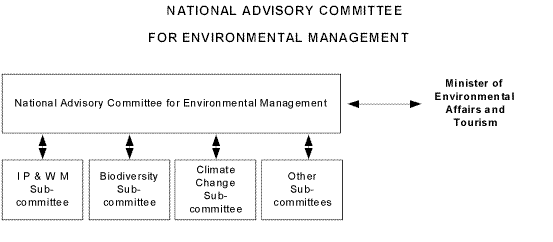
Figure 3: National Advisory Committee for Environmental Management
6.5.1 Business and industry
Various levels of environmental performance and commitment will be recognised by the Department of Environmental Affairs and Tourism and incentives will be developed in consultation with other relevant departments for companies that are willing and capable of exceeding minimum standards.
Government will support the role that business and industry will play in enhancing integrated pollution and waste management performance will by:
The lead agent will establish mechanisms to facilitate this involvement and ensure that the role of business to run internationally competitive enterprises, to exercise management responsibilities and judgements and to discharge their duties as corporate citizens in a clear legal framework is protected, so as to promote sustainable economic development.
6.5.2 Labour
Workers tend to be in the front-line of pollution problems and exposure to hazardous environments. Therefore, government will support the role of labour by:
The lead agent will ensure that the rights of workers to divulge information to the public and to refuse to perform operations that could result in pollution, are protected. The lead agent will also provide guidelines, developed in collaboration with labour representatives, for the participation in integrated pollution and waste management issues with industry and business and other stakeholders. In addition, measures will be implemented to facilitate participation in integrated pollution and waste management decision making and enforcement, especially where it affects employment.
6.5.3 Community Based Organisations
Community based organisations must have access to integrated pollution and waste management decision-making and local information, since many communities live adjacent to polluting industries.
Mechanisms and capacity building to address grievances to ensure their participation will be developed by the lead agent.
Government will support the role of communities by:
6.5.4 Non-Governmental Organisations
Non-governmental organisations have been instrumental in driving the growth of environmental awareness and in advancing Integrated Pollution and Waste Management policy. Therefore, the Government will support their role by:
The lead agent will ensure their access to information and establish the mechanisms and ability to address grievances, as well as ensuring their for involvement in integrated pollution and waste management decision-making and enforcement. Particular attention will be paid to the needs of non-governmental organisations and the constraints involved in their participation in integrated pollution and waste management forums. In order to ensure their part, the lead agent will develop mechanisms and capacity building to address their grievances.
6.5.5 The public
South Africans are concerned about integrated pollution and waste management issues. Recognising the value and potential of a well-informed and committed citizenry for effecting positive change, the lead agent, i.e. the Department of Environmental Affairs and Tourism, supports meaningful public involvement in integrated pollution and waste management issues. The lead agent will expand public participation in the regulatory process through consensus-based approaches and negotiated rule-making and establish new ways to make information more directly accessible and relevant to the public to build capacity and raise awareness on integrated pollution and waste management issues.
6.5.6 Appeals and complaints
Appeals and complaints regarding integrated pollution and waste management decisions and/or implementation will be routed initially through the lowest appropriate sphere of government. In the event of this not achieving the result required by the complainant, the next level of government may be approached.
An independent appeal mechanism will be set up to handle cases where an aggrieved party has failed to obtain a satisfactory response from government.
The Minister of Environmental Affairs and Tourism has initiated a legal audit and review process, which will result in recommendations for the necessary legislative changes.
Once this Draft White Paper on Integrated Pollution and Waste Management for South Africa has been approved by the government, a policy implementation phase will be initiated which will address urgent administrative issues, the development of a National Waste Management Strategy and legislative measures.
7.2 National Waste Management Strategy
The Strategy will focus on and prioritise goals and objectives requiring action by government and other parties within the next five to ten years. Where necessary the National Waste Management Strategy will identify priorities for fast-tracking to address urgent needs. These priorities will form the basis for developing action plans to address the strategic goals set out in this Integrated Pollution and Waste Management policy. The action plans will include clear time-frames and budgetary allocations for realising the accompanying objectives. These action plans will provide for interim updates and take account of new information, new technology, or other factors that may call for revision of standards, mechanisms, or targets. The action plans will also take account of South Africa's international obligations.
The national Departments of Environmental Affairs and Tourism and of Water Affairs and Forestry are currently drawing up an inception phase report through a participatory process of consultation with all interested and affected parties. The inception report will specify the terms of reference and provide a detailed programme and schedule for the development of a National Waste Management Strategy for South Africa. It is anticipated that within two years of this Draft White Paper on Integrated Pollution and Waste Management for South Africa being accepted, the development of the National Waste Management Strategy should be completed.
The National Waste Management Strategy will address the following priority topics:
7.3 Legislative Amendments and Implementation of Legislation
Once this Draft White Paper on Integrated Pollution and Waste Management for South Africa has been accepted by government, an investigation of the legal requirements of this policy and its implementation will be undertaken.
The government will consider the ratification of outstanding international conventions on integrated pollution and waste management and give specific legislative effect to them.
Contents
Chapter 1 Chapter
2 Chapter 3 Chapter 4
Chapter 5 Chapter
6 Chapter 7 Appendicies