DEPARTMENT
OF ENVIRONMENTAL AFFAIRS AND TOURISM
DEPARTMENT OF WATER AFFAIRS AND FORESTRY |
DRAFT WHITE PAPER ON
INTEGRATED POLLUTION AND
WASTE MANAGEMENT FOR SOUTH AFRICA
4. APPROACHES TO INTEGRATED POLLUTION AND WASTE MANAGEMENT
4.1 Shift to Prevention
The government believes that pollution prevention is one of
the most effective means of protecting South Africa’s people and environment.
Pollution prevention eliminates costly and unnecessary waste and promotes sustainable
development. It focuses on avoiding the creation of pollutants rather than trying to
manage pollution after it has been created.
This Integrated Pollution and Waste Management policy
stresses the need to make pollution prevention a part of everyday activities and
decisions, whether as government agencies, business or industry, labour, communities, or
individuals. This policy shows how the focus of environmental protection can be shifted
from reacting to pollution towards the prevention of pollution at source.
4.1.1 Achieving prevention and minimisation
Historically, pollution control focused primarily on
pollution impact management and remediation. In order to achieve sustainable development,
this focus should shift to a management approach combining pollution and waste prevention
and minimisation at source, impact management, and, as a last resort, remediation.
Pollution prevention aims at reducing risks to human health
and the environment by seeking to eliminate the causes of pollution, rather than by
treating the symptoms of pollution. This objective reflects a major shift in emphasis from
‘control’ to ‘prevention’.
It is clear that effective pollution prevention is not only
focused on the installation of pollution abatement equipment in industry, but reflects an
understanding of the shared responsibility of all sectors of society in protecting South
Africa’s natural resources. In order to promote pollution prevention initiatives
throughout the country, an Integrated Pollution and Waste Management policy is required.
While the implementation of pollution prevention will differ
amongst sectors, the general techniques will include the following: policy and regulation;
technical assistance and compliance monitoring; prioritising substances of concern;
efficient use and conservation of natural resources; reuse and recycling; operating
efficiencies; economic incentives and disincentives; integration of environmental concerns
into land-use planning and urban development; training; household waste minimisation and
recycling; product design; process changes; cleaner production; creating efficient
information systems; life cycle analysis; partnerships; and awareness raising, capacity
building and development of strategies and tools to enable people to follow sustainable
lifestyles.
Pollution prevention is about expanding the range of options
for environmental decision making. It is about innovation in product design and
production. It encourages cost savings through efficiencies and conservation. It insists
on sound management of persistent, bio-accumulative and toxic substances and on
eliminating their use where necessary. It offers South Africans an opportunity to achieve
their environmental goals in ways that are more effective than the traditional means of
environmental protection and that stimulate innovation and the ability to compete.
Changes in behaviour are paramount to the pollution
prevention approach to environmental protection. There are a number of ways to help
organisations and individuals realise the benefits of pollution prevention and incorporate
pollution prevention strategies into the way they go about their business and their lives.
Government guidance and regulation is needed to improve pollution prevention measures by
means of enabling legislation that sets the framework for responsive pollution prevention
programs.
4.1.2 Benefits of the shift to prevention
The shift to prevention will:
- minimise and/or avoid the creation of pollutants and waste,
- minimise and/or avoid the transfer of pollutants from one
medium to another,
- accelerate the reduction and/or the elimination of pollutants,
- minimise health risks,
- promote the development of pollution prevention technologies,
- use energy, materials and resources more efficiently,
- minimise the need for costly enforcement,
- limit future liability with greater certainty,
- avoid costly clean-up practices,
- promote a more competitive economy,
- reduce human impact on the environment,
- enhance the quality of life, and
- ensure intergenerational equity.
4.1.3 Implications of the shift
The course of action that this Draft White Paper proposes
will have a significant influence on how South Africa's pollution and waste management
goals and objectives are pursued in the future. The government will establish an
integrated pollution and waste management system which will offer greater protection to
people and the environment.
The integrated pollution and waste management system will:
- assist the government in attaining its sustainable development
goals,
- ensure that quality, quantity and accessibility of information
is improved,
- allow for greater public access to information,
- facilitate strong partnerships between the government sector,
private sector, labour, non-governmental organisations and communities,
- facilitate compliance with environmental laws and reduce the
amount of bureaucratic delays, and
- build capacity and awareness.
4.2 Approach to the Development of the Policy
The approach to identify pollution and waste issues and
address them in a practical manner includes the following:
- adopting a media based approach focusing on the primary
receiving media, i.e. water, air and land,
- recognition of waste as a primary source of pollution,
- an integrated and phased approach dealing firstly with source
control, secondly with impact management and lastly with remediation (see Figure 1),
- training, education and capacity building of all sectors,
- public participation, and
- ensuring a holistic approach by integrated pollution
prevention and waste minimisation.
Specific aspects of pollution prevention and waste
minimisation which will be considered for each of the media are set out below.
4.2.1 Water pollution
The policy on water pollution management covers inland
waters, both surface and ground water, as well as estuarine and marine waters.
Issues which will be considered in relation to policy
implementation are:
- river catchments as basic management units,
- land uses affecting catchment water quality,
- water quality requirements as specified by the catchment water
users,
- management of stormwater from industrial and urban areas,
- point sources of pollution, e.g. sewage treatment works and
industrial wastewater treatment works, and
- diffuse source pollution, e.g.:
polluted base flow originating from industrial areas
(including marine outfalls),
leachate from waste disposal sites, and
leakage from sewage reticulation systems and sewage
works.
With regard to integration, the following issues will be
considered:
- the regulation of water pollution by the Department of Water
Affairs and Forestry,
- the agricultural and domestic use of herbicides, pesticides
and poisons, and their contribution to the contamination of storm water run-off,
- soil erosion resulting in siltation of reservoirs and high
silt loads in rivers,
- atmospheric deposition on land and the indirect impact on
surface and ground water, and
- windblown dust and solids from tailings deposits and its
impact on water quality.
4.2.2 Air pollution
The policy on air pollution management considers pollution on
a local, regional, national and global scale. Atmospheric pollution, malodour generation
and control, as well as indoor air pollution will be covered.
Issues which will be considered in relation to policy
implementation are:
- smoke (particulates) arising from coal and fuel burning
(including particulates from power generation),
- vehicle emissions,
- emissions from industrial activities,
- dust arising from mining and industrial activities,
- various sources of greenhouse gases,
- waste disposal sites,
- incinerator emissions,
- acid rain, and
- noise.
With regard to integration, the following issues will be
considered:
- the regulation of air pollution by the Department of
Environmental Affairs and Tourism, the provinces and local authorities,
- the pollution of water used for scrubbing air, and
- air pollution arising from the disposal of solid waste.
4.2.3 Land pollution
The policy on land pollution considers the following: urban,
industrial, mining, rural and agricultural land. The loss of arable land through
compaction and alien invasion will not be discussed in this document. Soil erosion will
also not be covered per se, except under the water medium, where it is regarded as
a pollutant (see section 4.2.1).
Issues and land pollution sources which will be considered in
relation to policy implementation are:
- injudicious/over-use of fertilisers,
- inappropriate utilisation of agricultural chemicals,
- unsustainable farming practises,
- irrigation with sewage sludge,
- over irrigation, and
- the impact of agricultural chemicals such as pesticides,
herbicides, and fertilizers on surface water and groundwater quality.
With regard to integration, the following issues will be
considered:
- the regulation of land pollution by the Department of
Agriculture, the Department of Water Affairs and Forestry, the Department of Minerals and
Energy and other pollution control authorities,
- the impact of land pollution on water quality,
- the impact of organic agricultural wastes on ground and
surface water quality,
- the impact of soil erosion and agricultural management
practices on water quality,
- land pollution from liquid effluent disposal via irrigation,
- the impact of industrial activity on ground and surface water
quality,
- the impact of sewage treatment works,
- the impact of residential development,
- land application of sewage sludge, and
- the impact of waste and hazardous waste disposal sites.
4.2.4 Waste
The policy on waste management considers domestic,
commercial, agricultural, mining, industrial, metallurgical, power generation, nuclear,
medical, and hazardous waste, as well as litter. Since waste is considered as a source of
pollution, so that this policy will address the management of the entire waste handling
process, that is from generation to final disposal
Issues which will be considered in relation to this
Integrated Pollution and Waste Management policy implementation are:
- waste avoidance, minimisation and prevention,
- recycling and reuse,
- treatment and handling, and
- storage and final disposal.
With regard to integration, the following issue will be
considered:
- regulation of waste by the Department of Environmental Affairs
and Tourism.
4.2.5 Integration
The government will adopt the functional approach to
integrated pollution and waste management (see Figure 1).
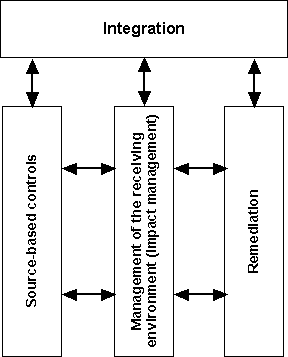
Figure 1: A functional approach to integration of pollution and waste management
Source-based controls are used to control waste
generation and discharge. By controlling waste discharges at source, this type of control
supports management of the receiving environment. In some instances, source-based controls
can be extended to prevent waste production altogether.
Management of the receiving environment (impact
management) entails anticipating threats to the environmental media and ensuring that
source-based controls are put in place to control such threats. It includes setting
ambient quality standards.
Remediation entails retroactive intervention to
achieve reversal of environmental damage. Source based controls and remediation actions
are used to achieve or monitor a specific ambient quality as required by impact
management.
4.2.6 Education and training
The government will promote the education and empowerment of
South Africa’s people with regards to integrated pollution and waste management by
increasing their awareness of and concern for pollution and waste, and assisting in the
developing of the knowledge, skills, values and commitment necessary for successful
integrated management.
4.2.7 Public participation
Public participation is considered a cornerstone for the
development of this policy. The government’s approach in this policy is to establish
mechanisms and processes to ensure effective public participation and capacity building in
integrated pollution and waste management.
4.3 Policy Principles
Policy principles are the fundamental premises government
will use to apply, develop and test policy and subsequent actions, including: decision
making, legislation, regulation and enforcement.
The overarching principles of this Draft White Paper on
Integrated Pollution and Waste Management for South Africa are those of the constitution
and Bill of Rights, as well as those adopted in the Draft White Paper on Environmental
Management Policy for South Africa (see Appendix 2).
In addition to these general constitutional and environmental
principles, the following specific principles for pollution and hazardous waste management
have been adopted:
- Transboundary Movement
Potential trans-boundary effects on human health and the environment will be taken
into account.
- Duty of Care Principle
Any institution which generates hazardous waste and which decides not to manage its waste,
is always accountable for the management and disposal of this waste.
- Universal Applicability of Regulatory Instruments
All industrial operations in South Africa will be subject to the same integrated
pollution and waste management regulatory system.
4.4 Policy Criteria
Policy criteria are norms for evaluating the implementation
of the policy principles. The following criteria will be used to evaluate the
implementation of Integrated Pollution and Waste Management policy principles:
Accessibility
Management systems and information must be accessible to all sectors of civil society.
In addition there will be access to authorities for complaints, especially at local level.
Clarity
Legislation regarding the management of pollution and waste, including regulatory
instruments (such as standards, technology, incentives and effective policing and
monitoring) will be drafted in an unambiguous manner and be understandable and accessible
to all sectors of society.
Consistency
All elements of this policy will be interconnected and interrelated to ensure that
there is no contradiction between different elements, and that policy will be formulated
and implemented on an ongoing basis and consistently through all sectors of society.
Effectiveness
All elements of this policy should work together to ensure that the results of the
management process enhance the quality of the environment.
Enforceability
Policy will be backed by effective legislation with mechanisms to enforce it.
Role of Women
Recognition of the role women can play in transforming society and building capacity
will be recognised as regards integrated pollution and waste management.
Timeousness
Subject to this criterion, decision making procedures should take place within
reasonable time frames, but not be used to restrict public participation.
Transparency
All reasons for decisions will be recorded and be available for public scrutiny.
Providing capacity-building
Resources must be provided to build capacity in both government and civil society.
- Recognition of the different status of developed and
developing countries
Where South Africa is involved in international negotiations on Integrated Pollution
and Waste Management, it will promote a position that recognises the different status of
developed and developing countries. In this regard, it will promote the concept of common
but differentiated responsibility.
5. STRATEGIC GOALS AND OBJECTIVES
This chapter sets out, in the form of broad strategic goals
and supporting objectives, the priorities for achieving the vision of Integrated Pollution
and Waste Management over the next five to ten years. These goals chart the direction the
government will follow in meeting its commitment to integrated pollution and waste
management. The chapter also introduces the concept of the National Waste Management
Strategy which will form one of the bases for translating the goals and objectives into
practice.
5.1 Achieving Policy Goals and Objectives
The overarching goal is integrated pollution and waste
management .
The intention is to move from a previous situation of
fragmented and uncoordinated pollution control and waste management to integrated
pollution and waste management and waste minimisation.
In order to ensure that this Integrated Pollution and Waste
Management policy is translated into practice, the national Departments of Environmental
Affairs and Tourism and of Water Affairs and Forestry will develop a National Waste
Management Strategy. This national strategy will deal with the problems of waste and
associated pollution. It will detail strategies and action plans and set time frames and
targets. However, many aspects of this Integrated Pollution and Waste Management policy
can be implemented without delay and it will not be necessary to wait for the completion
of the National Waste Management Strategy. These aspects will be dealt with through
existing administration routes.
5.2 Strategic Goals
Within the framework of the overarching goal of integrated
pollution and waste management, the government has identified seven strategic goals for
achieving integrated pollution and waste management. These goals are interdependent and
implementation must address all of them to be effective. It is vital to recognise that
environmental concerns and issues cut across various sectors and functions. Therefore,
integrated pollution and waste management depends on cooperation and initiatives from all
sectors of society. The supporting objectives address functions of Department of
Environmental Affairs and Tourism and Department of Water Affairs and Forestry, as well as
functions of other government departments that impact on pollution and waste management
and will require their cooperation and commitment for effective implementation.
The strategic goals and their supporting objectives, listed
under the headings of Administrative Actions and/or the National Waste Management
Strategy, address the major issues the government faces in its drive to achieve and ensure
integrated pollution and waste management.
- Goal 1: Effective Institutional Framework and Legislation
- Goal 2: Waste Minimisation, Impact Management and Remediation
- Goal 3: Holistic and Integrated Planning
- Goal 4: Participation and Partnerships in Integrated Pollution
and Waste Management Governance
- Goal 5: Empowerment and Environmental Education
- Goal 6: Information Management
- Goal 7: International Cooperation
Government has initiated a process of formulating a National
Waste Management Strategy which will include implementation strategies to give effect to
this Integrated Pollution and Waste Management policy and a number of action plans. The
strategies and action plans are set out in terms of the seven strategic goals listed
above. Action plans will be incorporated in the programme of the Department of
Environmental Affairs and Tourism which will guide the reallocation of resources. Clear
management responsibilities for the achievement of programme targets will be assigned.
5.2.1 Goal 1: Effective institutional framework and
legislation
To create an effective, adequately resourced and harmonised
institutional framework, an integrated legislative system and build institutional
capacity.
Institutional Framework
Administrative actions
- establish mechanisms to give effect to the institutional
arrangements for all spheres of government as set out in Chapter 6; and
- conduct an audit and review of existing skills, capacities,
functions and the deployment of resources in the national Department of Environmental
Affairs and Tourism and the Department of Water Affairs and Forestry and realign them to
achieve implementation of this Integrated Pollution and Waste Management policy.
National Waste Management Strategy
- establish mechanisms to set national minimum ambient or
environmental quality criteria which consider both concentration and load of pollution;
- develop uniform procedures for the setting and enforcing of
environmental criteria throughout the country;
- develop a comprehensive information system which is easily
accessible to all users and interested parties;
- develop mechanisms to encourage reductions in pollution
through a system of economic incentives, e.g. by low- and non-waste technologies;
- establish mechanisms to develop a system of incentives to
supplement the existing command and control approach;
- develop mechanisms to internalise the costs associated with
waste; and
- develop mechanisms to ensure that every effort is made to
identify the parties responsible for the damage to the environment and make them
responsible for the costs of remediation.
Standards and enforcement
National Waste Management Strategy
- establish, attain and maintain ambient standards which are
conducive to good human health and safety and which allow for sustained ecosystem
maintenance;
- develop mechanisms to set up appropriate regulations, quotas
and standards to regulate waste generation in order to promote waste minimisation;
- develop mechanisms to encourage wider involvement by all
stakeholders in agreements and partnerships, with the aim of improving pollution
prevention and waste management performance and developing and adopting best practice
standards that exceed minimum requirements;
- develop mechanisms to ensure the safe transportation of raw
materials, products and wastes to prevent accidents and spills which could adversely
affect the environment and public health;
- develop mechanisms to encourage the use of voluntary
agreements; and
- develop mechanisms to involve affected parties, environmental
groups, labour, community based organisations, non-governmental organisations, business
and industry, monitoring committees, and particularly local, regional and provincial
authorities as appropriate in the enforcement of environmental standards.
5.2.2 Goal 2: Pollution and waste minimisation, impact
management and remediation
To promote holistic and integrated pollution and waste
management through pollution prevention, minimisation at source, impact management and
remediation.
Integrated pollution and waste management
National Waste Management Strategy
- develop mechanisms to set targets to minimise waste and
pollution at source;
- develop mechanisms to prioritise pollutants requiring
prevention control by utilising a risk based approach to assess the impact on the
environment;
- develop mechanisms to set up information systems on chemical
hazards and pollution releases and the introduction of a system to track the
transportation and disposal of waste materials; and
- develop mechanisms to promote cleaner production technologies.
Media specific subsidiary objectives to be addressed through
legislative means and administrative actions:
- Water pollution management
- to manage, prevent, reduce, control and remediate surface
water pollution: including salinisation; enrichment by plant nutrients; microbiological
deterioration; sediment and silt migration; pollution due to harmful inorganic and organic
compounds; thermal pollution; acidity and various point and non-point pollution from a
variety of different land uses including infrastructure development,
industrial/mining/manufacturing, human settlements, agriculture, recreation and tourism;
and the disposal of wastes resulting from all forms of human activity;
- to manage, prevent, reduce, control and remediate groundwater
pollution: including pollutants due to the introduction of both organic and inorganic
substances; as the result of leachate from waste disposal facilities, leaking underground
storage tanks; surface impoundment; and groundwater recharge with polluted surface water;
- to manage, prevent, reduce, control and remediate marine
pollution: including oil spills; illegal dumping at sea; land-based pollution through
ocean discharge of polluted rivers, streams and sea outfalls; activities such as off-shore
exploitation of marine resources; oil gas exploration; and diamond exploitation in coastal
and deep sea regions; and
- to ensure that the quality of water required to maintain
ecological functions is protected, so that the human use of water does not individually or
cumulatively compromise the long term sustainability of aquatic and associated ecosystems.
- Air pollution management
- to manage, prevent, reduce and control air pollution:
including emissions of sulphur oxides, nitrogen oxides, volatile hydrocarbons, carbon
monoxide and dioxide as well as particulates, to maintain human health and ecological
functions at an acceptable level; and
- to manage, prevent, reduce and control air pollution from the
following specific key pollution sources: industrial and domestic fuel combustion, and
vehicle emissions.
- Land/soil pollution management
- to manage, prevent, reduce and control agricultural soil
pollution resulting from inter alia: the injudicious/over-use of fertilisers;
over-irrigation; irrigation with sewage sludge; unsustainable farming practices; and
inappropriate land use of agricultural chemicals;
- to manage, prevent, reduce and control soil pollution linked
to water quality management: including salinisation by agricultural return water and the
concomitant salinisation of irrigation soils which reduces crop yields;
- to adopt an integrated approach to soil quality management;
- to develop an appropriate policy which deals with pesticides
in an integrated manner, by taking into account the economic and development imperatives
underpinning pest control and the impact of pesticides on human health and the
environment; and
- to manage, prevent, reduce and control soil pollution problems
arising from other sources: such as the wood processing industry and wood impregnation;
waste treatment and disposal; repair shops and scrap yards; service stations; the metal
industry, and pollution from mining related activities.
Waste specific subsidiary objectives to be addressed through
the National Waste Management Strategy
Pollution and waste avoidance, prevention and minimisation to
be achieved by:
- adhering to mechanisms to ensure appropriate design
parameters, optimising operating procedures and good housekeeping for all waste generating
processes; and
- identifying mechanisms by means of risk assessment for
situations where accidents and spills can cause unscheduled waste emissions, whether it be
at a facility or during transport.
Resource recovery, recycling and re-use mechanisms for:
- reduction in the waste stream by ensuring an economic
environment which favours recycled materials;
- subsidising recycling campaigns in order to make them
economically viable;
- separation and recovery of resources as early as possible in
waste generating processes in both the commercial and domestic sectors;
- resource recovery at waste transfer stations, waste treatment
facilities and waste disposal sites;
- organised and controlled waste reclamation, as opposed to
uncontrolled picking at waste disposal sites;
- extraction and utilisation of landfill gas; and
- ensuring that all South Africans have adequate and sufficient
waste and refuse collection services.
Waste collection, treatment and processing mechanisms for:
- encouraging waste reduction and resource recovery by local
authorities;
- ensuring that wastes are appropriately treated and processed
prior to their disposal in accordance with relevant laws, regulations, standards and
guidelines; and
- rendering harmless any pollutants which may be released during
waste treatment processes.
Final waste disposal mechanisms for:
- timeous identification, investigation and development of
environmentally and socially acceptable waste disposal facilities, in a manner which
promotes the regionalisation or sharing of waste disposal sites to reduce their number;
- compliance with the relevant laws, regulations, standards and
guidelines;
- permitting waste disposal sites in terms of the Environment
Conservation Act (No 73 of 1989), Section 20(1); and
- by developing, operating and/or closing all other waste
disposal facilities, including tailings dams, metallurgical slag dumps, whether proposed,
existing or closed, in terms of the appropriate guidelines and pollution control
legislation.
Pollution remediation mechanisms
- in instances where the environment has been impaired through
accidental, insidious or intentional pollution or unacceptable waste management practices,
it must be remediated and returned as close as possible to its original state.
Hazardous waste importation
- giving effect to the requirements of the Basel, including
decision 3.1 (amendment to the Basel Convention) and Lome Conventions, and
- investigating the benefits of becoming a signatory to the
Bamako Convention.
5.2.3 Goal 3: Holistic and integrated planning
To develop mechanisms to ensure that integrated pollution and
waste management considerations are effectively integrated into the development of
government policies, strategies and programmes, all spatial and economic development
planning processes, and all economic activity.
Integrated environmental management mechanisms
National Waste Management Strategy
- to incorporate integrated environmental management principles
and methodologies in spatial development planning, as it affects aspects related to
pollution and waste management;
- to make timeous and appropriate provision for adequate waste
disposal facilities;
- to develop management instruments and mechanisms for the
integration of pollution and waste management concerns in development planning and land
allocation;
- to develop standards for pollution and waste management
systems, environmental impact assessments, monitoring and audit procedures for and
reporting of all activities including government activities that impact on pollution and
waste management; and
- to develop agreed, appropriate indicators to measure
performance in all areas of national, provincial and local pollution and waste policies.
5.2.4 Goal 4: Participation and partnerships in integrated
pollution and waste management governance
To establish mechanisms and processes to ensure effective
public participation in integrated pollution and waste management governance.
Administrative actions
- ensure that communication strategies in all spheres of
government address public participation needs; and
- allocate government resources (financial and human) to build
institutional capacity in national, provincial and local government spheres for effective
management of public participation in integrated pollution and waste management
governance.
National Waste Management Strategy
- encourage strategic alliances between government and
interested and affected parties to ensure integrated pollution and waste management and
achieve sustainable development;
- develop mechanisms to ensure public participation and
community involvement in processes relevant to Integrated Pollution and Waste Management;
- make the involvement of the public mandatory in waste
management decisions, where people will be or can be affected; and
- investigate extending the use of environmental monitoring
committees, which involve representation and participation of the public, to monitor all
waste disposal sites and other sensitive waste management projects. This strategy will
also encourage continued ad hoc monitoring by involving interested and affected
parties.
5.2.5 Goal 5: Empowerment and pollution and waste
management education
To promote the education and empowerment of South Africa's
people to increase their awareness of, and concern for, pollution and waste issues, and
assist in developing the knowledge, skills, values, and commitment necessary to achieve
integrated pollution and waste management .
Administrative actions
- integrate pollution and waste management education in all
education programmes, at all levels, in all curricula and disciplines of formal and
non-formal education in the National Qualification Framework;
- enhance integrated pollution and waste management literacy
through the use of all forms of communication media;
- promote "outreach programmes" aimed at people in
rural areas and the education of decision makers;
- ensure that integrated pollution and waste management
education programmes and projects foster a clear understanding of the inter-relationship
between pollution and waste, and of the economic, social, cultural, environmental and
political issues in local, regional, national and global spheres; and
- develop a culture amongst all South Africans to discourage
pollution and waste generation.
National Waste Management Strategy
- promote capacity building programmes and projects that assist
people, particularly those from disadvantaged sectors of society, in developing social and
organisational skills to employ local and other knowledge in assessing and addressing
their pollution and waste management concerns;
- assist small, micro and medium enterprises in developing
appropriate integrated pollution and waste management procedures;
- encourage and support the involvement of women, workers, the
unemployed, the disabled, traditional healers, the elderly and other special interest
groups in the design, planning and implementation of integrated pollution and waste
management education and capacity building programmes and projects; and
- build capacity for effective implementation of government's
national policy on Integrated Pollution and Waste Management.
5.2.6 Goal 6: Information management
To develop and maintain databases and information management
systems to provide accessible information to interested and affected parties that will
support effective integrated pollution and waste management.
National Waste Management Strategy
- establish effective and efficient information systems,
including the development of appropriate pollution indicators, to ensure informed decision
making, measure progress in policy implementation and enable public participation in
integrated pollution and waste management governance;
- strengthen and build the capacity of government to collect,
analyse and use relevant information and knowledge for integrated pollution and waste
management from all sources including formal, non-formal and traditional sources;
- disseminate information through formal and informal channels
including communication media in an accessible format;
- develop a register of pollution releases from point and
diffuse sources;
- develop a register for all waste handlers; and
- register all waste disposal sites.
5.2.7 Goal 7: International cooperation
To develop mechanisms to deal effectively and in the national
interest with international issues affecting pollution and waste.
Administrative Actions
- adopt a uniform approach to the handling of international
agreements and obligations;
- consider conventions or other instruments which are being
negotiated by an international body, as well as conventions which have been adopted
internationally, by giving due attention to:
- recognising the interest of stakeholders in formulating an
official national position to be submitted to the relevant international negotiating
forum;
- arranging the formation of a multi-sectoral committee which
will be responsible for formulating a national point of view;
- constituting national delegations which comprise government
officials, as well as all sectors of society; and
- making a recommendation to Parliament as to the accession to
an international obligation, and in the process taking the following issues into account:
- available resources to ensure implementation,
- views of stakeholders,
- benefits to the nation, and
- disadvantages to the nation.
- ratification of a convention must be followed by ensuring that
the necessary domestic legislation complies with the international obligation, as well as
promulgating the legislation prior to the entry into force of the convention where
applicable, including:
- designation of the responsible national authority or focal
point,
- publication of the full text of the convention, and
- publication of the legislation to give effect to the
convention;
- ensure South Africa acts in accordance with this Integrated
Pollution and Waste Management policy in dealing with international treaties and
agreements and that pollution and waste management considerations are included in all
relevant international negotiations;
- ensure adequate opportunity for consultation with all relevant
interested and affected parties before negotiating, entering into and implementing
international agreements;
- meet all requirements arising from international agreements
and obligations dealing with pollution and waste management; and
- cooperate internationally on common pollution and waste
management concerns, giving priority to the Southern African Region.
Contents
Chapter 1 Chapter
2 Chapter 3 Chapter 4
Chapter 5 Chapter
6 Chapter 7 Appendicies