Chapter Five: Legislative Reform
Laws Passed During 1999
Two welfare laws were passed by Parliament during 1999, namely -
- The Prevention and Treatment of Drug Dependency Amendment Bill which provided for the
establishment of a Central Drug Authority in order to implement the Drug Master Plan for
South Africa; and
- The Child Care Amendment Act, which, amongst others, provided for the establishment of
secure care facilities and for the prohibition against the commercial sexual exploitation
of children.
Regulations
Amongst others, the following regulations were passed during 1999:
- Regulations under the Non-profit Organisations Act, 1997;
- Regulations under the Social Assistance Act, 1992;
- Regulations under the Child Care Act, 1983; and
- Regulations under the Social Work Act, 1978.
Legislative Programme For 2000
It is envisaged to submit the following Bills to Parliament for adoption during the
2000 session:
- Non-profit Organisations Amendment Bill;
- Developmental Welfare Governance Bill;
- Probation Services Amendment Bill; and
- Status of Older Persons Bill.
The Department will review its mandate in 2000 to consider policy fields where new
legislation may be required.
Chapter Six: International Collaboration
International Welfare Liaison
The Department of Welfare is committed to an improved and strengthened framework for
international, regional and sub-regional co-operation for social development. The
functions of the International Liaison Desk in the department are to:
- Promote, co-ordinate and monitor the exchange of international experience in the social
sector;
- Ensure awareness of international decisions;
- Inform the policy formulation process and;
- Disseminate information on international
The Department of Welfare participated in international forums during the past year.
- The 22nd Session of the OAU Labour and Social Affairs Commission
in Namibia - April 1999. At this meeting the Department initiated discussion on the
situation of older persons in Africa.
- The UN Preparatory Committee (PrepCom) for the Follow-up and
Implementation of the World Summit for Social Development for Social Development (New
York, May 1999). In partnership with the South African Committee for Social Development a
progress report on activities in social development since1995 was submitted to the UN
Commission for Social Development.
- The 38th Session of the UN Commission for Social Development.4
From 8-18 February 2000 the Commission undertook the overall review of the implementation
of the outcome of the World Summit for social Development, and transmitted the results to
the Preparatory Committee at its Second Session in April 2000. The Department will
participate in the preparations for the UN Special Session in Geneva in June 2000.
- Ministers responsible for the follow-up and implementation of the
Copenhagen Declaration in the Southern African Region (SADC) met in Durban on 7 and 8
December 1999. The meeting was convened and chaired by Dr ZST Skweyiya, Minister of
Welfare, Population and Development.
- The SADC Ministerial Conference in Swaziland - February 9-24 2000.
Minister Skweyiya tabled the Statement of Intent for Social Development in the Region.
The Department was also represented at the following international meetings and
conferences:
- Annual Meeting of the UN Commission on Narcotic Drugs, Vienna in
March 1999
- 9th UN Congress on Prevention of Crime and Treatment of Offenders
in Vienna in March 1999
- Annual SADC Gender Ministerial Meeting in Addis Abba from 22 to 27
November 1999.
- Annual SADC Council of Ministers Meetings in August 1999 and Feb
2000
- SADC NGO Meeting in Botswana from 26-29 November 1999
- Annual Advisory Council and Executive Committee Meetings of the
International Social Services (ISS) in Rome, Italy from 23 May to 4 June 1999
- 9th International Conference on Information Technology in Social
Security in Montreal from 27-30 November 1999
- Workshop of the WHO on the Development of minimum data sets on the
situation of older persons in Harare from 20 to 22 January 2000
- Workshop and Training for Poverty Reduction in Jaipur from 14-16
November 1999
- Third African Regional Workshop of the African Gerontological
Society in Nairobi, Kenya from 12 to 16 April 1999
- African Conference on the use of children as soldiers, in Maputo
Mozambique from 19-22 April 1999
- An educational visit to Uganda, Kenya and Zimbabwe in order to
develop a bilateral partnerships in HIV/AIDS
- A study tour in Social Security in Belgium in May 1999
- A The 3rd Cohort of the Senior Executive Training Programme in
Boston from 24 July to 13 August 1999
- Copenhagen Seminar for Social Progress in Denmark from 16 to 22
September 1999
United Nations Commission on Crime Prevention and Criminal
Justice (UNCCPCJ)
A major achievement for South Africa was its acceptance as a Member State of the above
Commission in May 1999. This places SA, together with 40 other Member States at the
forefront of international development in the field of crime prevention and criminal
justice. The Department of Welfare, for the first time ever, formed part of the South
Africa Delegation to the 8th Congress in Vienna in April 1999 and ensured that the issues
of crime prevention through social development, as well as youth and restorative justice
were highlighted. South Africa also co-sponsored the resolutions relating to the latter. A
number of UN Conventions such as the Convention on the Rights of the Child and the
Guidelines for Action on Children in the Criminal Justice System. are binding on SA and
necessitates regular reporting on progress.
Chapter Seven: National Department of Welfare's Budget for 1999/2000 Year
| Item |
Amount |
1. Presentation according to programmes:
Administration |
29 407 |
Aim: To conduct overall management of the Department
Aim: To facilitate the development, implementation and monitoring of policies and
strategies for a comprehensive social security system.
Aim: To facilitate planning, research and efficiency evaluation of welfare.
| Developmental Social Welfare Services |
10 739 |
Aim: To develop and maintain relevant social welfare service legislation, policy
framework and national strategies which contributes to the well-being and competence of
citizens in relation to HIV\AIDS, disability, crime prevention, substance abuse, etc.
| Social development |
57 793 |
Aim: To facilitate the development, implementation and monitoring of policies,
strategies and regulations for community development and public private partnerships.
| Population and Development |
6 643 |
Aim: To advocate for a balanced integrated and sustainable development of the South
African population.
| Auxiliary and Associated Services |
319 |
Aim: To provide for miscellaneous payments and services
|
2. Presentation according to standard items
Personnel expenditure Administrative expenditure
Stores and livestock Equipment
Land and buildings
Professional and special services
Transfer payments
Miscellaneous expenditure Total 185 429 |
33 456
6 666
2 293
1 972
86 619
53 620
803
Total 185 429 |
3. In the Adjustment Estimate for the 1999/2000 financial year provision was made
for the following additional items that will have an effect on the National Department of
Welfare's budget:
Funds rolled over from the 1998/99 financial year:
| Improvement of the Social Security System |
87 068 |
| Child Support Grant |
15 418 |
| Criminal Justice System |
14 895 |
| Secure Care |
7 701 |
| Women (Flagship) |
2 700 |
| Victim empowerment |
4 000 |
| Poverty Alleviation |
202 950 |
| Disaster Relief Fund |
13 000 |
| Management from the Netherlands |
1 817 |
| Printing of the Annual Statistical Report |
103 |
| Research on Flagship programme |
479 |
| Printing of the National Drug Master Plan |
352 |
| Subtotal |
350 483 |
| Less suspension released in terms of Poverty
Alleviation |
10 000 |
| Additional amount received in the Adjustment
Estimate for the 1999/2000 financial year |
340 483 |
|
The total allocation to the national Department of Welfare for
the 1999/2000 financial year amounts to R 525,912 million.
A schedule on the comparative allocations for the welfare function from the 1996/97 to
the 1999/2000 financial year is attached.
Comparative Allocations for the welfare function
Spending Agency |
Voted 1996/97 |
Voted
1997/98 |
%Increase from 1996/97 |
Voted
1998/99 |
%
Increase from 1997/98 |
Voted
1999/2000 |
%
Increase from 1998/99 |
| Eastern Cape |
2,641,018 |
2,848,133 |
7.8 |
3,883,562 |
36.4 |
3,676,418 |
(5.3) |
| Northern Cape |
418,169 |
551,139 |
31.8 |
566,119 |
2.7 |
601,178 |
6.3 |
| Western Cape |
2,055,285 |
2,267,236 |
10.3 |
2,240,286 |
(1.2) |
2,192,087 |
(2.2) |
| Kwa-Zulu Natal |
3,091,383 |
3,353,698 |
8.5 |
3,985,614 |
18.8 |
3,796,905 |
(4.7) |
| Free State |
887,771 |
1,024,353 |
15.4 |
1,202,000 |
17.3 |
1,222,181 |
1.7 |
| North West |
1,026,343 |
1,095,942 |
6.8 |
1,314,950 |
20.0 |
1,397,506 |
6.3 |
| Northern Province |
1,487,084 |
1,565,772 |
5.3 |
1,819,000 |
16.2 |
2,132,705 |
17.2 |
| Mpumalanga |
705,582 |
872,013 |
23.6 |
1,090,720 |
25.1 |
1,061,417 |
(2.7) |
| Gauteng |
1,788,667 |
2,343,974 |
31.0 |
2,332,592 |
(0.5) |
2,452,427 |
5.1 |
| SUBTOTAL |
14,101,302 |
15,922,260 |
12.9 |
18,434,843 |
15.8 |
18,533,364 |
0.5 |
| NATIONAL DEPARTMENT |
79,845 |
98,438 |
23.3 |
175,397 |
56.1 |
185,429 |
5.7 |
| GRAND TOTAL |
14,181,147 |
16,020,698 |
13.0 |
18,610,240 |
13.9 |
18,718,793 |
0.6 |
Chapter Eight: Human Resource Management, Development and Strategic Planning
An integrated approach to welfare services recommends an
organisational structure where policy, strategy and legislation on welfare matters are
strongly integrated.
The Organisational Review and Business Analysis Process recently undertaken by the
Department confirms this approach. Furthermore, whatever steps are taken to enhance
service delivery have to be informed by research and scientific analysis in order to come
up with strategies based on as much objective analysis as possible.
Human Resource Development in the Welfare Sector
- The 'Re-orientation for Social Service Workers' courses were presented to 760 provincial
officials in Kwa-Zulu Natal, Mpumalanga and Northern Provinces. A total of 388 people
completed the courses and received their graduation certificates.
- In conjunction with important stakeholders a core curriculum for the re-orientation of
Social Service Workers is being finalized whereupon the responsibility for retraining will
be handed over to the provinces.
- The Netherlands Government donated R2m for capacity building programmes. Capacity
Building courses for middle and senior management were conducted for 292 participants from
national and provincial departments of Welfare.
- The ABET training for lower graded workers within the national Department of Welfare
commenced on 10 January 2000. A complement of 29 learners is being taught numeracy and
communication in English at all the different levels (1 - 4).
- Twenty trainers from the provinces will undergo social security training in identified
areas of need.
- Twenty social security personnel will be trained in general management principles.
- Planning for the training of development workers in partnership with training
institutions and the Development Workers Association is at an advanced stage. It is
estimated that about 300 development workers will be trained over a 3-year period. The
first 150 trainees will be drawn from the three provinces prioritized within the
Integrated Rural Development Strategy. The training will run within the next two years.
Human Resource management in the National Department
1. Optimal Use Of Human Resources
The recently announced ten priorities that drive the Department's response to the social
crisis will have a direct impact on the utilization of the Department's human resources.
All components will have to focus on these priorities with the result that certain areas
will have to be restructured to deliver in these ten areas.
2. New Public Service Management Framework
2.1 Where does the new framework obtain its mandate?
It begins with the 1996 Constitution and includes the Public Service Act, which governs
public administration. This act has been amended by the following legislation:
- Public Service Commission Act, 1997.
- Public Service Laws Amendment Acts of 1997,
- 1998 and 1999.
- Public Service Regulations.
- Collective Agreements.
- Management Guides.
2.2 What is this new framework about?
The new framework is a management tool designed to enable departments to make appropriate
decisions about how they can manage themselves. It is about changing the way we work in
order to provide better services to our customers, both within and outside the public
service. The focus of the framework is on delivering services as opposed to the
preoccupation with the administration of rules and regulations.
As a direct result of the new framework, the Department has commenced the process of
developing its own human resource and work organization policies and practices according
to its service delivery objectives and circumstances. The minimum requirements given in
the new Public Service Regulations assist the Department in determining its policies,
plans and practices.
3. Job Evaluation
The Regulations require departments to use job evaluation to assist them in
achieving cost-effective work organization and to determine appropriate remuneration. The
Department of Welfare has started work on job evaluation. A few job analysts and panelists
have been identified and trained.
4. Progress With Regard To The Improvement Of Representivity
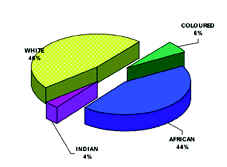
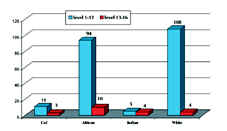
The Department made substantial progress in improving the diversity of its workforce as
far as representivity of the population of South Africa is concerned
5. A New Performance Management And Development System
The Department has embarked on a process of developing a comprehensive system
during the year 2000 that will enable managers to manage the performance of the Department
as a whole, teams and individual employees. The system will be fully implemented with
effect from 1 January 2001.
Strategic Planning and Business Repositioning
One of the functions of the Department is to ensure the business repositioning of the
Department through among others strategic planning. As required in the Public Service
Regulations of July 1999, the Department has developed a strategic plan for the period
2000/01 to 2002/03. This is in line with the 3-year Medium Term Expenditure Framework
(MTEF) of government. The Strategic Plan contains a promise from the national Department
of Welfare to its stakeholders - a promise to deliver for the benefit of the people of
South Africa. New leadership, a changing environment and shifting needs, necessitated a
varied approach to strategic planning for the Department, one that was fully informed by
stakeholder needs and expectations. The latter input was obtained from the outcome of the
National Consultative Process of the Minister, during October 1999. The Ministry has
identified priorities that must be addressed over the next five years, which are covered
in the Strategic Plan.
Representivity statistics - 1999 (Whole Department)
Representivity statistics according to salary level - 1999
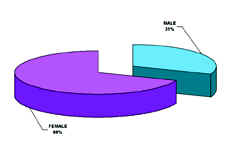
Gender Statistics - 1999 (Whole Department)
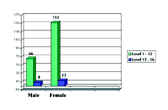
Gender statistics according to salary level - 1999
The Departmental Business Plan for 1999/2000 was developed and will pave the way to
fulfilling the promise made by the Department of Welfare, as will each annual business
plan in the 3-year cycle of the Strategic Plan. These plans will continually evolve to
meet the specific needs of different stakeholders and be adjusted to differing strategic
requirements. This will facilitate the strategic alignment of thinking and actions at all
levels for maximum impact. A system was also developed and implemented to assist managers
to monitor progress made with the implementation of the Business Plan on a monthly basis.
A system was also developed and implemented to assist managers to monitor progress made
with the implementation of the Business Plan on a monthly basis.
In order to be relevant and also be able to provide relevant services to those in need
and thus shape a better society, policy research for the Department of Welfare has become
a powerful tool. It is hoped that research undertaken by the Department of Welfare will
meet the needs of policy makers, researchers and social welfare practitioners in solving
problems they confront on a daily basis.
Achievements in the past year
- A tender was awarded to Datadesk: University of South Africa to
undertake a research study on the Phasing Out of the State Maintenance Grant (SMG). The
study began in June 1999 and is due for completion in early 2000.
- A tender was awarded to Community Agency for Social Enquiry (CASE)
to undertake a research study on the Phasing In of the Child Support Grant (CSG). The
study began in July 1999 and is due for completion in May 2000.
- A tender was awarded to Social Dimension to undertake a Welfare
Research Update. The study began in May 1999 and is due for completion in April 2000.
- Embarked on a Re-design of the Departmental Library into a
Resource Centre.
- Embarked on a research capacity building programme for the
Department.
Plans for the year 2000/2001
- On-going monitoring, co-ordination and evaluation of above
mentioned research studies.
- Development of strategies for the implementation of
recommendations from the above mentioned research studies.
- The identification and prioritisation of research to be
undertaken.
- Award of tenders for the prioritised research studies.
- On-going monitoring, co-ordination and evaluation of these
research studies.
- Continuation of research capacity building within the Department.
Chapter 9: Mobilising for a Caring Society
The National Consultation and the Ten-Point Plan
The first five years of democratic governance has laid the foundation to respond to the
social crisis facing our country. We have put in place legislative and policy frameworks
that are in keeping with the principles of the Reconstruction and Development Programme
and our constitutional mandate. However, much more needs to be done to create a caring
society.
We need a collective vision and strategy that is more responsive to the structural
causes of problems as well as their social manifestations.
To be responsive in this way means that the Department of Welfare has to mobilise our
communities to establish a caring society, based on the principle of people first for
sustainable development. As government, we will be guided by the Batho Pele (people first)
approach in creating this collective vision and strategy to respond to the social crisis,
and in transforming social welfare.
This mobilisation for a caring society began with the national consultative process in
October 1999. For six days the Minister for Welfare engaged in a dialogue with a range of
organisations representing women, children, people with disabilities, the homeless, poor
people, development workers, and professional associations.
The verbal presentations and written inputs made during this national consultative
process confirmed the analysis that the welfare system is not responding to the
fundamental social crisis South Africa is facing.
Given this situation, the Minister identified the following priorities that will be
addressed over the next five years:
- We will restore the ethics of care and human development into all our programmes. This
requires the urgent rebuilding of family, community and social relations in order to
promote social integration. Nationally we will promote a culture of volunteerism and civic
responsibility. We must begin to evolve our own methods of meeting people's needs without
transplanting foreign models.
- We will design an integrated poverty eradication strategy that provides direct benefits
to those who are in greatest need, especially women, youth and children in rural areas and
informal settlements. This will take place within a sustainable development approach.
The integrated poverty eradication strategy will include the recommendations of the
Presidential Jobs Summit as well as the expansion of the Micro-Save Programme - a
programme to strengthen stokvel-type savings and credit collectives and promote a culture
of savings.
- We will develop a comprehensive social security system that builds on the existing
contributory and non-contributory schemes and prioritises the most vulnerable households.
Such a system must reduce dependency on non-contributory cash payments and give
consideration to food security. Work on the feasibility of a basic income grant is being
fast tracked. A new welfare payment and information service will be established to improve
the administration of social grants. We will also work with other government departments
such as Home Affairs to ensure that the birth of every child is registered so that
services such as the Child Support Grant, education and health services can be accessed.
- We must respond to the brutal effects of all forms of violence against women and
children as well as effective strategies to deal with the perpetrators. An advocacy
campaign to highlight the role of men in preventing violence against women and children
will be launched. The department will also strengthen services under the Victim
Empowerment Programme of the National Crime Prevention Strategy.
- Our programmes will include a range of services to support the community-based care and
assistance for people living with HIV/AIDS. Particular attention will be given to orphans
and children affected by HIV / AIDS. We are finalising a National Strategic Framework for
Children Infected and Affected by HIV / AIDS as a priority.
- A national strategy will be developed to reduce youth criminality and youth unemployment
within the framework of the National Crime Prevention Strategy. Together with the National
Youth Commission and other organisations, we will support the initiative for a national
youth service programme that is developmental for youth and communities.
- We will make social welfare services accessible and available to people in rural,
peri-urban and informal settlements, and ensure equity in service provision. This is
critical as no woman or child should be so powerless as to believe that murder or suicide
is the only option. The welfare financing policy will be refined with a clear focus on the
re-direction of resources to under-serviced areas.
- We will redesign services to people with disabilities in ways that promote their human
rights and economic development. We will support and advocate for the appropriate
production and supply of assistive devices. The ratification of various international
instruments will be completed and programmes to ensure access to information for people
with disabilities will be undertaken. The Department will work with people with
disabilities to ensure that their needs are met without further marginalising them.
- All our work must be based on a commitment to co-operative governance that includes
working with different spheres of government and civil society. The Department will work
in partnership with communities, organisations and institutions in civil society. As first
step, the national consultation process will be continued as a dialogue with and report
back to the sector and citizens.
The national department will create a framework for provincial MECs and local structures
to carry out this strategic vision and mandate. After all, our performance nationally
depends on effective service delivery by provincial and local officials.
- We must train, educate, re-deploy and employ a new category of workers in social
development to respond to the realities of South Africa's crisis. This includes the
re-orientation of social service workers to meet the development challenges of South
Africa and link these to our regional and global demands.
The National Population Unit will be strengthened as a support unit to help all government
departments take cognisance of the key challenges as reflected in national data, such as
HIV / AIDS rates, and to build a shared set of indicators on key development issues.
These priorities will form part of a systematic, co-ordinated strategy for social
development over the next 5 years. It will be linked to the department's medium term
expenditure framework. In addition the plan will involve the mobilisation of national and
inter-national resources, including the use of a wider pool of technical expertise.
Linkages with other programmes of government will be consolidated to integrate the work
of the Department of Welfare into these programmes. Particular focus areas will be the
Integrated Rural Development Strategy, the National Plan of Action for Children, the work
of the Office on the Status of People with Disabilities and the Office on the Status of
Women.
We need to move quickly at all levels to link social development and population
concerns to economic strategies so as to establish socially integrated and caring
communities.
STATUS OF DISASTERS THAT OCCURRED BETWEEN AUGUST 1999 AND
FEBRUARY 2000
All disasters that occurred prior to August 1999 have been
finalised in terms of the Fund Raising Act, 1978.
Eastern Cape Province
In August 1999, veld fires ravaged the magisterial district of Mount Frere, destroying
a number of homes, livestock, and grazing land. Theses areas were declared disaster area
in terms of the Fund Raising Act, 1978.
Action taken
- The provincial welfare department provided short term social
relief to the affected communities.
- About 500 application forms for assistance form the Disaster
Relief Fund have been processed and cheques are currently being issued.
Western Cape
In August 1999 a tornado struck Western Cape areas of Mannenberg, Guguletu and Surrey
Estates. The tornado caused untold suffering and damage to people's lives and property.
These magisterial districts were declared as disaster areas.
Action taken
- Heavy floods affected KwaZulu-Natal between the period 18 to 20
December 1999.
- The province is still assessing applications for assistance from
the Disaster Relief Fund.
Mpumalanga and Northern Province
Heavy rains that fell over Mpumalanga, Northern Province, since 6 February 2000, left a
trail of destruction amounting to hundreds of millions of rands. The total amount of
damaged is still being assessed. Roads and bridges were washed away and houses crumbled
due to flooded rivers. Thousands of people have been cut off from food supplies, left
destitute and a number of fatalities have been reported.
The destruction of water purification plants and the sewerage systems has heightened
the possibility of the outbreak of diseases such as typhoid, cholera and malaria. The
ordinary activities within communities have been disrupted. Roads leading to homes have
been destroyed beyond recognition.
Certain areas in the Northern Province and Mpumalanga have been declared as disaster
areas by the President in terms of the Fund Raising Act, 1978. One area in Mpumalanga was
declared as a disaster area by the Minister for Provincial and Local Government in terms
of the Civil Protection Act, 1977.
Northern Province
Action taken
- The Department of Health and Welfare is the leading the
co-ordination of the provision of the social relief programme.
- From the Welfare budget, 8 067 food parcels at a total of R1 102
161-00 were purchased.
- A sum of 1 600 additional food parcels were purchased from the
provincial disaster relief Fund created by the Premier.
- Thus far over 9 667 food parcels have been issued.
- The Department of Welfare personnel, assisted by the SANDF, are
involved in the distribution of foodstuffs, medicines and other items to affected
communities.
- Social workers are actively involved in identifying and assessing
cases of need amongst individuals and families and providing counseling.
Mpumalanga
The magisterial districts of Nelspruit, Nkomazi and Nsikazi were declared as disaster
in terms of the Fund-Raising Act, 1078. Mpumalnaga has suffered extensive damages to
roads, bridges and houses.
Action taken
- National Department officials visited Mpumalanga on 23 to 25
February to conduct training for social workers and assist with the establishment of local
committees and distribute application forms for assistance from the Disaster Relief Fund.
- 20 000 application forms for assistance, in terms of the Fund
raising Act, 1978, are being distributed to affected individuals.
- The National Department has employed four contract workers to
assist with processing of the application forms for these disasters.
- Welfare offices in the Provinces serve as delivery and collection
points for donations.
Long term plans
- The Department in conjunction with the provinces will be
conducting training of officials in disaster co-ordination within the sector in all the
nine provinces.
- Permanent local committees will be established in the provinces
and be trained to fast track the process of the provision of disaster relief and
counselling to victims.
- An information brochure will be created, that explains up to the
actual distribution of funds to victims. The document will be available to the public.
Appeal to the
people of South Africa
Dear Friend
We write to you to appeal for your support and that of your
organisation for the Government's efforts to promote Humanitarian assistance to the people
of Angola.
The Government took a decision on September 15 last year to appeal to
South Africans to contribute towards this effort because of the serious humanitarian
situation in Angola as a result of the prolonged war situation in that country.
An inter-departmental committee to co-ordinate activities of this
effort has been set up and meets regularly every two weeks at the Department of Welfare.
The Committee is organising an Angola Focus Week from May 15 to May 23
(Africa Day), and we urge you support activities during this period.
Government has also established the Humanitarian Assistance to the
People of Angola Fund as a non-profit humanitarian fund, in terms of the Non-Profit
Organisations Act of 1997. A bank account has been opened to receive donations from the
public and others. It is ABSA account number 40-5115-2214.
Please make donations to this fund, and let us know with a letter that
you have done so. We appreciate your support and co-operation.
If you have any questions regarding the Angola Appeal, please do not
hesitate to write or call. The numbers you can call are (012)
312-7775 or 0828089486 or fax (012)
323-8336 or e-mail wels027@welspta.pwv.gov.za
With kind regards
DR ZST SKWEYIYA (MP)
MINISTER FOR WELFARE, POPULATION AND DEVELOPMENT |
Contents