The higher education institutions that were inherited by democratic South Africa have their roots in an apartheid social order. Some institutions unreservedly served the apartheid government's goals and policies. Others protested against racism and the creation of racial and ethnic institutions. Yet other institutions challenged and actively resisted the social purposes that were defined for them by apartheid planners and attempted to elaborate new purposes linked to democracy and social justice. In a number of areas, the higher education system developed real strengths, whether in relation to knowledge production and application, co-operative education or producing graduates that compare with the best in the world. However, overall, the inherited system is not effectively responding to the new needs of the country and it is essential to reconfigure it to serve the new democracy.
The country requires institutions with particular social mandates and a diversity of institutions with different and distinct missions. The heart of the system must be well-resourced high-quality predominantly undergraduate teaching institutions oriented towards the production of graduates with the knowledge, competencies and skills to contribute to the economic and social development of the country. Institutions with this mandate must constitute the bedrock of the higher education system. Excellence and the quality of the graduates of these institutions will fundamentally determine whether South Africa will grow, develop and create a better quality of life for all its people.
South Africa will not be unique in reconfiguring and reconstructing its higher education landscape. Higher educational reform and the re-organisation of higher education systems have occurred and continue to occur in countries throughout the world. Impetus for reorganisation arises from significant changes in national conditions and/or momentous world-wide changes that impact on the economy, labour market and society more generally and have major implications for the requisite knowledge, competencies and skills base of graduates and the production and application of knowledge.
The role of the nation state in creating an innovative society is crucial to the well being of citizens in the information age1. There is overwhelming evidence that in developing integrated market economies, the strategic role and interventions of the state must balance market forces. Such interventions must establish the institutional, infra-structural and interlocking policies and instruments that are needed to underpin both equitable social development and successful incorporation into the global economy.
A number of government departments are contributing to an institutional and policy environment to facilitate growth and development through cross-sectoral state policy co-ordination, partnerships and co-operation. The Department of Trade and Industry (DTI) is implementing policies to simultaneously stimulate export-led growth and opportunities for labour intensive growth and marginalised small, medium and micro enterprise. The Department of Labour has introduced an ambitious Skills Development Programme which, through the establishment of Sector Education and Training Authorities (SETA), seeks to enhance skills development through education and training. The Department of Education has advanced policies that emphasise institutional 'responsiveness' and 'relevance' to local economic and social needs. The Department of Arts, Culture, Science and Technology (DACST) is building a National Innovation System (NIS). The Presidency, together with the Departments of Labour and Education, is focusing on the development of a national human resource strategy. Higher education must participate in, respond to and ultimately help give effect to the development of an integrated and co-ordinated human resource development strategy.
Chapter Two made the case for higher education as a potentially powerful contributor to, and necessary condition for, achieving the goals of social equity, economic and social development and democracy. The national system must respond to the requirements of a society emerging from a long history of structural inequality and underdevelopment. It must respond to the challenges of social, economic and cultural development and encompass development across a broad range of areas of knowledge1. Higher education's primary role is to develop the intellectual and skills capabilities of our society to address and resolve the range of economic (including labour market), social, cultural, political and other challenges faced by society. It must do so at a national, regional and local level as well as contribute to the development of the continent. Higher education must also play a central role in meeting the difficult realities of international competition under the new conditions of globalisation.
Internally, the higher education system must strive to achieve equity and aspire to excellence, which is essential to the achievement of meaningful equity. It must also be committed to achieving significant improvements in the quality of higher education teaching and learning, research, community service and innovation.
There are many positive features of the South African higher education system - widespread commitment to equity and excellence and improvements in quality, innovative programmes and learning and teaching, quality of research outputs etc.
Reform and innovation are continuous processes. Changing environments - national and international, internal and external to higher education - require timely and flexible institutional responses. While the White Paper provides a powerful and robust framework for the transformation of higher education, it did not, and could not, anticipate a number of conditions and developments. These include:
These conditions threaten important policy goals and require an immediate response. South Africa cannot continue to function on the basis of an inefficient, fragmented and unplanned set of institutional roles. No single institution has the capability to achieve all that is expected of higher education as a system. The White Paper calls for a coherent, co-ordinated and integrated national higher education system that is simultaneously differentiated and characterised by diversity. This is no contradiction. A coherent, co-ordinated and integrated national system need not be a uniform system. Indeed, uniformity in South Africa's circumstances is highly undesirable.
The terms 'differentiation' and 'diversity', as employed by the Task Team, are both distinct and connected. 'Differentiation' is used to refer to the social and educational mandates of institutions. The mandates orient institutions to meet economic and social goals by focusing on programmes at particular levels of the qualification structure and on particular kinds of research and community service. Qualitative and quantitative criteria (minimum student Full-time Equivalents [FTEs], minimum enrolments in broad fields, staff qualifications and research output, etc.) underpin the mandates of institutions. 'Diversity' is used with reference to the specific missions of individual institutions. Differentiation and diversity are connected in that mandates provide the overall national framework within which individual institutions pursue specific institutional missions. To ensure diversity, the missions of individual institutions must be varied.
The goal is a differentiated and diverse but also integrated and co-ordinated system. Articulation between institutions with different mandates and different missions to ensure student and staff mobility, enable teaching and research collaboration and promote partnerships must be an integral feature of the new reconfigured system. Mechanisms for articulation cannot be voluntary in nature and only depend on the goodwill of individual institutions, administrators and academics. They must be a structural feature of the new system.
Differentiation and diversity are necessary for a number of reasons. First, nothing is gained through a homogenous and uniform system in which all institutions have exactly the same mandates and missions and seek to be the same in all respects. Nor does homogeneity and aspirations to sameness result in institutional equality. Second, a differentiated and diverse system will over time enable certain critical outcomes that are strongly related to achieving quality higher education, ensuring more meaningful equity for historically disadvantaged students, enhancing the efficiency and effectiveness of the system, and meeting development needs of society. These critical outcomes would be:
Achieving a more rational landscape than the incoherent, wasteful and uncoordinated higher education system inherited from the past by defining overall mandates for institutions within which diversity is encouraged through explicit, clear and coherent institution-specific missions. Such a new landscape would enhance the investment of public resources to deliver quality and equity.
One definition of quality in higher education is fitness for purpose in the context of missions. This would enable the quality assurance system to make better judgements about institutional fitness for purpose as a result of the clearer demarcation of institutional purpose in place of the diffuse spread of purposes across institutions.
Goals and objectives of higher education can exist in a distributed way across the entire system to enable a more appropriate allocation of resources in a rational landscape for higher education.
One example illustrates this. At the moment the goal of providing market-responsive training receives more explicit attention than the goal of contributing to cultural and civic life. This is squeezing out the humanities, particularly at historically disadvantaged institutions. A reconfiguration would create legitimate spaces and support for knowledge disciplines and fields in the humanities and social sciences threatened by parochial and crude interpretations of what the market requires. Informed business and union leaders suggest that with respect to employment the field of study is only one consideration. A key consideration is the quality of the graduate.
After an iterative process between the Department of Education and individual institutions, the range and level of programmes and qualifications that an institution should offer through focused institutional mandates and specific missions must be identified. This would concentrate attention, energy and resources on a more limited range of purposes and outcomes. It will also enable the more effective and efficient utilisation of physical and human resources.
Quality assurance can then target programme improvement in a strategic way within single or across multiple institutions. Given limited financial resources and the small number of academics with advanced qualifications and research experience, it makes little sense from a quality assurance point of view to have all higher education institutions offering, for example, doctoral level (or perhaps, even masters level) studies in all fields.
The prospects of increasing overall participation levels in higher education will be greater since a diverse system in which institutions orient themselves towards different social and educational needs and purposes will enable different and more flexible criteria for admission. This will also provide much greater levels of access to school-leavers and mature learners.
Active policies are needed to develop a more diverse student profile at every institution. The student population should be consciously drawn from diverse backgrounds defined by 'race', socio-economic origins, gender, age and other social characteristics. There are good educational and social reasons for such policies of 'constituting the class'. It also provides practical ways to address the equity of access challenge for higher education institutions. Institutions should be required to incorporate into their planning quantitative targets to ensure adequate representation of African students, women and students from working class and rural poor backgrounds. In addition, consideration should be given to including a target for international students, particularly from the African continent.
Providing a focused framework for knowledge production and application and innovation is better achieved in a reconfigured and rational landscape for higher education. Innovation in teaching and learning, research and community service will occur through a concentration of resources and attention on niche areas rather than across all areas within the system. The quality assurance system cannot be satisfied with minimum standards only. It must also facilitate the excellence that will yield innovation as well.
It will provide for and encourage different modes of teaching, learning and assessment. At the same time it will also establish the parameters - possibilities and limitations - of different modes of delivery (different forms of contact and distance) for different institutional focuses. This will help to address the unregulated and unfortunate manner in which institutions are currently establishing satellite campuses and tuition centres and moving into the distance education arena.
It will provide an acknowledged framework for competition as well as collaboration within the public sector, as well as between the public and private higher education providers. Some types and levels of competition can enhance quality. Unrestricted competition, however, could damage public institutions and programmes whose capacity is being strengthened within a reconfigured system.
Perceptions and uninformed notions will exist about the social and educational status, excellence and quality of institutions with different mandates and different specific missions. These must be vigorously addressed. The purpose of differentiation and diversity is to ensure a range of institutions, institutional programmes and capabilities appropriate to national need.
Differentiation and diversity must not undermine the development of an integrated and 'seamless' national system. There must be continuities, permeability and articulation between institutions regardless of individual missions and effective mechanisms to overcome barriers to articulation. Mechanisms to ensure student mobility and staff collaboration and mobility between institutions must be put in place so that life-long learning and horizontal and vertical mobility are all enhanced. Focused projects that enable learning that has occurred in non- formal contexts to be considered for entrance to higher education programmes - for example through 'Recognition of Prior Learning' - should be promoted. The system of accreditation and quality assurance, the national qualification structure and national planning processes must reinforce articulation.
The extent to which the higher education system will evince high levels of diversity and differentiation to serve South Africa's diverse needs is dependent on policy intervention and effective steering. It will not occur on its own or through the 'market'.
A range of institutions with different institutional mandates based on different orientations and foci are necessary to achieve the diversity of social and educational goals, purposes, roles and outcomes. Institutional mandates provide a framework for individual institutions to formulate the specific institutional missions and strategies that would ensure diversity.
This section sets out the key characteristics that should define institutions with different mandates. Institutions are further described on the basis of orientation and foci.
The knowledge economy and complex societal problems require inter-disciplinary and multi-disciplinary knowledge production and graduates that possess a range of competencies and skills. The production of graduates as critical citizens vital to a democratic society also requires education and training that is not narrow but spans and incorporates various disciplines and fields. Public higher education institutions should be multi-purpose institutions and offer broad-based higher education to achieve the goals set for higher education. Programmes should not be concentrated in only one or two broad areas of study. This would enable institutions to accommodate newly developing areas of study, which in many cases arise from the combination of existing knowledge areas, more easily in their learning programmes.
Single purpose institutions generally tend to be expensive and unable to subsidise expensive programmes. A large number of single-purpose institutions would also not be appropriate given the already existing inadequacies in higher education management capacities and skills.
Higher education institutions are primarily concerned with advanced levels of learning. The principal aim normally is to develop increasing levels of intellectual maturity in learners to enable them to contribute to the creation of new knowledge and to new applications of knowledge. To meet this and other higher educational goals, as well as for reasons of economic viability, institutions should have a minimum operational basis. This is usually expressed in terms of the size of institutions, using the measure of the number of FTE enrolled students. Academic viability as a multi-purpose institution requires that student enrolments in public institutions should not be concentrated in a single broad area of study but should be spread over a number of broad areas of study. In South Africa it has proved useful to distinguish between the following broad areas of study: Humanities and Social Sciences (including Education), Business and Commerce, and Natural Sciences, Engineering and Technology (SET). This is expressed as the shape of institutions.
Distance education institutions do not generally offer many learning programmes in engineering and the natural and health sciences due to the intensive laboratory/practical components associated with such study. Typically, distance education student enrolments would be concentrated in the Social Sciences, Humanities, Education and Business and Commerce. Special consideration would have to be given to these institutions in applying this criterion.
Some countries have expressed the characteristics concerning academic and economic viability quantitatively. In Australia, for example, institutions were required to make applications to join the unified national system (UNS) and qualify for federal funding on the basis of Equivalent Full-time Student Units (EFTUs). The required institutional size for membership of the UNS was 2000 EFTUs. The required institutional size to have a broad teaching profile with funding for some research activity was 5000 EFTUs. The required institutional size for comprehensive involvement in teaching and research was 8000 EFTUs.
In 1994, the Higher Education Quality Council of the United Kingdom established various quantitative criteria for institutions to be recognised as universities. These included a higher education student enrolment of at least 4000 FTEs, an enrolment of at least 3000 FTEs on degree level courses, and an enrolment of at least 300 FTEs in degree level programmes in each of five different academic subject categories. In South Africa, the Minister of Education recently determined that colleges of education with a student enrolment of less than 2000 FTEs would have to be incorporated into a university or technikon.
A goal of higher education is to contribute to the creation, dissemination and evaluation of new knowledge and to contribute towards finding new applications of knowledge. This is normally achieved through high-level intellectual enquiry and research. The generation of new knowledge and its evaluation is an activity subject to national and international norms and standards through the generally accepted mechanism of peer review. Involvement in research therefore makes heavy demands on higher education institutions with respect to the qualifications and quality of staff, research infrastructure, the quality and availability of post-graduate students, the quantity and quality of research outputs, etc. These requirements make it impossible for South Africa to sustain an adequately resourced extensive and high-level research capability and involvement at every higher education institution on an efficient and effective basis.
High-level research requires appropriately qualified staff. The ability of institutions to conduct high-level research is usually measured by the number of staff possessing doctorates - the doctorate serving as an indicator of being able to conduct independent research and supervise high-level research. The guidelines of the Australian Vice Chancellors Association (AVCC) state that to operate as a university, at least 25% of all academic staff should have a relevant doctorate and some research experience. An institution's high-level research ability is generally also measured in terms of the refereed research outputs of its academic staff members. The AVCC suggests an average of 0.5 refereed publications per annum per FTE academic staff member. Since research in higher education institutions also draws on post-graduate students, extensive and high-level research involvement would also require a sufficient FTE student enrolment at the masters and doctor's degree levels. In both the Australian and New Zealand systems, benchmark levels are set for such postgraduate enrolments.
It is useful to draw on the characteristics noted above. With appropriate modifications that are sensitive to conditions of the present South African higher education institutional landscape, they are used later in proposing what should be the key features that characterise institutions with different mandates. The question of the characteristics that should be used for social and educational reasons to promote the development of certain historically disadvantaged institutions is addressed in the following chapter.
Having made the argument for differentiation and diversity, the Task Team recognises that there are two outcomes that must be avoided. The first is to spread all the purposes and functions of higher education so widely that the higher education system becomes characterised by homogeneity rather than differentiation and diversity. The second outcome is creating a new landscape that is, or is perceived as, characterised by 'poor quality' and 'high quality' institutions. A new differentiated system cannot produce ghetto and privileged institutions and also reproduce the apartheid institutional configuration.
The Task Team proposes that over a period of time and through an iterative process within the framework of the national and institutional planning processes, the country should strive to achieve institutions with the following broad mandates, predicated on principal orientation and core focus.
The future political, economic and social well-being of South Africa is crucially dependent on the quality of the first degrees and diplomas of graduates. To this effect, the country critically requires as the bedrock of its higher education system institutions that are dedicated to predominantly undergraduate teaching. Such institutions should constitute the foundation of the higher education system and also the great majority of institutions in South Africa. They should be well-resourced to undertake their vital responsibility of providing undergraduate programmes of high quality to the great majority of learners in the system and producing graduates with the knowledge, competencies and skills needed for economic and social development.
Institutions that focus on excellence in undergraduate teaching programmes are fundamental to any prosperous society but are also critical to the transformation of the current higher education system. They are crucial in ensuring equity and redress through increasing and widening participation based on appropriate admission requirements and quality and standards. Since these institutions will face the challenge of providing not simply access but also equity of opportunity on a large scale, they will have to be provided with resources to address the specific needs of under-prepared students through academic support and development initiatives.
The geographic location of these institutions must ensure that learners from both urban and rural areas are able to access higher education provision. Unlike under apartheid, when the remote rural location of some institutions imposed various limitations, location must now be put to use to strengthen equity and to contribute to both urban and rural development needs through appropriate community service programmes.
Such institutions would function as multi-purpose institutions operating across a broad range of learning areas. They should achieve pre-eminence in various undergraduate programmes, particularly those that are for specific professions and career-oriented. The vital role that the current technikons play in co-operative education and producing technically competent and skilled diplomates in a range of science, engineering and technology fields should be expanded and enhanced. In cases where institutions apply the practice of co-operative education, this should be valued and adequately resourced.
These institutions should also offer limited postgraduate programmes up to a taught masters level in alignment with their capabilities and institutional missions. Excellence in undergraduate learning and teaching would provide graduates access to the more extensive range of postgraduate teaching and research programmes of institutions with different mandates.
Institutional research focus should be largely on improving curriculum, learning and teaching and enhancing the quality of graduates. Academics with research capabilities will continue to have access to research funding through the science councils. Collaborative research relationships with academics from other institutions must be facilitated.
In essence, the orientation and focus of such multi-purpose institutions would be, in alignment with the institutional mission, the provision of:
- Quality undergraduate programmes.
- Limited postgraduate programmes up to a taught masters level.
- Research related to curriculum, learning and teaching with a view to application.
'Constituting the class' in these institutions will entail special attention to the 'race' and gender of students, access for learners with disabilities and from working class and rural poor backgrounds, the incorporation of continuing education students and mature learners through flexible entry requirements, including the 'Recognition of Prior Learning'. Institutions with this orientation and focus must be encouraged to build strong links with the schooling system, further education and training institutions and the world of work. Equity of access and opportunity depends on working with schools and other institutions to ensure greater levels of academic preparedness on the part of learners for the demands of higher education and training.
Innovative partnerships with further education and training institutions could contribute to building a high quality SET sector and enable more students to enter higher education. They should be encouraged to give special attention to facilitating access for learners through recognition of prior learning initiatives and continuing education programmes. There should be a consolidation of the links that presently exist between the technikons and business and industry to ensure responsiveness to economic needs. There should also be a focus on local and regional development needs through partnerships with local and provincial governments, communities and trade unions.
In view of the earlier arguments concerning the academic and economic viability of institutions, institutions with such an orientation and focus should consist of at least 4000 FTEs. In addition, student enrolments should be spread over the three broad fields of study: humanities and the social sciences, commerce and SET and should not be highly concentrated in only one or two of these broad areas of study. Institutions wishing to have a strong technological learning orientation would need to have a minimum of 25% student enrolments in SET.
Many countries have institutions which play the role described above with distinction. Such institutions are regarded as highly prestigious in their own right because of their critically important contribution to meeting particular social and educational objectives.
Since these institutions are fundamental to the social needs of the country, they must be accorded their proper social value and their contributions duly acknowledged. To enable them to discharge their important social responsibilities they must be provided with the necessary resources to undertake academic support and development activities, promote quality improvements, reward excellence in teaching and become institutions of first choice for the vast majority of learners.
Multi-purpose institutions with this mandate would, in terms of their orientation and focus, provide both undergraduate programmes as well as a comprehensive range of quality taught and research postgraduate programmes. Their social value would be to produce high-level graduates and knowledge producers and to ensure that in an environment of high levels of international competition between countries, South Africa maintains an appropriate degree of high-level research capabilities related to the production and application of new knowledge and technologies. At the same time, the capabilities must also be turned towards an engagement with the concrete economic and social development problems of South Africa, the Southern African region and the African continent.
No countries can institutionalise postgraduate teaching and high-level research in a comprehensive way in every one of its higher education institutions. The constraints of available human and financial resources preclude this and permit the development of only a limited number of institutions with such a mandate. There would need to be dedicated funding for postgraduate teaching and research. However, this will not necessarily be across the board for it cannot be assumed that postgraduate teaching and research capabilities will exist in every field and discipline at every institution. Institutions will be subject to accreditation processes and quality assurance procedures to access public funding.
In essence, the mandate of such multi-purpose institutions would be, in alignment with the institutional mission, the provision of:
- Quality undergraduate programmes.
- Comprehensive postgraduate taught and research programmes up to the doctoral level.
- Extensive research capabilities (basic, applied, strategic and developmental) across a broad range of areas.
In producing new generations of high-level knowledge producers of national and international standing, these institutions must be fully cognisant of the inherited social relations of knowledge production in South Africa that results in knowledge production being the preserve primarily of white and male South Africans. They must be held tightly accountable in ensuring that this pattern of knowledge production is eroded and transformed in all disciplines and fields through high-level education and training opportunities to expanding numbers of black and women South Africans.
In collectively offering a comprehensive range of taught and research postgraduate programmes, these institutions must also ensure that they produce increasing numbers of high-level black and women graduates that are equipped to occupy positions in the public and private sectors and academic positions in higher education institutions. Thus, they have the social responsibility of contributing to transforming the inequitable predominance of white and male South African as academics in research and development establishments and at senior levels in the private and public sectors.
Constituting the class will be a special challenge of these institutions if they are not to become the preserves of solely white and Indian students and students from upper middle-class and wealthy backgrounds. Serious attention will need to be given to access and opportunities for African and Coloured students, students from working class and rural poor families and adult learners.
Until conditions in schooling are considerably improved, these institutions will require resources for academic support and development initiatives in key fields, particularly in the broad areas of Natural Science, Engineering and Technology and Business and Commerce. They should also be encouraged to seek donor and private sector support in this regard.
These institutions have, especially at postgraduate levels, the potential to attract greater numbers of international students, particularly from sub-Saharan Africa and parts of Asia. The appropriate infrastructure should be put into place to promote the internationalisation of the student body. Such a process would be the yeast to enhance excellence in higher education as well as to mobilise extra resources. Long-term relationships promoted through higher education contact have proved to be invaluable in promoting life-long intellectual, social and economic collaboration.
To realise their potential and become integral elements of the national innovation system, such institutions would need to pursue strong partnerships with the science councils, private sector research and development establishments, industry, and continental and international academic and research institutions. Dense networks should be created through which there could be flows of academics, researchers and postgraduate students between higher education and other institutions. This would also enhance the potential of higher education institutions to contribute to the ongoing development of practising professionals.
These institutions must not be permitted to exist as islands with no connection to institutions with other mandates. Articulation mechanisms must enable students with the requisite qualifications from institutions with alternative mandates to enter these institutions. There should be funding incentives to promote research collaboration with academics from institutions with other mandates. Finally, academics based at institutions with different mandates that have recognised specialist expertise in particular disciplines and fields should have the opportunity for collaboration through research funds awarded on merit to them as individuals.
Diversity would be encouraged to obviate homogeneity. This should be reflected in specific institutional missions, undergraduate programme offerings, taught and research postgraduate offerings up to the doctoral level, a variety of community service and linkages with the external environment.
To ensure the academic and economic viability of these institutions, they should consist of at least 8 000 FTEs. In addition, student enrolments should be spread over the three broad fields of study in the following way: a minimum of 15% enrolments in Humanities and the Social Sciences, 10% in Commerce and 25% in SET. Institutions wishing to have a strong technological learning orientation and be regarded as technological higher education institutions would need to have 50% of their enrolments in SET.
To achieve the research-related goals, a minimum of 10% of FTE enrolments should be at the masters and doctoral level. At least 40% of academic staff should have relevant doctorates. In addition, average annual research outputs per academic staff member should, in terms of the Department of Education's research output system, be not less than 0.5 units.
Multi-purpose institutions with this mandate would, in terms of their orientation and focus, provide both quality undergraduate programmes, an extensive range of postgraduate programmes up to the masters level and selective doctoral programmes.
In essence, the orientation and focus of these multi-purpose institutions would be, in alignment with the institutional mission, the provision of:
- Quality undergraduate programmes.
- Extensive postgraduate taught and research programmes up to the masters level.
- Selective postgraduate taught and research programmes up to the doctoral level.
- Select areas of research (basic, applied, strategic and development).
A limited number of institutions with such an orientation and focus are necessary to prevent the overall system from becoming excessively rigid and to provide necessary flexibility. These institutions would share social purposes and roles and, thus, various characteristics with the institutions whose mandates have been defined above. For example, in common with institutions with mandates to function as predominantly undergraduate teaching institutions, academics with research capabilities at these institutions must continue to have access to research funding through the science councils and must be enabled to enter into collaborative relationships with academics from other institutions. Similarly, in common with institutions with mandates to function as comprehensive predominantly postgraduate institutions, there must be articulation mechanisms to enable students with the requisite qualifications from institutions with alternative mandates to enter these institutions. Moreover, funding incentives should exist to promote research collaboration with academics from institutions with other mandates.
However, in contrast with institutions with mandates to function as comprehensive postgraduate institutions, the responsibilities of these institutions, with respect to knowledge production, production of high-level knowledge producers and graduates for the academic and other professions, would be more limited in scope.
For reasons related to the academic and economic viability of these institutions, they should consist of at least 6000 FTEs. In addition, student enrolments should be spread over the three broad fields of study in the following way: 25% in the Humanities and the Social Sciences, 10% in Commerce and 15% in SET. Institutions wishing to have a strong technological learning orientation would have to have 30% of their student enrolments in SET.
In order to achieve the research related goals a minimum of 5% of FTE enrolments should be at the masters and doctoral level while at least 20% of academic staff should have doctorates. In addition, average annual research outputs per academic staff member should, in terms of the Department of Education's research output system, not be less than 0.20 units.
There would need to be a diversity in specific institutional missions, undergraduate programme offerings, taught and research postgraduate offerings up to the masters level, selective doctoral level programmes, basic and applied research, and community service and linkages with the external environment. This would obviate homogeneity. 'Constituting the class' at these institutions would entail considerations of a similar nature to that of institutions with comprehensive postgraduate mandates.
There is debate around the usefulness of depicting provision as 'contact' and 'distance' and the dichotomy between 'contact' and 'distance' as modes of education delivery. It is suggested that while historically the distinction was useful and facilitated the establishment of innovative responses to education problems, it has outlived its usefulness. Reference is made to the wide diversity of practices within institutions that challenges the traditional dichotomy of 'distance' and 'contact' education. It is also argued that South Africa's traditionally contact institutions now evince a growing diversity of education - telematic education, flexible learning, reduced contact and mixed mode - that are all clustered under the catch-all phrase of 'distance' education.
Although these new initiatives all utilise 'distance' education strategies, it is difficult to categorise them as either 'contact' or 'distance' programmes. There could be a need to introduce the notion of a continuum of education provision for planning purposes. This continuum would have as two poles, provision purely at a distance and provision that is solely face-to-face. In reality, all education provision could increasingly exist somewhere on this continuum. The crucial issue is the nature of learning, and the social and educational value of a programme's content.
These developments are also related to the exponential growth of information and communication technologies, which have created opportunities for a variety of educational delivery strategies. These technologies should be harnessed to improve the quality, flexibility and cost effectiveness of provision. However, while these developments are largely positive, there are negative features that require some regulation. At the same time the costs of the new technologies should not be underestimated and their value must not be overstated.
Most of the programmes at traditionally contact institutions that make extensive use of distance education strategies are aimed at relatively small numbers of post-graduate students. This sometimes makes them expensive. Ways need to be explored of stimulating cooperation across these programmes especially where significant resources are needed for programme design and development. The large-scale programmes, which often achieve economies of scale, are in general confined to very few educational sectors, most notably nursing and teacher education.
In recent years, some institutions appear to have embarked on large-scale distance programmes primarily for financial gain. This has generated concern about the quality of provision. Some of these programmes do not appear to relate to the social or education goals of the country. Appropriate measures are now required that allow institutions to respond imaginatively to new demands and make use of innovative teaching and learning strategies, but at the same time ensure quality programmes and dispense with unnecessary duplication and inefficient use of precious resources.
The Task Team recognises that the current moratorium on the introduction of new distance education programmes by contact institutions which was imposed by the Minister has created uncertainty and has made institutional planning difficult. It therefore recommends that the Minister should lift the moratorium. However, the lifting of the moratorium should be linked to the development of a clear policy directive, including conditions and criteria, for the continued provision of large-scale distance education programmes by traditionally contact institutions. For example, the Department of Education could stipulate that to introduce any large-scale (say, more than 500 enrolments) distance learning programmes, institutions should prove that there is a demonstrated need for such a programme and that appropriate quality assurance mechanisms are in place. The Task Team recommends that the Higher Education Quality Committee (HEQC) give priority to the quality assurance of such large-scale predominately distance programmes.
The rationale for supporting South Africa's dedicated distance education provision remains. The Task Team is of the view that a single predominantly dedicated distance institution that provides innovative and quality programmes, especially at undergraduate level, is required for the country. The opportunities that the present distance education institutions have created for students in Africa and other part of the world must be maintained and expanded.
As a multi-purpose institution, a dedicated distance education institution would, in alignment with its institutional mission, provide:
- Quality undergraduate programmes of a predominantly distance nature.
- Extensive taught and research postgraduate programmes of a predominantly distance nature up to the masters level.
- Select taught and research postgraduate programmes of a predominantly distance nature up to the doctoral level.
The Task Team advises that the Minister should establish a Working Group to investigate integrating the current dedicated distance education institutions in South Africa and to provide recommendations by the end of June 2001.
The South African Constitution and the Higher Education Act of 1997 provide for private higher education. Appropriate legislation and regulations would enable private institutions to contribute to providing access to higher education of quality and to meet development needs, on their own or in responsible partnerships with South African public institutions. The accreditation and registration of providers will enhance quality provision and protect students.
The extensive demand for accreditation and registration as higher education providers has taxed the relatively new public bodies charged with these responsibilities. A crucial issue is the definition of 'provider'. The Task Team welcomes the proposed amendments to the Higher Education Act relating to private higher education. It also welcomes the impending issuing of regulations around the registration of private providers and future regulations around accreditation, once the HEQC is operational.
The numerous public institution-private institution partnerships have posed challenges with respect to accreditation of programmes and the registration of private providers. Some partnerships could have possible detrimental effects on other public institutions. The Task Team recommends that the moratorium that has been in place as of early 2000 with respect to new public-private partnerships should remain in place until investigations have been completed.
Private providers will in the main be single-purpose institutions. While they should be accredited and registered as such, it must be noted that a concentration by private providers on programmes with high economic returns could damage public institutions.
Private providers seeking to function as multi-purpose institutions with the mandates defined in 1), 2) and 3) above should be required to meet the set criteria for these institutions and also fulfil their social purposes, roles and goals. It is important that any measures applied to public institutions to ensure achievement of overall social and educational goals do not disadvantage public institutions vis-ˆ-vis private institutions.
The proposed institutional landscape is essential to meet the socio-economic needs of South Africa. It enables institutions to focus on particular challenges and address specific needs. At the same time, higher education should also be able to deal with special needs and accommodate changes in the economic and social environment. Planning should be responsive to innovative ideas and initiatives that seek to extend access to higher education and equity, and make a meaningful contribution to economic and social development.
Apartheid generated a historical geography of higher education that resulted in an excessive concentration of institutions and provision in certain areas of the country and an absence of readily accessible contact provision in other areas. In view of this, the Task Team encourages the Minister to consider creative initiatives that may be advanced to accommodate needs in particular regions of the country, as may be the case with the Northern Cape and Mpumulanga provinces. The sustainability of new initiatives must be thoroughly investigated. Moreover, there should be no accession to any claims for provincial competencies in the area of higher education. In the interests of coherent and rational planning, higher education is and must remain an exclusively national competency.
Finally, a question posed in the Task Team was the terms that should be employed to designate institutions in a reconfigured system. The Task Team is of the view that all multi-purpose public and private institutions that satisfy the characteristics of at least 'bedrock' institutions should be permitted to use the term 'university' and qualifying terms appropriate to their missions.
Single purpose higher education institutions should be restricted to using the term 'college', or other relevant term, and qualifying terms appropriate to their missions. Institutions seeking to refer to themselves as 'technological universities' must meet the additional criterion of certain minimum student enrolments in the SET area of study.
While differentiation and diversity must be a principal feature of a reconfigured higher education system, articulation mechanisms must exist to ensure that the system is also highly integrated. Indeed, the success of a differentiated and diverse system is dependent on structural integration. Articulation mechanisms cannot be of a solely voluntary and goodwill nature and dependent entirely on institutional partnerships. Articulation between institutions must be embedded features of, and must permeate, the entire system so that continuing education, life-long learning, horizontal and vertical mobility are all enhanced. The system of accreditation and quality assurance, the national qualification structure and national planning processes must overcome barriers and reinforce articulation.
Articulation must enable the horizontal and vertical mobility of students between institutions with different missions and mandates. It must also enable staff mobility for the purposes of teaching and research. Thus, academics that have recognised specialist expertise in particular disciplines and fields should have opportunities to teach and supervise students of, and at, other institutions. There should also be funding incentives to promote research collaboration between academics from institutions with different missions and mandates.
Not only must there be articulation within the higher education system but also between this system and schooling, further education and training, the world of work and other social sectors. Appropriate admission requirements and programme development should be pursued to enable access of adult and mature learners. Healthy partnerships should exist between higher education institutions and the Sector Education and Training Authorities (SETAs) to provide programmes that respond to the skills development needs of the country. As noted, institutions should also pursue strong partnerships with the science councils, private sector research and development establishments, industry, civil society institutions, local, provincial and national development structures and international academic and research institutions. Dense networks should be created through which there could be flows of knowledge and personnel between higher education and other institutions.
It is necessary to re-examine the current academic policy and qualification structure to ensure quality and equity and the overall integration of the system and to orient higher education to the changing knowledge environment.
Certain qualifications, such as the current traditional three-year degree programmes, could have limitations in responding to changing educational and socio-economic needs. In some disciplines, the three-year degree is being
questioned as an adequate terminal qualification for professional purposes. It is suggested that such qualifications do not provide an adequate foundation for the development of generic skills. Three years also makes it difficult for programme planners to reconcile the demands of outcomes based learning with the constraints imposed by available time.
In addition, the phenomenon of high attrition and problems in throughput and graduation rates are being ascribed partly to the nature of the three-year degree.
The Task Team proposes that provision should be made for the introduction of a four-year first bachelor's degree. The first two years of the four-year first bachelor's degree could provide for the development of required generic and foundation skills and include some broad discipline and multi-discipline based knowledge. Years three and four of the degree could include a strong emphasis on single discipline and multi-discipline based specialisation, including an introduction to elementary forms of investigation and research methodology. The implication of and the relation between the four-year degree and the existing Honours qualification would need to be examined.
The desirability and feasibility of the four-year degree being established in a two-year plus two-year curriculum structure should be investigated. It has been suggested that a number of initial two-year programmes leading to an associate bachelor's degree could be developed which would have relevance for the world of work. Some learners may wish to exit with a qualification after two years of study. Others could opt to continue with the third and fourth specialisation years of the four-year bachelor's degree.
The extent to which a two-year plus two-year curriculum structure could be harnessed to also expand access of adult and mature learners to higher education and consolidate linkages between higher education and further education and training institutions should be examined.
The CHE's Academic Policy Task Team has been conducting work around a new academic policy and qualification structure. The CHE is also convening an initiative to formulate a 'Joint Implementation Plan' between the South African Qualifications Authority and all the relevant stakeholders for the coherent implementation of a National Qualification Framework within the higher education and training band.
The Task Team proposes that the CHE Academic Policy Task Team and the Joint Implementation Plan committee should examine alternative degree structures, and what would constitute an appropriate qualification structure within the higher education and training band. The question of admission requirements for institutions with different mandates should also come under the purview of these bodies. Cognisance should be taken of discussions around the Further Education and Training Certificate.
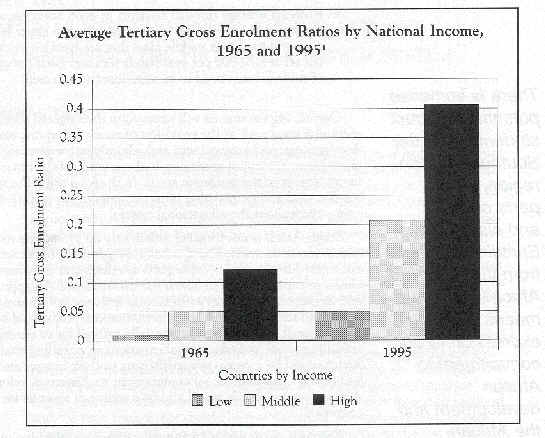
On the basis of cross-national research, Jan Sadlak of UNESCO argues that there is a clear correlation between the level of participation in higher education and economic development1. For example, the participation rate in the United States is over 70% and for the OECD countries it is 51%, compared to 21% for middle income countries and 6% for low-income countries. Sadlak's view is that 'any society that does not give at least 12% of the age group access to higher education does not have a chance to survive in the type of future that lies ahead'.
The graph on the opposite page dramatically demonstrates the growing relationship between participation in higher education and national income.
In South Africa the overall participation rate is estimated at 15% in 1999 (564 000 students in public higher education) though it is only about 12% for African students. Enrolments at private institutions are not likely to significantly increase the participation rate. This low level is compounded by the racially skewed participation in higher education and the unsatisfactory 'race' and gender distribution of participation in particular broad areas of study.
To ensure an adequate supply of human resources, an increased participation rate of 20% of the age group 20-24 years in public higher education should be the target over the next 10-15 years. On current population figures a gross participation rate of 20% would amount to 752 000 students. In addition there should be targets for the increased participation of adult learners. The present physical infrastructure and capacity of the higher education system is not always utilised optimally. This allows for an increased participation rate without major new expenditure. The increase in the participation rate should be made up principally of African students so that their current under-representation is eroded.
The problem of participation is closely related to school throughputs - the ability of the schooling system to provide adequate numbers of learners to enter the higher education system. A 20% participation rate of 20-24 year-olds would require 160 000 school-leavers qualified to enter higher education. It is also related to the barriers to enhancing greater participation from outside this population.
Only a modest growth of new entrants into public higher education is envisaged in the immediate future. This view is based on the following:
Relationship Between Participation Rate and National Income
Notwithstanding these impediments to the growth of participation, increases in participation in public higher education could be achieved over the next 10-15 years. These could result from:
Overall, improvements will necessitate the targeted allocation of resources in particular areas such as the provision of access for equity, academic support and development, and management and administrative capacity building. The adequate remuneration of academics is also a critical factor in obtaining sustainable improvement in the academic arena. In the long term, the solution lies in making dramatic and far-reaching improvements to the quality of educational outcomes throughout the educational system.
South Africa is not focusing sufficiently on promoting its higher education system internationally. There is immense potential to attract students from the Southern African region, other parts of Africa and elsewhere without reducing efforts to expand access to South African students. An appropriate framework and infrastructure that draws in various relevant government departments should be created for this purpose and internationalisation should be promoted. International students must be specially catered for to ensure that they enjoy rewarding social and educational experiences. Enrolling students from the rest of Africa would be a means of contributing to their human resource development and giving expression to our commitment to African development and the African renaissance. It would also be a source of revenue for institutions and the country.
The issue of the size of higher education also raises the question of the number of institutions that are appropriate to the needs of the country. The present number of institutions is inextricably bound up with South Africa's apartheid past. In the view of the Task Team, for reasons presented in the following chapter, it is not possible to sustain the current number of institutions. However, the current capacity of the system needs to be retained and the Task Team therefore proposes that there should be no closure of institutions, or that this should be avoided. However, in the interests of a sustainable higher education landscape there is a need to reduce the absolute number of higher education institutions through the mechanism of combination. This issue is dealt with in the following Chapter.