Department of Posts and Telecommunications
Annual
Report 1995/6
TABLE OF CONTENTS
Excerpt
from the speech by Dr Z Pallo Jordan at the launch of the White Paper on
Telecommunications Policy
Cape Town, 15 March 1996
"Soon
after assuming office as Minister, I realised that the present framework
governing telecommunications services in South Africa is outdated and in
need of amendment to meet the ever-increasing demand and expectations of
the telecommunications industry as well as the user community. When I tabled
my ministry’s budget in Parliament in June 1994, I made mention of the
outdated and superannuated legislation governing telecommunications. At
that time, I announced that my ministry would engage in preparations with
a view to initiating wide-ranging consultations regarding future telecommunications
policy and regulation. I envisaged a consultative process that would be
as inclusive as possible to rationalise the statutes governing telecommunications
and to optimise the capacity South Africa has acquired in this domain.
What we are unveiling today is the
product of that open, transparent and rigorous process to develop the new
policy and regulatory framework that will enable the telecommunications
sector to contribute maximally to the Reconstruction and Development Programme
(RDP).
From the outset we placed two interlocking
goals in the forefront of our policy. These are to balance and interconnect
the goal of providing basic universal service in telecommunications to
the disadvantaged rural and urban communities with the goal of delivering
advanced information services capable of meeting the needs of a growing
South African economy. It is the fundamental anchorage of our policy that
it cannot promote one of these goals without the other. The simultaneous
pursuance of growth and development is at the heart of the RDP.
Our policy recognises the centrality
of telecommunications to our growing economy and that extension of the
telecommunications infrastructure is a crucial component of the Government
of National Unity’s strategy to pair development with growth. We are setting
our telecommunications industry on the road to full, regulated competition
because we recognise that changes in communications technology, trade liberalisation
and the globalisation of communications will have a dramatic impact. We
shall not adopt the posture of those who resist change. We are rather engaging
in the politics of position in which we seek to maximise strategic advantages
for South Africa and a growing economy on the southern tip of Africa. This
requires us to engage with the global forces of change rather than blindly
resisting them.
Such engagement requires interaction
with external partners such as the international telecommunications companies
and our neighbouring states in SADC. We also need a range of internal partners
such as our own telecommunications stakeholders community. It is for this
reason that the achievement of consensus at national level is so critical
for the success of our policy.
I am persuaded that, in order to engage
with the forces of change, we need a South African telecommunications industry
that can work together under the twin conditions of universal service and
regulated competition to enable our entire industry to position itself
successfully at every level - national, regional and global. We equally
need an over-arching vision of the telecommunications sector that every
stakeholder can identify with, regardless of normal tensions between worker
and employer, between operator and supplier and between competitors with
each other.
I believe that the policy that we have
evolved does provide the basis for such shared vision for our community
of telecommunications stakeholders and this is largely because of the period
of consultation that we have just concluded. Although a great deal of work
was done on telecommunications policy prior to April 1994, amongst others
by the National Telecommunications Forum (NTF), the policy formulation
process was given a new impetus with my announcement on 27 March 1995 that
my ministry would be publishing a Green Paper on Telecommunications Policy.
Work began in earnest in May 1995.
The consultative process was intense, often flaring into debate and passionate
disputation. But that is how it should be. We do not occupy identical positions.
We have differing interests. This is democracy in action. We all participated
in the policy that emerged. It belongs to all of us and we must all assume
responsibility to make it work in practice. The ministry, for its part,
will continue to play a role of consensus building and facilitation.
There are a number of issues that require
follow-through over the next few months. The first is the issue of ownership
and financing of Telkom.
The second issue that requires follow
through is the question of the local equipment supply industry, GATT binding
levels and the World Trade Organisation. In the next few months, the Department
of Trade and Industry will convene a number of meetings to discuss the
matter, and I propose to table the outcome of these meetings at a summit
meeting of the telecommunications stakeholders prior to the implementation
of any measures.
The third issue pertains to the economic
empowerment of the historically disadvantaged South Africans. The White
Paper proposes a set of measures regarding such empowerment. I aim in the
near future to convene a meeting of stakeholders to discuss how these proposed
measures can be implemented in practice.
The fourth issue relates to the position
of South Africa’s telecommunications industry within the regional context
of Southern Africa. I propose shortly to engage SADC members on this issue
and to visit the Southern African Transport and Communications Commission
in Mozambique to discuss the issue of regional telecommunications integration
and interconnection with Southern Africa.
The fifth
issue is
that of
the passage
of the
White Paper and Telecommunications Bill through Parliament,
the subsequent establishment of the Southern African Telecommunications
Regulatory Authority
(SATRA)
and the
Universal Service Agency. With regard to Parliament, I wish to encourage
all stakeholders to engage with the portfolio committees on communications
to clarify and deepen their understanding of the telecommunications sector
and the proposed policy.
We who participated in the shaping
of the policy must make sure that any decision or amendment the parliamentarians
make to policy or the Bill, is an informed decision. We must build on the
solid platform and vision of telecommunications that has emerged from the
consultative process. I want to ask all telecommunications stakeholders
to take this spirit of consultation and co-operation into Parliament.
With regard to the appointment of SATRA’s
Council, I would like all stakeholders to begin thinking about suitable
candidates for nomination to SATRA. The White Paper specifies two main
criteria for selection - broad representativity of South African society
and experience in the telecommunications sector. We need the best people
for the Regulator, and I would ask you to consider releasing people for
this task. The success of the entire telecommunications policy may well
depend on the calibre of people we are able to put forward for the Council
of SATRA.
Lastly, the successful implementation
of our telecommunications policy will require ongoing consultation with
the community of stakeholders and the public at large. We cannot afford
to relax and let go of the delicate process of finalising policy and the
beginnings of its implementation. I am, therefore, committed to ongoing
consultation with the sector and I hope that the National Telecommunications
Forum will continue to play its vital consultative role and to make sure
that the vision become reality and we can all move forward together".
HIGHLIGHTS
OF THE YEAR
|
April 1995
|
Establishment
of the National Telecommunications Policy Project (NTPP) to manage the
Green/White Paper process, and appointment of a Technical Task Team, a
local Advisory Panel and a team of international experts |
|
June 1995
|
Vodacom and
MTN submit the first actual traffic information for their cellular networks |
|
7 July 1995
|
Launch of the
Green Paper on Telecommunications Policy |
|
16 August 1995
|
Initial meeting
of the Review Council regarding the Joint Economic Development Plans (JEDP)
and annual reports of the two licensed cellular operators |
|
30 August 1995
|
The Postmaster
General determines a Chart of Accounts and Cost Allocation Manual (COA/CAM)
for the two licensed cellular operators |
|
31 August 1995
|
Adv Ters Oosthuizen’s
term of contract as Postmaster General expires |
|
4 to 8 September 1995
|
The Department
hosts a regional seminar on frequency management and regulatory matters
for African countries at Midrand |
|
15 September 1996
|
Discussion
document is published for proposals on technologies to be implemented in
the 440 to 470 MHz frequency band which will be vacated by the C450 Motorphone
System on 1 June 1999 |
|
29 September 1995
|
The Department
submits its own submission to the Green Paper to the NTPP |
|
30 September 1995
|
Closing date
for submissions on the Green Paper on Telecommunications Policy |
|
6 October 1995
|
Licence issued
to Swiftnet (Pty) Ltd to provide national wireless data telecommunications
service |
|
7 November 1995
|
Industry briefing
on responses to the Green Paper on Telecommunications Policy |
|
November 1995
|
Preparatory
work begins on the South African Band Replanning Exercise (Project SABRE) |
|
20-23 November 1996
|
National Colloquium
on Telecommunications Policy |
|
December 1995
|
The RMFMS is
commissioned by the Department |
|
1 December 1996
|
Closing date
for submissions on technologies to be implemented in the 440 to 470 MHz
frequency band (proposals submitted to Project SABRE) |
|
15 December 1996
|
Vodacom and
MTN receive temporary licences to operate in the former Ciskei |
|
January 1996
|
Project SABRE
commences |
|
8 January 1996
|
Mr Andile Ngcaba
is appointed as Postmaster General |
|
17 January 1996
|
Announcement
of the South African Band Re-planning Exercise (Project SABRE) |
|
5 February 1996
|
Final debate
on outstanding issues regarding Telecommunications Policy at the National
Telecommunications Forum (NTF) Plenary Conference |
|
13 March 1996
|
The White Paper
on Telecommunications Policy is published in the Government Gazette |
|
15 March 1996
|
Launch of the
White Paper on Telecommunications Policy |
|
26 March 1996
|
Connection
Agreement between Telkom and Swiftnet submitted to the Postmaster General
for approval |
FOREWORD
REVIEW BY
THE POSTMASTER GENERAL
Telecommunications has become increasingly
important and is evolving on an unprecedented scale world wide. This situation
requires responsiveness and commitment on a national scale to ensure that
the diverse needs in the South African context are met.
The Department of Posts and Telecommunications
has an unique role to play towards realising the aspirations and expectations
of the people of South Africa. Transformation has been the key word over
the last few years and apart from setting the scene for structural change,
a Green and White Paper process was launched during the year under review.
In this way the most important issues and options could be steered to formulate
a broad telecommunications policy for South Africa.
The objective to ensure universal affordable
service and from a telecommunications point of view improve the quality
of life of all South Africans, requires action-orientated and results-orientated
strategy plans. In the short term a legislative and regulatory framework
should serve as stepping stone and directive towards meaningful reform.
In essence, the process is aimed at a redistribution of homogenous functions,
i.e. responsibility for policy on broadcasting, postal services, telecommunications
and the radio frequency spectrum to remain with the Department, whilst
an independent regulatory authority will be entrusted with the regulatory
functions.
In addition to the activities expounded
upon in this report, much time has been devoted to the empowerment of those
who will be closely linked with policy, regulation and management of communication
institutions. The process involved joining forces and sharing a knowledge
base with tertiary institutions to initially establish a conceptual understanding
of telecommunications. In time to come the focus will shift to equip large
numbers of potential employees with suitable qualifications, knowledge
and skills to facilitate flexibility and diversity in the work place.
An achievement which can be attributed
to the fine leadership of the Minister of Posts, Telecommunications and
Broadcasting is the reincorporation of the so-called TBVC territories into
Telkom SA Limited and SA Post Office Limited. The task was finalised in
the shortest possible time to the satisfaction of all parties concerned.
In conclusion, my sincere appreciation
to my predecessor, Advocate Oosthuizen and the Minister, Dr Pallo Jordan
for a great job done during the year under review. The Management Board
and the staff once again ensured a successful conclusion of our activities
for the period 1 April 1995 to 31 March 1996. I have full confidence that
the fine spirit that prevailed during my short term of office as departmental
head will continue in the year to come.
Andile Ngcaba
POSTMASTER GENERAL
COMMUNICATIONS
POLICY
One of the most important and time
consuming activities in which this division was involved during this report
period, was the drafting and publication of the Green and White Papers
on telecommunication policy.
With the establishment of the National
Telecommunications Policy Project (NTPP) in March 1995 by Minister Pallo
Jordan for the purpose of developing new telecommunications policy and
legislation, this division provided the departmental representation on
the NTPP Technical Task Team (TTT). An all inclusive process was followed
which involved numerous discussions between the TTT and all major stakeholders,
both on a one to one basis and via the National Telecommunications Forum
(NTF), which resulted in the publishing of the Green Paper in the Government
Gazette of 7 July 1995. The closing date for comments on the Green Paper
was initially set for 15 September and eventually extended to 30 September.
This office participated with other divisions in the Department in the
preparation of the most comprehensive submission on the Green Paper.
After the expiry date, the TTT spent
the major part of October reviewing and processing the many Green Paper
submissions received. A statistical analysis and a narrative report was
published. During the second half of November the Department participated
in a colloquium held in order to resolve a number of outstanding issues.
However, at the colloquium consensus could not be reached on the issues
of market structure and ownership of Telkom SA Ltd. The first issue was
referred to an eminent persons group established by the Minister from representatives
at the colloquium and the second issue was referred directly to Minister
Jordan. A final debate of all outstanding issues took place during the
February 1996 plenary meeting of the National Telecommunications Forum,
whereafter the White Paper was published in the Government Gazette of 15
March 1996.
| Terminal
Equipment
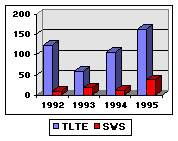
Type-approval and licensing of Telecommunication
Line Terminal Equipment (TLTE) showed a constant increase since 1993, as
reflected graphically. From an all-time low of only 60 applications in
1993; 152 applications for licensing of TLTE were received during the report
period. Applications for Switching Systems increased from 20 in 1993 to
48 in 1995. |
 |
| Maintenance
Organisations
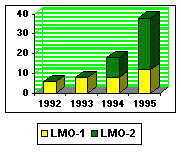
Applications for maintenance organisations
(LMOs) also showed a marked increase during the report period, especially
in the LMO-2 category. Whereas no LMO-2 category existed prior to 1994,
this had increased to 26 applications during the report period.LMO-1 applications
increased from 8 in the previous year to 12 in 1995. See graph. |
 |
Policy documents
and specifications
The envisaged phasing out of the addition
of local content as a prerequisite for type approval for switching systems,
necessitated a change in approval procedure. New policy documents for the
approval for switching systems were compiled and the procedure documents
for TLTE updated. Specifications for the cabling of buildings and subscriber's
premises were compiled in consultation with Telkom and published. These
documents serve mainly as guide documents to architects and civil engineers
in the design of building complexes and for LMOs in the cabling of buildings
for the provision of telecommunication services.
Revenue
Revenue earned by application and licence
fees, and the sale of specifications during this report period totalled
R105,995.00, made up as indicated in the chart.

Seminars and
courses attended
Two meetings of the Negotiating
Group on Basic Telecommunications of the World Trade Organisation were
attended in Geneva.
CELLULAR
TELECOMMUNICATIONS
Swiftnet licensing
After extensive negotiations
between the Minister, the Postmaster General, Telkom and Swiftnet, Swiftnet
was awarded the first national wireless data telecommunications licence
by the Postmaster General on 25 August 1995. Simultaneously with the award
of the licence a National Wireless Data Telecommunication Access Agreement
was concluded between the Postmaster General and Telkom. The purpose of
this access agreement is to, together with the licence, establish the regulatory
environment for wireless data telecommunications networks. This agreement
inter alia includes stipulations to ensure that similar wireless data telecommunications
operators can be licensed as soon as spectrum is available and that Telkom
and each wireless data operator has to conclude a connection agreement
which has to be approved by the Postmaster General. Subsequently wireless
data operators will be licensed with similar obligations and authorities
as Swiftnet and will have to conclude connection agreements with Telkom
which must be no less favourable than the connection agreement between
Telkom and Swiftnet. The connection agreement between Telkom and the operator
sets the terms and conditions that pertain to services provided to the
operators by Telkom. The Connection Agreement between Telkom and Swiftnet
was concluded on 26 March 1996 and submitted for approval by the Postmaster
General.
GSM cellular licence for former Ciskei
In line with the Reconstruction
and Development Program goal of the Government to provide telecommunications
access to all communities, the Department assisted the former Ciskei Department
of Posts and Telecommunications in licensing Vodacom (Pty) Ltd and Mobile
Telephone Networks (Pty) Ltd (MTN) to operate GSM networks in the Ciskei
area. This was necessary since the interim constitution provides for the
legislation of the former TBVC states to apply until specifically repealed
and replaced with South African legislation. Legislation reform was only
planned for 1 April 1996 and the people of Ciskei have an urgent, immediate
need for telecommunications services. Temporary GSM telecommunications
and radio licences were issued to MTN and Vodacom on 15 December 1995.
This process also contributed towards the earlier start of cellular services
in Transkei.
Invitation to submit proposal of telecommunications
technologies to be implemented in the 440 to 470 MHz frequency band
In February 1995 an invitation
to submit proposals of telecommunications technologies to be implemented
in the 440 to 470 MHz frequency band was published in the Government Gazette.
This process was initiated to achieve transparency and get industry input
into the utilisation of the frequency spectrum that will be vacated when
the analogue C450 cellular system closes down by June 1999. Eighteen proposals
were received and a discussion document was published on 15 September 1995.
Comment on the discussion document was allowed until 1 December 1995. These
comments and proposals were used as input for Project SABRE and a final
decision on how the vacated spectrum will be utilised will only be made
after the SABRE band plan has been finalised.
Community services telephone users survey
and performance audit
The National Cellular Telecommunications
Licences oblige the cellular operators Vodacom and MTN to install, maintain
and operate community service telephones in under-serviced areas of South
Africa. By 1 June 1995 MTN had to have 1,000 and Vodacom 2,000 operational
community service telephones installed.
Consultants from the Bureau
for Market Research (UNISA) were appointed in December 1995 to assist the
Department in conducting a user survey on community service telephones.
The purpose of the user survey is to establish whether the current community
service telephone implementations of the cellular operators meet the needs
of the communities they are meant to serve. A questionnaire, to be completed
by members of the public in under-serviced areas, was developed and a training
course for field officers presented in February 1996. The field officers
are responsible for the appointment of field workers and for co-ordinating
the work done by field workers in completing the questionnaires in under-serviced
areas. The actual survey commenced in April 1996.
Chart of Accounts and Cost Allocation
Manual (COA/CAM)
On 30 September 1993, Vodacom
and MTN were licensed to operate cellular telecommunications networks in
South Africa. The mechanism to regulate the cellular industry and to ensure
a level playing field and therefore the long term viability of the sector
was created by the two Licences and the Multiparty Implementation Agreement
(MPIA).
Paragraph 12.1 of the National
Cellular Telecommunications Licence (NCTL) and Paragraph 17.1 of the MPIA
place the obligation on the Postmaster General to prescribe a Chart of
Accounts and Cost Allocation Manual (COA/CAM).
The COA/CAM project commenced
in February 1995 and the Department was assisted by Deloitte & Touche
Management Consultants. The project was based on consultation by the Consultants
with the Department, Telkom, Vodacom and MTN, although it was not applicable
to Telkom at that stage. Extensive negotiations were held with the parties
involved to ensure that they take co-ownership of the product.
The COA/CAM consists of a
broad framework applicable to all telecommunications operators and a detailed
extension specific to the cellular operators. The COA/CAM can therefore
easily be extended to include all other telecommunications operators.
The Postmaster General determined
the COA/CAM on 30 August 1995. The Department will review the results of
the COA/CAM reports to measure the extent to which the cellular licensees:
-
applications for tariff increases
on products and services and tariff applications on new services are fair
and reasonable;
-
(their agents, contractors and
service providers) may be engaging in anti-competitive practices such as
predatory pricing, cross-subsidisation, etc.; and
-
are meeting their licence obligations.
Paragraph 17.1 of the MPIA also
contain the obligation of the Licensees to implement and comply with the
COA/CAM. The cellular operators have begun to prepare their respective
procedures manuals for the Department’s review and approval.
The Department has also begun
to establish the necessary processes, skills and management capacity to
review and analyse the operators’ financial reports on an ongoing basis.
Deloitte & Touche assists the Department in the review of the cellular
operators’ procedures manuals as well as in the development of a decision
making framework (DMF) to be used by the Department. The DMF will provide
guidelines for analysing issues which the Department has identified as
being of regulatory importance, and guidelines for analysing and interpreting
financial information submitted by the operators in accordance with the
COA/CAM.
Joint Economic Development Plans (JEDP)
In terms of paragraph 9 of
the Joint Economic Development Plans (JEDP) of the cellular operators,
the first annual reports were due on or before 1 June 1995 for the period
from the Announcement Date (14 February 1993) up to and including 31 March
1995. Both the operators’ reports were submitted and although these reports
were not submissions for credit, but only to report on the operators’ progress,
it was clear that both operators were ahead of their commitments.
On 16 August 1995, the constituting
meeting of the Review Council was held to give the members background on
JEDP, to discuss the responsibilities of the Review Council and to discuss
the operators’ first annual reports.
Tariff plans
In terms of clause 13 of
the NCTL, the Licensees shall not charge any tariffs or fees for the Service
and any other services whatsoever until such tariffs and fees have been
lodged in writing with the Postmaster General. Several new tariff plans
as well as changes to existing tariff plans, including new services, were
submitted by both cellular operators during the 1995/96 financial year,
a total of 22 submissions.
During June 1995, one year
after the start of competition in the cellular industry, both cellular
operators submitted tariff plans in terms of clause 13.5. The effect of
this clause is that the licensee has a right to increase its tariffs as
long as it is less than the year on year increase in the Consumer Price
Index for all goods as published by the Department of Statistics. All the
increases in these tariff plans were acceptable and were approved.
On 31 January 1994 the Postmaster
General defined principles that will be used to assess whether a tariff
plan has been increased. Various assumptions had to be made because of
the lack of actual traffic information for the cellular networks. It was
intended that the principles would be changed when the cellular operator
supplied actual information. This would ensure that the assessment by the
Postmaster General would be based as closely as possible on the real situation
faced by the customer. During June 1995, both the operators supplied the
first actual information (i.e. call distribution, average usage and unitisation)
to the Department.
FREQUENCY
MANAGEMENT
Mission
The day to day mission of
this directorate remains the assignment of frequency spectrum to clients
in accordance with approved band planning for the country, as well as the
type approval of radio equipment. This is always done from the perspective
of maximising the efficient use of the national resource that is the frequency
spectrum, while harmonising its use to avoid harmful interference.
Routine activities
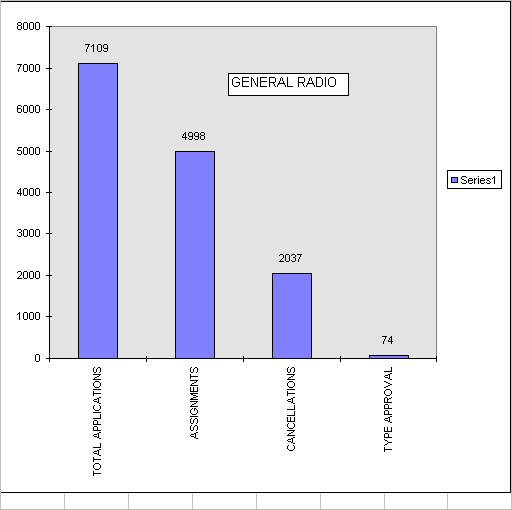
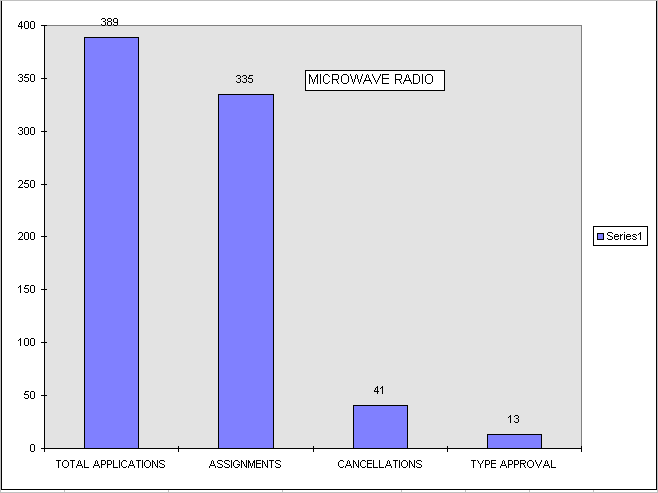
Well in excess of 5,000 frequency
assignments were processed with close to 80 equipment type approvals being
completed in this period. A detailed breakdown of these activities in graphic
form follows:
Extra-ordinary activities
The year under review proved
to be action packed with many activities occurring over and above the routine
activities of frequency assignment and equipment type approval. These included:
Project Spektrum
Frequency Management, with
support from Frequency Planning, gave assistance in the finalisation of
the technical modules of Project Spektrum, the development of an automated
spectrum management system covering licensing, billing, coverage predictions
and interference analysis amongst others. Additionally a start was made
in the data capture process required to update the records on the basis
of which this system will operate, with much technical assistance offered
to the public in regard to their queries on the data capture forms. Internally
steps have now been taken to begin the integration process of the system
involving various directorates. It is expected that more comprehensive
use of the system by some directorates will be possible will occur in late
1996, possibly utilising specific modules with integrated use of the entire
system following over a period of time thereafter.
Project SABRE
Frequency Management played
a supportive role to Frequency Planning in a new project known as Project
SABRE (South African Band Re-planning Exercise) which entailed a detailed
audit of the use of the frequency spectrum between 20 MHz and 3 GHz. The
intention of the project is the development of a new nationally agreed
band plan for this segment of the spectrum, together with a broad migration
plan to achieve it over the next 3-5 years. It is expected that once Frequency
Planning completes the revised Band Plan and the high level Migration Strategy
that Frequency Management, in conjunction with the licensing related directorates,
will play a leading role in the implementation of the revised Band Plan
via a Detailed Migration Planning process. The Detailed Migration Planning
is only expected to come to the fore during 1997.
Policy matters
Policy, and where necessary
notices in the Government Gazette, with regard to the introduction of spread
spectrum Local Area Network/Wide Area Network equipment were finalised.
A great deal of input to
the new policy with regard to the introduction of digital cordless telephony
using the DECT standard was also given by this Directorate. The policy
awaits final approval by the Postmaster General.
Large input from this Directorate
was also made to the process for the revision of policy with regard to
existing MPT 1,327 public trunking in the 254 MHz band.
Technical policy inputs were
also offered by this directorate in other arenas such as trunking in general,
Private Communication Services (PCS) and Mobile Satellite Services (MSS),
all of which are under ongoing discussion within the Department.
Conferences
Staff from this directorate
played an important role in meetings at the ITU such as the Conference
Preparatory Meeting (CPM) for World Radio Conference 95 (WRC-95), the Radio
Assembly, WRC-95 itself and later the first CPM for WRC-97 held early in
1996. These conferences were of great importance to the Department and
the country as they provided a point of access for the country to once
more begin playing a leading role in the ITU environment. The bridge building
within the African Group at WRC-95 was particularly heartening. Within
the ITU environment there was participation in an ITU Regional Radiocommunications
seminar which facilitated broad contact with various neighbouring countries.
FREQUENCY
PLANNING
Mission
The mission of the Frequency
Planning section is to plan the usage of the frequency spectrum in the
most efficient and effective manner possible, in order to

encourage the development
of the telecommunications industry, and to benefit all South Africans.
Functions of the frequency planning
section
-
Identify national and international
spectrum requirements and use these to develop and maintain the table of
allocations for the country
-
Perform regular spectrum reviews
-
Provide high quality technical
support to the department, the industry and neighbouring countries
-
Participate in local, regional
and international spectrum management fora.
-
Provide technical support for,
participate in, and implement the decisions of, ITU radio conferences
-
Identify and assist in the development
of policy regarding spectrum usage
-
promote and improve co-operation
with neighbouring countries
-
keep abreast of emerging technologies
and standards.
-
Promote standardisation and
the adoption of harmonised standards
South African Band Replanning Exercise
(Project SABRE)
The section is currently
focusing its energies on the Department’s major spectrum replanning project.
This project entails a review of the spectrum between 20 MHz and 3 GHz
and is known as project SABRE (South African Band Replanning Exercise).
The radio frequency spectrum
is national asset and a scarce resource. Today this resource has a far
reaching impact on economies, potential manufacturers and users, and is
a vital link in the development of telecommunications in a country.
This exercise therefore aims
to ensure that the limited spectrum available is utilised in the best possible
manner, in the interest of all South Africans, and consistent with international
trends.
The project team consists
of the Frequency Planning section of the Department, UK based Smith System
Engineering, the Mikomtek division of the CSIR, The UK Radio-communications
Agency and NERA (National Economics Research Associates).
Project Program
-
Phase 1 Current spectrum use
- Consultation phase. Information gathered from interviews, questionnaires,
Departmental records, responses to calls for comment, monitoring. To be
completed by April 1996.
-
Phase 2 Requirements capture
-Consultation. Spectrum requirements for the future seen from a user perspective.
To be completed by April 1996.
-
Phase 3 International trends
- investigate international trends in technology, standardisation and spectrum
management not only in ITU region 1 but also in ITU regions 2 and 3. To
be completed by April 1996.
-
Phase 4: Band Plan -
-
Draft band plan to be produced
by May 1996.
-
Launch of the draft band plan
- June 1996.
-
Consultation and feedback on
the draft band plan to take place.
-
Final band plan to be produced
by October 1996.
-
Draft migration plan to be produced
by the end of October 1996
-
Final migration strategy produced
by December 1996
Project progress
-
Tender awarded to Smith System
Engineering consortium in November 1995.
-
Preparatory work began during
November and December 1995.
-
Project commenced January 1996.
-
Project name chosen - SABRE
(South African Band Re-planning Exercise)
-
>50 Interviews took place with
the industry during January and February 1996.
-
Questionnaires sent out to >
300 users and organisations.
-
Press releases and adverts were
placed in the Sunday Times, Rapport, Communications Week, Engineering News
and the Government Gazette to inform everyone of Project SABRE, and invite
comment.
The way ahead
-
The Project SABRE team to visit
the regional offices to inform them and users in the area of the project.
-
Meetings to take place with
neighbouring countries to discuss the project.
-
Remainder of project as per
project program
Long-term goals of Frequency Planning
-
Maintain an ongoing process
of spectrum review.
-
Publish a spectrum strategy
document.
-
Harmonise table of allocations
for Southern Africa.
REGIONAL
ACTIVITIES : MONITORING AND INVESTIGATION
Radio has always been synonymous
with science and high technology. The growing demand for radiocommunication
services, along with the constant search for improved methods of satisfying
it, has transformed the management of the radio spectrum into an increasingly
complex field, both technically and administratively. As the radio environment
becomes more turbulent the Department, in connection with its responsibilities
for issuing licenses, must also ensure that stations comply with the relevant
provisions of the Radio Regulations as indicated in the terms of the license.
Currently this encompasses the mobile or professional radio spectrum and
not the Broadcast Spectrum (according to the Radio Act the Department is
also responsible for the management of the Broadcast Spectrum). Radio spectrum
users and Departmental relations have always been very close; and if ancestry
and history do not bestow sisterhood, they are surely first cousins.
The graph below shows
growth in stations from year 1976 to 1996.
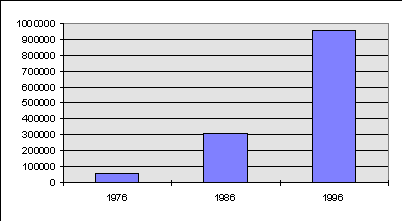
From the above the increased demands
by our society on the radio frequency spectrum and the likelihood/possibility
of unacceptable interference suffered by some receivers can be seen. To
satisfy the ever increasing needs it is thus of paramount importance to
control interference among stations and by reduction of the spectrum wasted
due to interference.
Monitoring and Investigation
(Enforcement) Section (MIS)
Spectrum management activities in
South Africa can be broadly divided into four functions: spectrum policy,
spectrum planning, frequency authorisation and enforcement. The Monitoring
and Investigation (enforcement) function sub-unit (MIS) currently
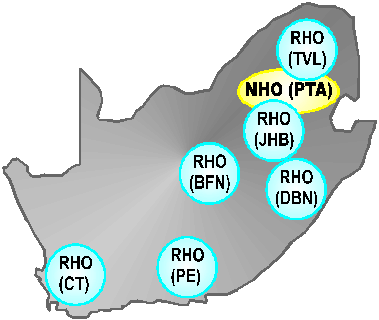
comprises six Regional Offices responsible for the investigation of cases
of harmful interference (also interference investigations concerning both
Radio and Television that fall beyond the scope of the SABC) and inspection
of installations. At the same time the MIS is working closely with the
Frequency Assignment and Licensing sub-units in collecting information.
Most of the staff, equipment and mobility needed to enforce the national
statutory and regulatory requirements with major task to keep the radio
frequency spectrum free from harmful interference are provided and in place.
Monitoring facilities at the regional offices, dispersed across the country,
are also provided to check emissions of radio stations and their technical
characteristics to ensure that they are operated in conformity with the
standards and various conditions on the basis of which their licenses were
issued.
New equipment, whether imported or
locally manufactured, is generally designed to strict specifications for
radio interference limits. Improper - i.e. non-approved - equipment is
attempted to be prevented from being taken in use by visiting dealers and
controlling the sales thereof. Today, the primary limiting factor in the
availability and clarity of most radio systems is interference that reduces
the effective sensitivity of equipment. The radio user normally experiences
his system through his equipment - which in most cases appears to him as
a black box with special functions. He or she is ultimately interested
in the setting up of a connection with the implicit expectation that the
connection will remain undisturbed up to the end of the connection. The
real problem lies in many cases with existing equipment, much of it of
considerable age and inferior modifications, which does not comply with
the requirements. Elimination of interference produced by such equipment,
as a result of poor system planning, poor engineering practice and poor
maintenance can only be achieved by investigation and measurement in all
cases of reported interference. The sources of man made noise and spectrum
pollution are virtually unlimited - incidental radiation from electrical
devices of all sorts and complex intermodulation products and spurious
transmissions from radio communication system are but a few. In practice
interference comes in all degrees, from barely perceptible to catastrophic.
Emphasis throughout is on reducing all forms of interference to the minimum
possible levels and to maximise spectrum usage by so doing.
Complaints are received daily and direct
at the MIS (regional office) and a radio inspector investigates. This phase
of implementation of spectrum management provides a very important and
necessary public service to users. Additional effort is put into improving
the utilisation of the radio spectrum as well as locating sources of interference
and ensuring corrective action. Inspectors sometimes have to appear in
court to carry out functions and to defend the Department’s interests.
Such a case recently was thrown out of court three times but determined
officials had it re-opened as many times and at the third hearing succeeded
in getting a conviction. In addition coastal MIS inspectors perform compulsory
examinations of ship stations and other systems are inspected on a spot-check
basis as a preventive measure. MIS Radio Surveyors often have to board
ships, far off the South African shore, to conduct surveys of radio station
equipment relevant to safety and distress. It costs a lot of money these
days for a ship to come into the harbour for a survey and consequently
MIS officials are often ferried or flown out to these vessels to conduct
surveys, sometimes under very dangerous conditions. These and other inspections
aid the Department in maintaining an accurate inventory of the types of
installation and equipment used at each location. Invaluable feedback from
the enforcement section is also provided to the spectrum planning function
to assist insight into the adequacy of current equipment standards, the
effectiveness of interference prediction models and current frequency assignment
procedures.
The year under review proved to be
action packed with many activities over and above daily regional tasks.
With the implementation of self developed databases the MIS has achieved
outstanding results, especially in the collection of outstanding license
fees and sealing of apparatus. This was achieved by a combined effort of
all staff, technical, administrative and management.
1,406 interference complaints
10,853 sealing files
786 RT examinations
199 marine surveys
The MIS, recognising the fundamental importance
of protecting users from interference, convened two Regional Conferences
at the Aventura Midwaters Resort, Colesberg in order to ensure that a national
regulatory strategy for regional offices could be determined and maintained
in view MIS eagerness to provide a more professional and effective service
to the telecommunication industry. We are confident that thanks to the
excellent spirit of co-operation which has always prevailed amongst the
MIS (Department Regional Offices) and our clients we will be able to meet
the challenges brought along by an era of the information age in which
telecommunication activities in all walks of life have become more intense
and complicated.
| Medical
Anecdote : Vampire Case
The so called
"Vampire Case" happened in a hospital (fortunately overseas) when the digital
control circuitry of an automated blood transfusion system somehow reversed
its flow and sucked blood out of the poor patient. This event was blamed
on interference that pulsed the unit’s control IC’s into their electrical
"forbidden region" |
ENGINEERING
SUPPORT
The WAN Network of the Department
The Department of Posts and Telecommunications
became the first Telkom corporate client to make use of a new networking
service called Frame Relay. This milestone of the monitoring project was
reached approximately in August 1995. Simply put, Frame Relay is a Wide
Area Networking (WAN) service supplied by Telkom and can accommodate data
speeds of up to 2 Mbt/s with redundant circuitry providing alternate routing
to the different Regional offices should a direct link fail. The benefit
of the service is that it is now not necessary to use leased lines or dial
up modems to connect to other offices in the network.
Although the network originally made
provision only for the Radio Monitoring sites, it now incorporates all
the Local Area Networks in the Department. Essentially all regions now
have access to e-mail, the Spektrum database and the file servers at Head
Office. The Department currently uses 64 Kbt/s entries to the Frame Relay
network.
Commissioning of the monitoring
system
In December 1995, Radio Monitoring
finally commissioned the Radio Monitoring Frequency Management System (RMFMS).
Rhode and Schwartz, winners of the tender, provided two engineers for this
purpose. The RMFMS presently consists of 13 equipment sites including 6
manned sites. The system is designed in such a way that any manned site
can control any other site remotely for monitoring purposes. After commissioning
the system was fully operational with the exception of the database, the
audio system and mapping system. The audio system is locally supplied and
required completion of the software development, while the other two systems
require work to be completed by Departmental staff. To provide the database
with usable data will be a considerable and drawn out process.
Monitoring mobiles
The original requirement of the Radio
Monitoring Frequency Management System (RMFMS), called for two mobile vehicles.
These vehicles were scheduled for commissioning after the close of the
financial year. The mobiles are literally mobile offices on wheels and
include the same database, audio and mapping systems as supplied at the
manned sites. Furthermore the mobiles have an extended frequency coverage
range utilising wider band receivers. The mobiles are totally self sufficient,
having an on board diesel generator, back up DC power supplies and air
conditioning. It is planned to base one mobile in the north of the country
(Johannesburg) and one in the south (Cape Town).
South African Band Re-planning Exercise
(Project SABRE)
Monitoring had some input to the above
project. The project team requested that occupancy measurements be taken
in various centres in the frequency range 20 to 1000 MHz. This was completed
over a two week period and the results passed on to the project. The information
supplied was compared to existing licence records and formed the basis
for the new draft band plan.
Computer support
During the year the post of Manager
: Computer Support, was filled and the development of the Computer Support
Division could proceed. Proactive planning, realignment of objectives and
restructuring commenced. The division was actively involved in the implementation
of a sophisticated data capturing system for application and issuing of
radio licenses. During the year a Wide Area Network, utilising Frame Relay
technology from Telkom, was commissioned. This development established
instant computer communication between Head Office, the regional offices
and Bureau Beta where mainframe facilities are available. The division
is also responsible for project "Spektrum", which is a frequency management
and administration system. The administration sub-system was commissioned
at the beginning of the year and the technical modules were accepted at
the end of the financial year.
PRIVATE
RADIOCOMMUNICATION
In order to modernise and streamline
licensing procedures, the new computerised system, named Spektrum, was
taken into use and certain types of licences have already been transferred
to the database of this system. It is anticipated that overall switch-over
will be effected by the end of 1996. This exercise is, however, dependent
on the prompt return of the data information forms which were posted to
62,851 existing private radio-communication licensees, of which approximately
10,500 have thus far been returned. Spektrum will, contrary to the existing
computerised system which can only be used for the issue of licences, also
assign frequencies. The information to be furnished by the licensees is
therefore of utmost importance to ensure the completeness and correctness
of the client’s details to be transferred to the Spektrum System.
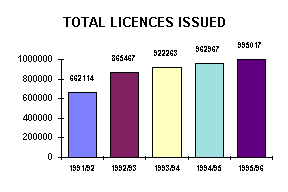
The total number of radio stations
licensed and certificates issued compared with that of the previous year
are detailed in the table below and reflects an increase of 3.328% against
that of the 1994/95 financial year.
|
STATION/CERTIFICATE
|
1994/95
|
1995/96
|
| Amateur radio
stations |
6 131
|
6,008
|
| Private radiocommunication |
900,248
|
929,304
|
| Radio Operator’s
Certificates (Aeronautical and Maritime) |
48,745
|
51,061
|
| Ship stations |
3,535
|
4 120
|
| Aircraft stations |
4,308
|
4,524
|
| TOTAL |
962,967
|
995,017
|
INTERNATIONAL
RELATIONS
As a consequence of South Africa’s
re-admission as a member of the Universal Postal Union (UPU) and to full
participation in activities of the International Telecommunication Union
(ITU) late in 1994, attendance of meetings and conferences of these Unions
gained momentum during the year under review. Participation in such meetings
and conferences could however only be structured on a limited scale due
to inadequate human resources. Thus the full benefits of re-admittance
to these communication agencies of the United Nations, whose fora adopt
decisions and formulate strategies concerning the development of communications
for the benefit of all its members, could not be reaped for South Africa
and its peoples.
On invitation by the Secretary General
of the ITU, members of the Department participated in a Committee which
was established to review the rights and obligations of the Union’s membership
and to make recommendations concerning wider participation by telecommunication
entities in the Union’s activities. The Committee’s recommendations will
be considered by the Council of the ITU in order to determine whether amendments
would be necessary to the Constitution and Convention of the ITU. Final
proposals in this regard will be considered by the ITU’s next Plenipotentiary
Conference during 1998.
On its re-admission, South Africa was
also elected as a member of the Council of the ITU and of the Council of
Administration of the UPU and meetings of these organs of the two Unions
were also attended during June and October 1995, respectively. Both Councils
are responsible for the functioning of the Unions in the four years between
meetings of their highest decision-making organs, namely Plenipotentiary
Conference in the case of the ITU and Congress in the case of the UPU.
Consequently, their agendas include items on a wide variety of subjects
such as personnel matters, the consideration and approval of their biennial
budgets - a budgetary method generally followed by United Nations agencies
-, developmental assistance in the field of communications to least developed
and developing countries and to countries with special problems, agendas
and duration of future conferences and meetings, progress measurements
of the strategic plans adopted by both Unions during 1994 and other aspects
related to the smooth functioning of their respective Secretariats which
are situated in Bern (UPU) and Geneva (ITU).
The Department, in co-operation with
Telkom SA Ltd, hosted a radiocommunication seminar during September 1995
which was organised by the ITU for English speaking countries in Africa.
The seminar lasted a week and was well attended by radiocommunication experts
from other countries and from within South Africa. On this occasion an
agenda item of the ITU’s World Radiocommunication Conference which was
held in Geneva, Switzerland during October of that year, was co-ordinated
among members of the Southern African Transport and Communications Commission
(SATCC).
The Department, as the South African
communications sub-sector co-ordinator for SATCC, participated in co-operation
with various communication stakeholders, in protocol development workshops
of the Commission and in SATCC Co-ordinating meetings which were held during
the year under review.
The Radiocommunication Sector, one
of the three sectors of the International Telecommunication Union (ITU),
annually holds regional seminars on frequency management to assist Administrations
to keep abreast of frequency management, associated regulatory issues and
technological developments in radiocommunication. In co-operation with
the ITU the Department decided to host such a seminar for some of the countries
in the African Regions from 4 to 8 September 1995. The St. George’s Hotel
in Midrand was chosen as the venue. This Seminar was intended to mark the
re-admission of this Administration to the organisation and to promote
and consolidate regional co-operation.
The main objectives of the Seminar
were to discuss, amongst other things.
-
Frequency management in both the telecommunication
and broadcasting bands
-
Regulatory and procedural matters
-
Preparation for the World Radiocommunication
Conference (WRC-95)
Delegates from fifteen African countries
attended the seminar, as well as a representative from the Southern African
Transport and Communications Commission (SATCC), the telecommunications
sub-sector of SADC. Members of our local telecommunications industry also
attended. Papers on, amongst others, terrestrial services, space notifications,
fixed and mobile services and space applications software were delivered
by four ITU experts.
The Seminar was instrumental in bringing
about a better understanding of the need for regional co-operation and
was acclaimed as a success by all who attended. It also served as a means
to formulating a regional standpoint for the World Radiocommunication Conference.
International Telecommunications
Satellite Organization (INTELSAT)
A Departmental delegation attended
the Twentieth Assembly of Parties of INTELSAT held in Copenhagen from 29
August to 1 September 1995. At this meeting the Assembly, the highest governing
body of the Organisation, amongst others, decided to give the highest priority
to the study of a commercial subsidiary option as a possible new long-term
structure for INTELSAT. The new structure is necessary in order to adopt
the Organisation to a more competitive market environment. A working party
was established to undertake the study and South African representatives,
in close collaboration with representatives from other African countries,
have participated actively in the work of the working party.
International Mobile Satellite Organization
(INMARSAT)
The Eleventh Inmarsat Assembly was
held in London from 27 February to 1 March 1996 and was attended by a Departmental
delegation. One of the more important decisions taken at this meeting was
that there is an urgent need to introduce changes to the Organisation’s
structure in order for it to remain commercially viable in a very competitive
market. A special working group is undertaking a study and will make recommendations
on a suitable new structure for the Organisation, which is planned for
implementation in 1997.
REPORT
OF THE STAFF MANAGEMENT BOARD
The Staff Management Board reports
as follows on matters it dealt with during the period 1 April 1995 to 31
March 1996:
Constitution of the Board
The Board was constituted as follows
during the year under review:
Chairperson : Adv P.J.T. Oosthuizen
(Postmaster General)
Vice Chairperson : Mr J.H. van
Loggerenberg (Senior General Manager)
Members : Messrs
-
P.N. Lochner (General Manager)
-
D.J.J. de Jongh (Senior Manager)
-
J.C. Klok (Senior Manager)
Messrs J.C. Klok and C.D. van der Hoven
were promoted to the rank of General Manager w.e.f. 1 October 1995 and
Mr Van der Hoven took over as a member of the Board from Mr De Jongh w.e.f.
21 December 1995.
Adv. Oosthuizen’s contract as Postmaster
General expired on 31 August 1995. Awaiting the appointment of a new Postmaster
General, Mr Van Loggerenberg acted as Postmaster General and Chairperson
of the Board.
Mr A.A. Ngcaba was appointed as Postmaster
General on 8 January 1996 and took over as Chairperson of the Board with
effect from that date. The Board was reconstituted as follows:
Chairperson : Mr. A. A. Ngcaba
(Postmaster General)
Vice Chairperson : Mr J.H. van
Loggerenberg (Senior General Manager)
Members : Messrs
-
P.N. Lochner (General Manager)
-
J.C. Klok (General Manager)
-
C.D. van der Hoven (General Manager)
Overview
Of the 39 case files referred to the
Board during the period under review, 15 were subject to approval by the
Minister. Two special Board meetings were held during this period. Most
of the cases considered by the Board dealt with the acquisition of personnel
and recommendations pertaining to service conditions.
Merit Assessment
The Central Merit Committee as constituted
by the Board met on 19 September 1995 to consider candidates’ claims to
promotion.
Motorcar Scheme for Senior Officers
The Board has authorised, subject to
the Ministers approval, that the existing Motorcar Scheme for Senior Officers
be replaced by a Motorcar Allowance Scheme for Senior Officers in line
with that applicable in the Public Service.
HUMAN
RESOURCES
Personnel
Telecommunications has become a very
important part of South Africa’s society. Ways and means towards closing
the gulf between developed and disadvantaged areas with regard to access
to facilities and services, have been the focal point for some time. Technological
advancement, the rapid integration of computer technology and a concomitant
demand for more sophisticated services by users, require a constant alertness
and commitment to meet the challenges over the broad spectrum.
Meeting the diverse demands in the
human resource discipline has been debated in many forums and is still
considered as one of the more complex issues in the South African context.
The involvement of the entire sector in a co-ordinated and committed manner
to ensure that South Africa becomes the so-called new hub in the Southern
Hemisphere, needs to be propagated in a meaningful manner. This in mind,
restructuring of the existing mechanisms of the Department into dynamic
entities is no doubt a step in the right direction and should be welcomed
as an incentive worthy of support. Experience has shown that a suitably
equipped personnel corps is essential to serve as the driving force to
develop an equitable resource strategy and in particular ensure that training,
skills development, research, etc. are effective. In the absence thereof
other efforts will be of little relevance.
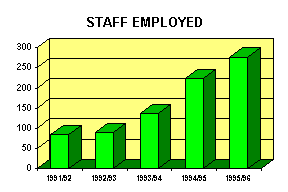
With a staff component comprising some
280 officials towards the end of the year under review, the commitment,
financially and otherwise, in meeting the demands in a new telecommunications
environment, needs no further elucidation. This can be better understood
if cognisance is taken of the fact that, apart from policy issues, certain
essential telecommunications functions such as Consumer Protection, Satellite
Communication, Technical Standards and Industry Relations virtually have
to emerge from the surface. As referred to previously, training, development
and related uplifted programmes will have to feature strongly as a sure
means of reaching our objectives. For this reason much effort has been
directed towards at least establishing a basic understanding of communications
through various methods of instruction where the need existed. These actions
need to be intensified, but the machinery is in motion and the longer term
investment will not go unrecorded.
Training and development
Global review
During the year the emphasis was primarily
placed on the training needs of the technical staff, which culminated in
the formulation of two courses for this group. Firstly an accredited three-year
post matric qualification, similar to a training programme provided by
City and Guilds of London, was developed. The course will be presented
during the ensuing year, subsequent to it having been screened by the to
be formed National Qualifications Framework. The other programme comprises
a radio course modelled in line with the Amateur Radio League Programme,
which has been designed to provide a non-qualified technical personnel
with basic information in the radio field.
A training needs analysis for the entire
Department was completed and the information processed. The following courses
has been developed:
-
Principles of Supervision
-
Team Building and Situational Leadership
-
Communication
-
Presentation Skills
-
Time Management
-
Middle Management
-
Literacy/Writing Skills
-
Enhanced Language Skills
-
Mentor-Protégé Programme
-
Project Management
In-service Training
In-service training has met expectations
and has created an awareness of its significance. The importance of quality
time spent to establish a structured and methodical means of developing
subordinates has been widely promoted. These incentives will continue.
The way forward
An understanding of the working and
interdependence of the various departmental structures has been promoted
where such a need existed. This exercise was amplified by focusing attention
on the importance of the individual and his/her role in the organisation.
This laid a sound basis for the official to grasp the responsibility individually
and collectively towards meeting the many new demands in a re-engineered
telecommunications environment.
COMMUNICATION
SERVICES
Mission
The aim of Communication Services is
to promote the image of the Department, cultivate sound relations and improve
the manner in which information is disseminated, both within the Department
as well as to the general public.
Activities
During the period 1 April 1995 to 31
August 1995, the Senior Manager: Communication Services was attached to
the Parliamentary Office in Cape Town where she acted as Public Relations
Officer for the Postmaster General and the Department. She returned to
Pretoria in September 1995, where a small section was started with two
staff members. A monthly internal staff newsletter was introduced, and
arrangements were made, in collaboration with the National Telecommunications
Policy Project and the Ministry, for the National Colloquium on Telecommunications
Policy which was held from 20 to 23 November 1995.
At the insistence of this section,
management sanctioned the introduction of an Achiever of the Month Award
during November 1995. The award takes the form of peer group recognition
of excellence, and is intended to give recognition to employees whose exemplary
conduct or achievements contribute to improving communication within the
Department, promoting the esprit de corps and enhancing the quality
of service rendered to the general public.
The regional offices were visited during
November and December 1995, and the opportunity was also utilised to distribute
promotional material regarding the Green Paper on Telecommunications Policy
to non-governmental and non-profitable organisations. Preparations were
made for the introduction of a departmental library, but due to financial
constraints, these plans had to be shelved until the following financial
year. Preparatory meetings for the Information Society and Development
(ISAD) Conference, a major international event which was planned for May
1996, were also attended. The activities of the section for the reporting
year ended with the launch of the White Paper on Telecommunications Policy
in Cape Town on 15 March 1996.
FINANCIAL STATEMENTS
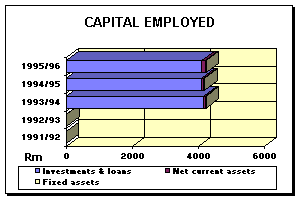
BALANCE SHEET AS AT 31 MARCH
1996
| Capital
employed |
1996 R'000
|
Notes
|
1995 R'000
|
Capital reserves.................................
|
4,100,163
|
2
|
4,100,163
|
Income reserves....................................
|
144,896
|
3
|
96,068
|
| |
4,245,059
|
|
4,196,231
|
| Employment
of capital |
|
|
|
Fixed assets..........................................
Investments and loans...........................
Net current assets..................................
|
|
4 5
|
|
| |
|
|
|
Current assets...................................
|
115,083
|
|
72,637
|
Debtors.....................................
Deposits and amounts immediately recoverable
|
10,957
104,126
|
6 7
|
12,264
60,373
|
| |
|
|
|
Current liabilities ............................
|
5,598
|
|
9,711
|
Sundry creditors..........................
|
5,598
|
8
|
9,711
|
| |
|
|
|
| |
4,245,059
|
|
4,196,231
|
| |
|
|
|
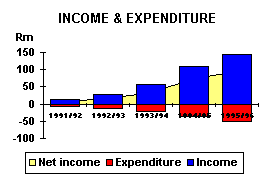
INCOME STATEMENT FOR THE YEAR ENDED
31 MARCH 1996
| |
1996 R'000
|
Notes
|
1995 R'000
|
| Income......................................................... |
143,806
|
|
108,963
|
Operating income...............................
|
143,806
|
9
|
108,963
|
| |
|
|
|
| Expenditure.......................................... |
50,358
|
|
35,421
|
Operating expenditure........................
|
50,358
|
10
|
35,421
|
| |
|
|
|
| Net income.................................................. |
93,448
|
|
73,542
|
| |
|
|
|
| Amounts
appropriated from operating surplus....... |
44,620
|
|
40,000
|
Transfer to the National Revenue
Fund ..........
|
44,620
|
|
40,000
|
| |
|
|
|
| Unappropriated
............................................ |
48,828
|
3
|
33,542
|
| |
|
|
|
CASH FLOW STATEMENT FOR THE YEAR ENDED
31 MARCH 1996
| |
1996 R'000
|
Notes
|
1995 R'000
|
| Cash
retained from operating activities............... |
95,193
|
|
52,504
|
Cash generated by operations...................
Investment income...............................
(Utilised to increase operating capital)
/ Produced by reduction of operating capital..............
|
89,988
8,011
(2,806)
|
11 11
12
|
64,340
10,037
(21,873)
|
| |
|
|
|
| Cash
utilised in investment activities.................. |
(6,820)
|
|
(16,608)
|
Additions to fixed assets............................
Proceeds of insurance claim in respect
of fixed assets....
Decrease in loans to officials.....................
|
(7,043)
91
132
|
13 14
|
(16,751)
-
143
|
| |
|
|
|
| |
88,373
|
|
35,896
|
| Cash
effects of financing activities |
|
|
|
(Increase) / Decrease in deposits
and amounts immediately recoverable..................
|
(43,753)
|
|
4,104
|
Appropriated from operating
surplus for transfer to the National Revenue Fund................
|
(44,620)
|
|
(40,000)
|
| |
(88,373)
|
|
(35,896)
|
| |
|
|
|
| |
|
|
|
Notes to the financial statements as at 31 March
1996
1. Accounting policy
1.1 Accounting basis
The transfer of the running of the
telecommunications service and the postal service to the public successor
companies Telkom SA Ltd and SA Post Office Ltd with effect from 1 October
1991, reduced the functions of the Department of Posts and Telecommunications
to regulatory governmental functions for which provision is made in the
Radio Act, 1952 (Act No. 3 of 1952), and the Post Office Act, 1958 (Act
No. 44 of 1958). The financial statements have been drawn up in terms of
the provisions of the Post Office Act, 1958, according to the historical
cost basis and conforms with the basis for the period 1 April 1994 to 31
March 1995. In terms of the provisions of section 12G(3) of the Post Office
Act, 1958 (Act No. 44 of 1958) the following expenditure in connection
with orders to which the Department is committed and which was incurred,
was, as far as possible, booked against voted funds for the 1995/96 financial
year :
-
Orders in respect of operating and capital
expenditure which were placed before the close of business on 31 March
and in respect of which the Department is obliged to perform but for which
the goods or services have not yet been received/delivered;
-
Ordered goods received and services rendered
for which payment had not been made at the close of the financial year;
and
-
Advance payments on a percentage basis
according to contract in respect of commitments entered into prior to 31
March for which equipment must be manufactured and delivery and final payment
be made upon completion after the close of the financial year.
The accounting policy has been consistently
applied in all material respects.
1.2 Income acknowledgement in
general
As opposed to the Department’s
financial year private radio communication licence fees are levied for
a calendar year. The acknowledgement of this income takes place without
taking into account the accrual basis and includes all amounts levied during
the financial year irrespective of the licence year to which it applies.
All other income is brought to account on the cash basis.
1.3 Fixed assets and depreciation
Fixed assets are stated at
cost price less accumulated depreciation and are depreciated according
to the straight-line method over their estimated useful lives from the
financial year that follows the date of commissioning.
Furniture is regarded as operating
costs and written off against income in the year of purchase.
1.4 Investments
Investments in shares are
shown at the valuation of the shares as at the date of issue.
2. Capital reserves
Telkom SA Ltd and SA Post
Office Ltd have, in terms of the provisions of sections 3(4)(a) and 5(1)
of the Post Office Act, 1958, each issued to the State 3,899,222,728 and
200,939,821 ordinary shares respectively with a par value of one rand each
which have been accounted for under Investments and Loans (See note 5).
The shares issued to the State represent the net asset value of the relative
enterprises as determined at 30 September 1991 by the then Minister of
Transport and of Posts and Telecommunications with the consent of the Minister
of Finance.
| |
1996 R’000
|
1995 R’000
|
| 3. Income
reserves |
|
|
Balance at beginning of year........................
Unappropriated income.....................................
|
96,068
*48,828
|
62,526
*33,542
|
Balance at year end..........................................
|
144,896
|
96,068
|
* Unappropriated income is
used to finance capital expenditure.
|
|
|
| |
|
|
| 4. Fixed
assets |
|
|
Electronic support equipment
for the control of radio activities at cost price ......................
Less: Accumulated depreciation...............
|
28,111
2,831
|
18,796,286
|
| |
25,280
|
18,510
|
Plus: Commitments accrued
in respect of assets that have not yet been received on 31 March......
|
* 1,038
|
* 6,021
|
| |
26,318
|
24,531
|
| |
|
|
Vehicles at cost price....................
Less: Accumulated depreciation..................
|
3,638,703
|
2,710,147
|
| |
2,935
|
2,563
|
Plus: Commitments accrued
in respect of assets that have not yet been received on 31 March......
|
* 205
|
* 93
|
| |
3,140
|
2,656
|
| |
|
|
Office equipment and labour-saving
devices at cost price.....
Less: Accumulated depreciation..................
|
6,642
1,410
|
4,988,411
|
| |
5,232
|
4,577
|
Plus: Commitments accrued
in respect of assets that have not yet been received on 31 March......
|
* 240
|
* 730
|
| |
5,472
|
5,307
|
| |
|
|
Private automatic branch exchange
at cost price...................
Less: Accumulated depreciation..................
|
504
92
|
491
43
|
| |
412
|
448
|
Plus: Commitments accrued
in respect of assets that have not yet been received on 31 March......
|
* 3
|
* 2
|
| |
415
|
450
|
| |
35,345
|
32,944
|
Creditors in respect of assets
received or on order as at 31 March (See notes 1.1 and 8)....................................
|
1,717
|
6,558
|
Less: Assets received but
not yet paid on 31 March (See note 1.1(b)).................
|
338
|
-
|
| |
1;379
|
6,558
|
Plus: Assets paid in advance
but not yet received on 31 March (See note 1.1(c)).................................
|
107
|
288
|
Total commitments accrued
.............................
|
* 1,486
|
* 6,846
|
Depreciation of assets
|
|
Fixed assets are depreciated
at rates calculated to write off the assets over their estimated life span
as indicated below:
|
|
| |
Life span (years)
|
| |
|
Electronic support equipment..................................
Vehicles..................................................................
Office equipment and labour-saving
devices.........................................
PABX system..........................................................
|
5
5
5
10
|
| |
|
Fixed assets to the value
of R11,952,000 (1995 - R12,637,000) were paid for at the end of the previous
financial period but only put into service at the beginning of 1995/96.
Consequently these assets have not been depreciated.
|
|
| |
1996 R’000
|
1995 R’000
|
| 5. Investments
and loans |
|
|
Investments in other enterprises
|
|
|
Telkom SA Limited..................................
SA Post Office Limited...............................
|
3,899,223
200,940
|
3,899,223
200,940
|
| |
*4,100,163
|
*4,100,163
|
Loans to officials
|
|
|
Motor scheme for senior officials.....................
Student loans (children of staff members)........
|
9,57
|
172,26
|
| |
66
|
198
|
* (See note 2)
|
4,100,229
|
4,100,361
|
| |
|
|
| 6. Debtors |
|
|
Private radio communication
debtors................
|
10,071
|
11,398
|
Other debtors....................................................
|
886
|
866
|
| |
10,957
|
12,264
|
| |
|
|
7. Deposits and amounts
immediately recoverable
|
|
|
On demand (Nedbank).............................
|
104,126
|
60,373
|
| |
|
|
| 8. Sundry
creditors |
|
|
Current account: Telkom SA
Limited.................
Creditors in respect of assets received
or on order as at 31 March (See note 1.1)...................................................
Creditors in respect of operating expenditure
as at 31 March (See note 1.1)...........................................................
Other creditors..................................................
|
22
1,717
3,857
2
|
1,731
6,558
1,421
1
|
| |
5,598
|
9,711
|
| |
|
|
| 9. Operating
income |
|
|
Private radio communication
licence income.........
Terminal equipment licence income..................
Income from investment (short term)..............
Miscellaneous income :
|
57,556
290
8,011
77,949
|
55,887
-
10,037
43,039
|
Cellular telecommunications
licence fees........
Cellular net operating income fee...............
Other.............................................................
|
*44,620
32,399
930
|
40,000
1,594
1,445
|
| |
143,806
|
108,963
|
* Payable to the National
Revenue Fund.
|
|
|
| |
|
|
| 10. Operating
expenditure |
|
|
Staff expenses..................................................
Material and services........................................
Accommodation................................................
Transport..........................................................
International commitments................................
Services rendered by state departments,
successor companies, consultants and agents.....................................
Losses : Fixed assets...................................
Operating........................................
Depreciation of assets.......................................
Miscellaneous.................................................
|
23,115
2,995
3,923
2,103
3,213
*9,894
402
273
4,149
291
|
15,644
1,782
3,080
1,254
2,701
*9,942
-
99
835
84
|
| |
50,358
|
35,421
|
* Includes audit fees amounting
to R266,000 in respect of regularity auditing. (1995 - R168,000)
|
|
|
| |
|
|
11. Cash generated by
operations
|
|
|
| |
|
|
Net income according to income
statement.........
Adjustments for :
Depreciation..................................................
Losses......................................................
Investment income........................................
|
93,448
4,149
402
(8,011)
|
73,542
835 -
(10,037)
|
| |
89,988
|
64,340
|
| |
|
|
12. Utilised to increase
operating capital / produced by reduction of operating capital
|
|
|
| |
|
|
Increase/(Decrease) in debtors.........................
(Increase)/Decrease in creditors.......................
|
(1,307)
4,113
|
681
21,192
|
| |
2,806
|
21,873
|
| |
|
|
| 13.
Additions to fixed assets |
|
|
| |
|
|
Electronic support equipment
for the control of radio activities
Vehicles..........................................................
Office equipment and labour saving
devices............
Private automatic branch exchange..................
|
(4,648)
(1,143)
(1,239)
(13)
|
(13,375)
(1,465)
(1,844)
(67)
|
| |
(7,043)
|
(16,751)
|
| |
|
|
| |
|
|
14. Proceeds of insurance
claim in respect of fixed assets
|
|
|
| |
|
|
Book value of assets written
off.........................
|
102
|
-
|
Loss due to write-off.......................................
|
(11)
|
-
|
| |
91
|
-
|
15. Tax
No provision for tax has been
made as the Department is exempted from income tax.
16. Pension fund
Pension benefits are provided
by membership of the Government Service Pension Fund (GSPF). The GSPF is
materially underfunded. It is expected that the State will assume responsibility
for the underfunded portion of the fund.
STATISTICAL
OVERVIEW
1 OCTOBER 1991 TO 31 MARCH
1996
| |
1995/96
|
1994/95
|
1993/94
|
1992/93
|
1991/92
|
| Capital
employed (Rm) |
4,245,059
|
4,196,231
|
4,226,689
|
28,427
|
13,239
|
Fixed assets (Rm)
|
35,345
|
32,944
|
17,028
|
2,302
|
0,170
|
Investments & loans (Rm)
|
4,100,229
|
4,100,361
|
4,164,504
|
0,456
|
0
|
Net current assets (Rm)
|
109,485
|
62,926
|
45,157
|
25,669
|
13,069
|
| Net income
(Rm) |
93,448
|
73,542
|
34,099
|
15,188
|
7,246
|
Income (Rm)
|
143,806
|
108,963
|
56,269
|
28,205
|
13,069
|
Expenditure (Rm)
|
50,358
|
35,421
|
22,170
|
13,017
|
5,823
|
| Staff employed |
277
|
223
|
137
|
90
|
85
|
| Licences/certificates
issued |
|
|
|
|
|
Amateur radio stations
|
6,008
|
6,131
|
5,793
|
5,584
|
5,372
|
Private radiocommunication
|
929,304
|
900,248
|
862,064
|
807,414
|
607,676
|
Radio operators certificates
|
51,061
|
48,745
|
46,629
|
44,392
|
41,976
|
Ship stations
|
4,120
|
3,535
|
3,489
|
3,695
|
3,530
|
Aircraft stations
|
4,524
|
4,308
|
4,288
|
4,219
|
3,437
|