Today we look back at a public service that has made significant strides in extending basic services to the disadvantaged; a public service more representative of the people it serves and more accountable to the electorate.
But despite the gains, the public service continues to be faced with daunting challenges. Expenditure on health, welfare and education services has grown rapidly since the dawn of the new democratic order, yet society is still afflicted by abnormally high infant mortality rates, low life expectancy, high levels of poverty and poor literacy levels. Equally, the criminal justice system is struggling to break the cycle of crime and lawlessness, notwithstanding significant increases in the budgets of departments in this cluster.
Against this background it is incumbent on the government to find ways of increasing the impact of public spending and improving the quality of service delivery. Initiatives already launched include the development of management plans, the “Batho Pele” campaign, improved financial management and improved co-ordination at the centre of government. But all these initiatives depend heavily on capable and committed senior government officials.
Senior managers and high-level professionals must concretise government’s vision of a better life for all through effective implementation strategies and the efficient utilisation of resources. In this demanding environment there can be no place for mediocrity or lack of commitment. Only the finest candidates, imbued with a spirit of selfless service to the community should be appointed. Their talents should be carefully nurtured, and once well developed, be utilised to the best advantage of the state.
With the above objectives in mind, the Minister for the Public Service and Administration commissioned a study on the senior layer of the public service. This comes at a time of growing concern at the ability of government departments to convert policy into practice and to utilise the resources allocated to them effectively.
Issues put under the spotlight in the study were the recruitment and selection of senior managers and professionals; their retention, terms and conditions of service, competency requirements and training needs; as well as performance assessments and career management. National and provincial departments were briefed on the findings of the study and given an opportunity to comment on the recommendations.
The report and the ensuing debates confirmed the following persistent problems:
The report1 also highlighted the uneven distribution of managers in the top layers.
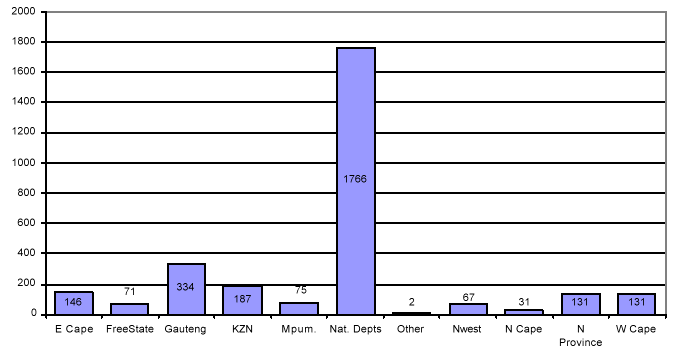
Chart 1: Senior managers by province and national departments
Chart 1 indicates that the majority of managers (around 60%) at the most senior levels are based in national departments, despite only around 30% of public servants being employed by national departments. This confirms that the provinces are essentially under-managed. The severity of the problem differs from province to province, but those worst affected are the Northern Province, Northwest, KwaZulu-Natal, Eastern Cape and Free State.
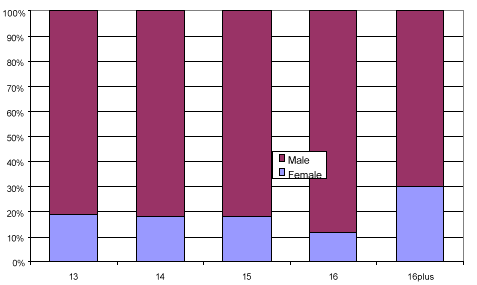
On a positive note the report confirmed that significant progress has been made in achieving greater representativeness at the top levels in terms of race. In all of these categories (director and higher) Government has met its target of at least 50% black managers by 2000. In terms of gender, progress has been less significant. The current situation is depicted by the following two charts:
Chart 2: Senior managers by race and salary level
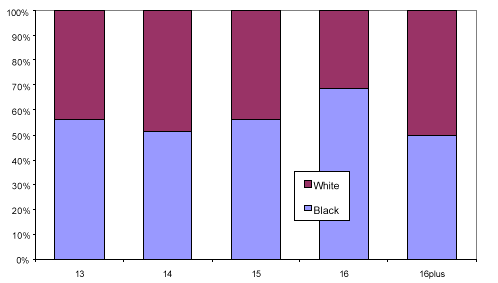
Chart 3: Senior managers by gender and salary level
Taking into account the need to attract and retain capable managers and professionals, the current remuneration framework was assessed: The key conclusion was that the framework is not flexible enough to attract and retain scarce skills. At the moment persons graded at the same level, e.g. directors, are all paid the same, notwithstanding groups such as medical and financial managers commanding much higher salaries in the open market. A range of other problems are also being experienced, including an unusually high percentage of the remuneration package going towards benefits and very little flexibility to structure packages according to individual need.
Another feature of the current remuneration system is the poor distinction between senior managers and highly skilled specialists (“professionals”). In order to access fringe benefits such as the car scheme, professionals at director level and higher level are often artificially classified as senior managers.
With regard to collective bargaining managers currently find themselves in an ambiguous situation. Many of their terms and conditions of service are contained in collective agreements, while their annual salary adjustments are determined outside of the collective bargaining process. Collective agreements such as the agency shop agreement also apply to senior managers. This causes serious conflicts of interests because the agency shop agreement encourages senior managers to become members of unions, often the very same unions they must deal with as managers.
Given the pivotal role of senior managers and high-level professionals in the delivery of public services, urgent interventions are required to:
To achieve the above, and generally to professionalise this important layer of the public service, a distinct Senior Management Service should be established. This would include Heads of Departments and the approximately 3000 other senior public servants.
Provision for the SMS would have to be made in law. This will ensure that uniform norms and standards apply to recruitment and selection, salary determination and conditions of service, performance assessments, career progression, training and development, management of conduct and ethics, and termination of service.
These uniform norms and standards will apply to all national and provincial departments. However, some differentiation will be required in respect of the SA Police Service (SAPS) and the SA National Defence Force (SANDF). Such differentiation should, however, not undermine the basic objectives in establishing the SMS. The systems to be introduced by SAPS and SANDF should be cleared with the Minister for the Public Service and Administration. With regard to magistrates and prosecutors, the same approach is proposed i.e. the degree of differentiation should be cleared with the Minister for the Public Service and Administration. The intelligence agencies (NIA & SASS) have totally different human resource systems and terms and conditions of service, with the result that it would be impossible to implement the under-mentioned recommendations without a major overhaul of their employment frameworks. This is not prudent at this point in time.
The following paragraphs outline the key action steps to be taken.
To improve the State’s ability to attract and select quality candidates, specially– designed systems of recruitment and selection need to be adopted. These systems must include appropriate control measures aimed at verifying the track records of candidates. Revised employment equity targets must also be set to ensure that momentum is retained in establishing a representative senior management cadre. In addition, top graduates with SMS potential must be identified for internships and possible employment after their graduation. Consideration will be given to introducing a competency assessment for junior and middle managers aspiring for appointment to the SMS. The names of top achievers, who also have a good performance record, should be made available to all departments.
The question has arisen whether senior managers should be appointed on fixed term contracts, but there is general agreement that the present system should be maintained whereby only Heads of Department (HOD’s) are appointed for fixed terms. Although nothing precludes an executing authority from appointing other senior managers and professionals on fixed term contracts as well, this should generally not be promoted. Open-term contracts (i.e. permanent appointments) encourage skilled personnel to consider a career in the public service and ensure continuity in the delivery of services. Furthermore, an open-term contract does not prevent the employer from terminating the employment of consistently poor performers, and termination is much cheaper for the state.
To enhance the quality of the SMS, the ideal would be to evaluate the jobs of all senior managers in order to establish at what level the jobs should be graded and what key competencies are required of the incumbents. The same process should be followed with respect to high-level professionals as well as heads of institutions in especially the provinces.
Having determined the correct grading of these positions and the job requirements, the jobholders should also be assessed. The latter assessments should focus on the core managerial and functional competencies required of the incumbents. This would reveal the suitability of the managers/professionals for the positions they hold and their training needs. Informed decisions can then be taken on the utilisation and development of the incumbents.
An alternative is to introduce centrally monitored job evaluations and competency assessments only for new jobs and new recruits, thereby gradually improving the quality of the SMS.
Given the pros and cons of each of the above two options as well the magnitude of the task, a hybrid of both is suggested. As a first phase quality-controlled job evaluations and competency assessments should be piloted in a number of departments that are undergoing restructuring. Once the methodology has been refined, phase two should commence. This would involve quality-controlled job evaluations and competency assessments in respect of all other SMS positions and incumbents. Priority attention should be given to those departments with the most severe delivery problems and those undergoing restructuring. The first phase would commence in August/September 2000 and phase two in January 2001.
To facilitate transparent budgeting and planning, while allowing greater flexibility in remunerating individual managers according to their market scarcity and individual worth, a new salary structure should be developed. Such a structure would have the following features:
In future, the MPSA will make an annual adjustment to the salary scale, essentially as a cost-of-living related adjustment. This adjustment will be delinked from the adjustment date for the rest of the public service to emphasise the distinct nature of the SMS.
HOD’s will be empowered to grant annual performance bonuses to senior managers and high-level professionals within defined parameters. These bonuses will be based on a formal (uniform) assessment process, drawing on the experiences of departments in developing their own systems.
To facilitate transition to the new system and to ensure its maintenance -
To allow for better mobility-
To address the need for improved human resource development–
A set of regulations/protocols will be developed governing various aspects of conduct and ethics in relation to political activities, declaration of interests and disclosure/use of official information after leaving the public service. These will be aimed at minimising conflicts of interest and promoting professional conduct.
A high-powered senior management unit will be established within the DPSA. This unit will assist departments in implementing the new SMS dispensation and develop and maintain appropriate human resource systems, uniform norms and standards, and improved management information on senior managers.
The unions in the Public Service Co-ordinating Bargaining Council (PSCBC) will be consulted on the establishment of a professional association for senior public servants and the removal of all conditions of service of senior executives from the ambit of the PSCBC so as to eliminate role conflict.
Provision for the Senior Management Service will be made in the Public Service Regulations. The Regulations will incorporate all norms and standards needed to give effect to the policy shifts advocated in this document.
Most of the groundwork for implementation of the SMS will be completed by the end of the year. Implementation will commence as from 1 January 2001.
________________________
Charts 1-3 indicate the number of employees at salary level 13 and above. It is based on an analysis of February 2000 data done by the DPSA. It excludes police and defence.