SCIENCE & TECHNOLOGY NEWSLETTER
May
1998
"HEADS
OF SCIENCE COUNCILS SPEAK TO THE PORTFOLIO COMMITTEE"
 The Presidents of the Agricultural
Research Council, Human Sciences Research Council, Medical
Research Council, Council for Geoscience, South African Bureau of
Standards, and the Executive Vice-President of the CSIR, met with
the Arts, Culture, Science and Technology Portfolio Committee on
May 11.
The Presidents of the Agricultural
Research Council, Human Sciences Research Council, Medical
Research Council, Council for Geoscience, South African Bureau of
Standards, and the Executive Vice-President of the CSIR, met with
the Arts, Culture, Science and Technology Portfolio Committee on
May 11.
Emanating from the discussion
was the concern that, given the correlation between economic
performance and investment in research and development, the
current DACST funding model for science and technology was not
being adequately resourced. With the Science Councils having
recently undergone a rigorous review, it was felt that to assure
value for money across the public sector, there should be a
review of all public institutions. This would include Government
departments and those in the Higher Education sector who do
research.
THE
VALUE OF INDIGENOUS KNOWLEDGE
 Scientists investigating the properties
of the African potato - called hypoxix
by botanists, but known to the indigenous people of the continent
for centuries - suspect it has the ability to boost the human
immune system.
Scientists investigating the properties
of the African potato - called hypoxix
by botanists, but known to the indigenous people of the continent
for centuries - suspect it has the ability to boost the human
immune system.
This knowledge, which could
prove to be of value in the field of AIDS research, was but one
example which could substantially improve the quality of life of
many South Africans, chairman of Parliament's Science and
Technology Portfolio Committee Dr Wally Serote said on Friday,
May 15.
 Through an "indigenous knowledge systems
programme" being conducted by a team of experts from five
science councils and nine universities, this technology could be
translated into enterprises and industry that would contribute
towards the African renaissance, he told a media briefing at
Parliament. African technologies were being examined in the areas
of arts and culture, medicines, food production and engineering.
Members of the team at the briefing cited other examples of
valuable local technologies.
Through an "indigenous knowledge systems
programme" being conducted by a team of experts from five
science councils and nine universities, this technology could be
translated into enterprises and industry that would contribute
towards the African renaissance, he told a media briefing at
Parliament. African technologies were being examined in the areas
of arts and culture, medicines, food production and engineering.
Members of the team at the briefing cited other examples of
valuable local technologies.
 One was the production of marula juice in
the Northern Province, which had the potential to become a viable
local enterprise. Another, in the same area, was the exploitation
of a species of frog as a food source. The creature was currently
eaten as a delicacy by local people. An investigation into the
properties of various herbs was yielding interesting results in
treating livestock diseases.
One was the production of marula juice in
the Northern Province, which had the potential to become a viable
local enterprise. Another, in the same area, was the exploitation
of a species of frog as a food source. The creature was currently
eaten as a delicacy by local people. An investigation into the
properties of various herbs was yielding interesting results in
treating livestock diseases.
Serote said a Private Members'
Bill to protect and promote indigenous technology was being
drafted. This would be ready for presentation to Parliament by
September.
GOVERNMENT
SHOULD HAVE AN ETHICAL FRAMEWORK
 The government should exercise a broad
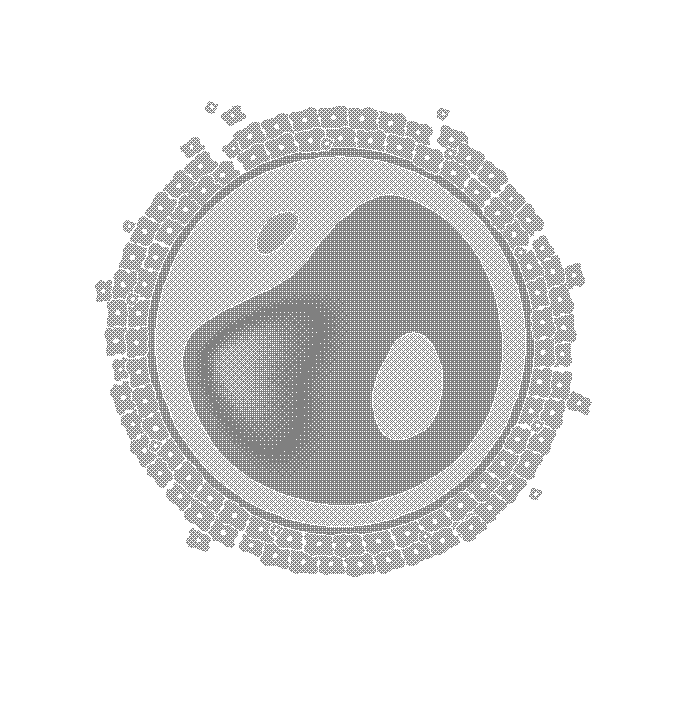
framework of control over the ethics of issues such as cloning
and test-tube babies, the chairman of the Medical Research
Council, Prof William Makgoba, said on Wednesday, May 20. Unlike
the United States of America, South Africa has no laws on ethics.
The government should exercise a broad
framework of control over the ethics of issues such as cloning
and test-tube babies, the chairman of the Medical Research
Council, Prof William Makgoba, said on Wednesday, May 20. Unlike
the United States of America, South Africa has no laws on ethics.
Briefing Parliament's Science
and Technology Portfolio Committee on the human cloning
conference he had recently attended in Turin, Italy, he said
pressure on society from infertile couples had driven it into all
kinds of directions. With South Africa not having any laws to
prevent producing test-tube babies, he said,
 "You can soon go and buy a test-tube
baby from anybody."
"You can soon go and buy a test-tube
baby from anybody."
He said the media could
"obviously" only play an important role on issues such
as ethics, "if it did not engage in sensationalist
reporting". "Journalists are good at inaccurate
reporting; we just hope they'll conduct themselves in a
responsible manner." Science assaults ignorance, and
reactions to the subject of cloning must not be based on fear.
This was an issue of society, not research, and scientists must
have a social conscience.
Makgoba said he had been the
only representative from the African continent at the Turin
conference. He would have thought that at least the relevant
South African government departments would have known about it -
there had been top-level government representatives from many
other countries. He warned that, since Africa has the most
diverse gene pool, it would become the new playground of the
West. It is not an issue we can dismiss, it has implications for
individuals, society and the African continent, and we need to
formulate legislation protect ourselves against this new
industry. Within this context, Committee chairman Dr Wally Serote
pointed out that the National Archive Bill would protect oral
intellectual capital; the National Council on Innovation would
advise on a point of reference for definitions in indigenous
knowledge systems, and the National Research Foundation would
link research and indigenous technologies.
"Until we better explore
relationships between our different knowledges, we will not have
a richer society," Makgoba said. Dr Serote concurred,
saying: "It is our responsibility as African intellectuals
to know what is on the world agenda."
This SCIFLASH, which
highlights current science and technology happenings, to inform
Members of Parliament, was put together by  CSIR
Parliamentary Affairs, in consultation with Wally
Serote (Chair
of the Arts, Culture, Science and Technology Portfolio
Committee). Please contact (021) 403-2655 with comments.
CSIR
Parliamentary Affairs, in consultation with Wally
Serote (Chair
of the Arts, Culture, Science and Technology Portfolio
Committee). Please contact (021) 403-2655 with comments.
 Back to the Portfolio Committee Table of
Contents
Back to the Portfolio Committee Table of
Contents