|
Vol. 418, No. 21126, 26 April 2000
GENERAL NOTICE
Notice 1689 of 2000
DEPARTMENT OF PROVINCIAL AND LOCAL GOVERNMENT
The White Paper on Municipal Service Partnerships (MSPs) is hereby published for comment.
All interested persons are invited to furnish written comments to:
The Director General
Attention: Ms. G Moloi
Department of Provincial and Local Government
Private Bag X804
Pretoria
0001
Comments may also be faxed to the facsimile number (012) 3340610
All comments must be received by no later than 2 June 2000.
Foreword by Minister Mufamadi
Section 1 The Rationale for a Municipal Service Partnership Policy
1.0 Overview
1.1 Challenges Facing Municipal Service Delivery
1.2 What are Municipal Service Partnerships?
1.3 Why Use Municipal Service Partnerships?
1.4 Realising the Benefits from Municipal Service Partnerships
Section 2 Policy Issues
2.0 Overview
2.1 MSP Policy
2.2 Implementation Strategy
Section 3 The Legislative Frarne~vork and Municipal Service Partnerships
3.0 Overview
3.1 Legal Authority of Municipal Councils to Engage in MSPs
3.2 Other Aspects of the Legislative Framework Affecting MSPs
Section 4 Municipal Service Partnerships Panning and Procurement
4.0 Overview
4.1 MSP Planning
4.2 Definition and Role of the Procurement Stage
4.3 Formal Competitive Tendering
4.4 Competitive Negotiation
4.5 Competitive Solicitation
4.6 Bid Evaluation
4.7 Exceptions to the Requirement for Competitive Procurement
4.8 Unsolicited Proposals
4.9 Probity
4.10 Transparency
4.11 Amendment and Re-Negotiation
Section 5 Capacity Building
5.0 Overview
5.1 The Linkage between Capacity Enhancement and Service Delivery
Section 6 Institutional Roles and Responsibilities
6.1 Municipal Council Institutional Arrangements
6.2 Additional Institutional Functions
Glossary of Terms
by Fholisani Sydney Mufamadi
Minister for Provincial and local Government
South Africa is Acing daunting challenges for municipal service delivery. As the White Paper on Local Government published in March 1998 indicates, achieving the Reconstruction and Development Programme (RDP) objectives within a reasonable time frame requires municipalities to look at innovative ways of providing municipal services. Partnerships between municipalities and the public sector, the private sector and community and non-governmental organisations (CBOs/NGOs) are a key option that municipalities should consider in their efforts to rectify infrastructure deficits and disparities. However, improving and expanding the delivery of municipal services through municipal service partnerships (MSPs) is new ground for South Africa. Developing the partnership concept into a practical and beneficial method for providing good quality and affordable services for all required Government to review and consolidate its policies on these matters.
The delivery of municipal services through MSPs requires a clear and stable policy environment for the municipalities, service providers and investors to enable mobilisation of resources to meet RDP objectives. For these reasons the Government embarked on an intensive 1 2-month period of consultation and research, which has culminated in the Policy Framework for Municipal Service Partnerships.
In the development of the policy, every effort has been made to ensure that the process has been inclusive, interactive and transparent. A four-phased approach ensured that all stakeholders were included in the consultative process over the past 12 months.The first phase resulted in an Issues Document that identified the key strategic and policy issues to be addressed by the MSP Policy Framework. The second phase, consisting of focused research, extensive interviews and other consultation processes resulted in the publication of the First Draft of the MSP Policy Framework, which was released for public comment in August 1 998.The third phase, consisting of MinMec discussions, public submissions, and workshops for councillors, municipal officials, the private sector and CBOs/NGOs, resulted in the Second Draft of the MSP Policy Framework in December 1 998.The fourth phase during which stakeholder opinions were further solicited and obtained, resulted in the Final Draft of the Municipal Services Partnership Policy, which was present for public comment in May 1999 at the conference Towards a Programme for Municipal Infrastructure in the 21st Century.
The Department of Provincial and Local Government (DPLG) has worked closely with the relevant national departments and the South African Local Government Association to produce the Municipal Service Partnership Policy document. To assist them in meeting our commitments in terms of the RDP,we hope municipalities will use this document. The document is the product of an intensive process in which a large number of dedicated people participated. They include the representatives from municipalities that attended the workshops, representatives from the private sector, NGO/CBO sector, unions, the authors of the draft.* policy papers, representatives from parastatals and members of my Department, to list a few.
I would like to thank the team of local and international advisors who assisted us to draw up this document. A special thanks is given for the financial support from the United States Agency for International Development. To all of you I would like to convey my thanks for the hard work that you have put into this important project. I believe that you will be rewarded through seeing this policy contribute to the social and economic upliftment of communities across the country.
| Responsibility | According to the Constitution, the executive and legislative authority of a municipality is vested in its municipal council.The Constitution gives municipal councils the obligation to ensure that municipal services are delivered to their municipalities in a sustainable way. This is a daunting challenge. Despite the significant contribution made by recent public infrastructure programmes, the demand for basic services continues to Or outpace available government finances. |
| Backlog | It is difficult to quantify the precise extent of the municipal infrastructure and service backlog. However, it has been conservatively estimated that the total cumulative backlog is about R 47 - 53 billion, with an average annual backlog of R 10,6 billion. According to the analysis of the Medium Term Expenditure Framework prepared for 1998/99, if these backlogs are addressed through public sector resources alone, many communities will receive adequate services only in the year 2065. |
| Innovation | The White Paper on Local Government recommends that municipalities look for innovative ways of providing and accelerating the delivery of municipal services. The Municipal Service Partnership (MSP) Policy aims to provide a clear framework within which to leverage and marshal the resources of public institutions, CBOs, NGOs, and the private sector towards meeting the country's overall development objectives. |
| Underlying principles | It is government's explicit expectation that all stakeholders in this country want all the people to have access to adequate municipal services and to contribute actively towards principles the economy of the country.The MSP Policy has been derived from the principles of batho pele (people first). It actively promotes an ethos of participation by consumers and other stakeholders throughout the process of determining and implementing service delivery options.The MSP Policy also endorses universal access to basic services, the progressive improvement in service standards, and openness and transparency in the processes used for selecting service providers. Underlying this is the core principle that services should be affordable and delivered efficiently.. Finally, the MSP Policy supports and encourages better information flows, value for money, avenues for citizen's redress and, importantly, courtesy in service delivery. |
| Gaps in policy | Municipal councils can improve, expand and accelerate service delivery through partnership arrangements with public institutions, the private sector, or CBOs/NGOs. However, recent efforts by municipal councils to use MSPs have highlighted the existence of a number of significant gaps and constraints in the existing policy and legislative framework.These gaps and constraints create uncertainties and impose risks on both municipal councils and MSP service providers.These factors presently limit the scope for the widespread and cost-effective application of the MSP option. |
| Enabling framework | The MSP Policy provides municipal councils with a framework for considering the use of MSP arrangements. It will help municipalities to identify and use appropriate partnership arrangements in their efforts to rectify infrastructure backlogs and build a foundation for equitable growth in their communities.The objective of the MSP Policy is to ensure that MSPs are applied in a manner that supports the Constitutional obligations of municipalities and the Constitutional rights of communities.The MSP Policy will create a more conducive environment for MSPs arrangements by addressing the gaps and constraints that presently limit the use of MSPs.This will make MSPs a viable and functional service delivery option for municipalities. Municipalities will also be assisted in establishing systems to monitor the performance of service providers to ensure that they perform according to expectations and report on this to their communities. |
| - |
|
The MSP option is not an end in itself, but simply one of the means available to councils to address the municipal infrastructure and service backlog. Too often, the debate around MSPs is presented as an attempt by Government to actively promote the private sector, at the expense of the public sector, as the mechanism for municipal service delivery. MSPs are not intended to be a substitute for traditional methods of direct service delivery. Nor should they be viewed as an alternative to ongoing efforts to improve the efficiency and accountability of service delivery by the council itself. Instead, MSPs are intended to provide municipal councils with greater flexibility in addressing service delivery needs.
Municipal services are those services identified in the Constitution (Schedule 4 and 5) and other services that may be assigned by national or provincial legislation to a municipal council. A contractual agreement between a municipality and an external service provider may take any number of forms.The most typical forms of MSP contractual arrangements and their characteristics are illustrated in the table on the right. Any other contractual arrangement to provide municipal services or any variant of the arrangements described below may also be an MSP.
Typical MSP ArrangementsService contract The service provider receives a fee from the council to manage a particular aspect of a municipal service. Service contracts are usually short-term (one to three years). Examples include repair and maintenance or billing and collection functions. Evidence suggests that this type of arrangement is a starting point for involving CBOs and NGOs in municipal service provision with the other arrangements being considered as capacity and experience are develop over time. Management contract The service provider is responsible for the overall management of all aspects of a municipal service, but without the responsibility to finance the operating, maintenance, repair, or capital costs of the service. Management contracts are typically for three to five years. Management contracts generally specify the payment of a fixed fee plus a variable component - the latter being payable when the contractor meets or exceeds specified performance targets. The service provider normally does not assume the risk for collecting tariffs from residents, however, high collection rates could be a trigger for incentive payments to the service provider. An example may be contracting the management of water utility. Lease The service provider is responsible for the overall management of a municipal service, and the council's operating assets are leased to the contractor. The service provider is responsible for operating, repairing, and maintaining those assets. In some cases The service provider may be responsible for collecting tariffs from resident and assume the related collection risk. The service provider pays the council rent for the facilities, which may include a component that varies with revenues. Generally, the service provider is not responsible for new capital investments or for replacement of the leased assets. Leases are typical for eight to fifteen years. Examples include the lease of a municipal market, port or water system. Build/Operate/Transfer (BOT) The service provider undertakes to design, build, manage, operate, maintain, and repair, at its own expense, a facility to be used for the delivery of a municipal service. The council becomes the owner of the facility at the end of the contract BOTs may be used to develop new facilities, or expand existing ones. In the latter case, the service provider assumes the responsibility for operating and maintaining the existing facility, but may or may not (depending on the contract) assume responsibility for any replacement or improvement of the facility. A BOT typically requires the council to pay the service provider a fee (which may include performance incentives) for the services provided, leaving responsibility for tariff collection with the council. Concession The service provider undertakes the management, operation, repair, maintenance, replacement, design, construction and financing of a municipal service facility or system. The service provider often assumes responsibility for managing, opening, repairing, and maintenance of related existing facilities. The contractor collects and retains all service tariffs, assumes the collection risk and pays the council a concession fee (sometimes including a component that varies with revenue). The municipality still remains the owner of any existing facilities operated by the concessionaire, and the ownership of any new facilities constructed by the concessionaire is transferred to the municipality at ht end of the concession period. |
| Improving efficiency | If they are well structured and properly implemented, MSP arrangements can lead to significant improvements in the efficiency of service delivery. Greater efficiency means that significantly more services can be delivered while still remaining within the council's overall budget limits. |
| Potential advantages | Contracting a specialist service provider can have several advantages. In addition to providing specialist knowledge and expertise, such a service provider can often gain efficiency from economies of scale that may not be available to a municipal council. M5Ps also permit municipal councils to reduce their expenses for equipment rental, lease costs, initial purchase costs and technology licensing arrangements. Over time, municipalities can save on the capital costs of infrastructure expansion and technology upgrades. By linking the provision of municipal services to a definitive contractual arrangement, municipal councils are also able to know their costs in advance and therefore are in a better position to prepare their budgets and plans. In addition, by requiring a number of potential service providers to bid for the provision of municipal services, municipal councils can gain from the benefits of competition. |
| Track record | While MSPs are not a new concept for South Africa, they have not yet enjoyed widespread application or acceptance. Moreover, while some MSPs are contributing to desired improvements in service delivery, others have yielded only mixed results. |
| Requirements | An enabling environment is needed in order to realise the
potential benefits of MSPs. Municipal councils should be able to structure cost-effective
service delivery arrangements that address the needs of their communities. This means that
MSPs should meet the following requirements:
|
| Integrated initiatives | Creating a conducive enabling environment for MSPs requires a
package of closely integrated initiatives.This would include:
|
There remains some residual uncertainty within the community regarding the necessity or desirability of providing public services through partnership arrangements. This section outlines the Government's commitment to use of MSP arrangements by municipalities the and its strategy for implementing the policy.
| One option | While the Government is committed to facilitating the use of MSP arrangements, this does not mean that MSPs are the preferred option for improving service delivery. It is rather that MSPs should enjoy equal status among a range of possible service delivery options available to municipal councils. |
| Service partners | As indicated in Section 1, an MSP may include arrangements
between a municipal councils and:
|
| Integrated development plan | Determining whether to use the MSP service delivery option begins with the process of preparing the integrated development plan (IDP).The result of this process will be the municipality's municipal infrastructure investment plan. This plan sets out the specific investments and programmes (including proposed MSPs) that the municipality will require to carry out its service delivery goals and objectives. |
| Strategic direction | The choice to use an MSP is based on the needs and capacities
of individual municipal councils.The role of the national and provincial spheres is to
provide strategic direction by:
|
| Choice of partner | In developing an MSP arrangement, municipalities have to decide whether to involve the private sector, a public institution, or a CBO/NGO as their service delivery partner.This partner decision will depend on the needs of the municipality concerned.They would have to consider which of these possible partners has the capacity and resources best suited to service delivery in their particular context. |
| Private sector partnership | At the opening of parliament in June 1999, the President set a platform for a concerted action program to promote a greater role for partnerships between the private sector and the government. This type of partnership will consolidate and strengthen the resources that can be deployed to satisfy the need for public services, and for the development of South Africa's economy. In the context of MSPs, where large-scale capital investments are required, the private sector generally has the greatest capacity to enhance service delivery. |
| Public sector partnerships | Public-public partnerships can help municipalities develop important infrastructure facilities that may be beyond the capacity of CBOs/NGOs, or that may not be feasible for a public-private partnership.The development of basic infrastructure such as waste water and storm water systems could be especially suitable for public-public partnerships. Municipal councils should also consider establishing partnerships with other municipalities as this can often lead to economies of scale in purchasing and operating activities. Such benefits can also extend to sharing facilities, overheads, skills and experience. |
| Partnerships with CBOs and NGOs | Partnership arrangements with CBOs and NGOs can promote economic development in communities, strengthen democracy and empower civil society at the local level. Experience in South Africa and other countries has shown that the direct involvement of communities can be positive and beneficial in the creation of accessible and sustainable services, especially in rural areas and low-income communities. However, it is also necessary to build the capacities of these institutions so that they can be vital and active participants in service delivery.This objective is also supported by the provisions of the Non Profit Organisations Act The government will support capacity building, particularly in the area of identifying appropriate projects for NGOs/CBOs, business and financial management skills, as well as sound corporate governance. Government is developing a programme that will utilise the resources and capacities of CBOs and NGOs more effectively to realise empowerment objectives at the "grass roots" level. |
| Policy Implementation | Government's commitment to the MSP Policy will be given
practical effect through the following strategy:
This process will begin with the Local Government Municipal Systems Bill.The bill falls within the mandate of the Ministry of Provincial and Local Government. It will provide a simpler and more robust platform for municipal councils to establish MSP arrangements.
|
| Unclear legal framework | The current legal and regulatory environment relating to MSP activities is unclear in several respects.This creates risks for councils and service providers alike.These risks framework increase the projected cost of MSP arrangements, thereby reducing the present viability of many potentially useful MSP projects.This section provides an overview of the present legal and regulatory environment, identifies where actual and potential problems exist and indicates where legislative reform is necessary to operationalise the MSP Policy. |
3.1.1 Notional end provincial intervention
| Broad definitions | The scope, extent and responsibility of provinces or national departments to intervene in a municipal function are only defined in very broad terms within the Constitution.The Constitution for instance states that provinces may assume responsibility for specific obligations of a municipality in order to "maintain essential national standards or meet established minimum standards". It is however uncertain exactly what authority a province would have when intervening in a municipal function. For instance, it is not clear whether it could make a decision on behalf of the municipal council to increase local rates or tariffs to pay for the improvements in a municipal service. It is also unclear what responsibility a province would incur if it intervenes, for instance, by exercising executive authority on the municipality's behalf. |
| Definition of provincial power | Proposed legislation will more clearly define the broad provincial power that is granted by the Constitution and national legislation.This will reduce the risks heed by municipal councils and MSP service providers in cases where intervention occurs. |
3.1.2 Transparency end fairness in council decision~mokino
| Legality of arrangements | The requirement for transparency and fairness in council processes and decision making is embodied in the Constitution. However, what may be regarded as an abuse of transparency and fairness on the part of a council is largely determined under the common law. Given that MSPs are still relatively new in South Africa, it is not known how the courts may interpret a council's actions relating to an MSP arrangement. At present there is the risk that a council's decision to enter into an MSP could be challenged by law, which could delay or block the implementation of the MSP. Proposed legislation will provide suitable assurances to all stakeholders that council decisions relating to MSPs are lawful and procedurally Air. |
3.1.3 Tariff setting and collection
| Grounds for delegation | Under the Local Government Transition Act, the authority of a
council to delegate tariff setting methodologies and tariff collection is not clear
(particularly LGTA Sections IOC (7)tb), IOD (3) and I OG(7)(a)(ii)) This is a major
impediment to the successful use of lease and concession type MSPs. Tariffs are also
subject to the valid regulations and directives from national sectors (for instance, the
National Energy Regulator or the Department of Water Affairs and Forestry). Proposed
legislation will clearly establish the authority of municipal councils to, among other
things:
|
3.1.4 Council reporting
| Reporting obligations | Councils are presently obligated to meet a variety of national and provincial reporting requirements.Among other things, councils are required to report on aspects of public private partnership arrangements to the national sphere. At the same time, they are not required to report on other forms of MSPs or on traditional direct service delivery. In addition, the Promotion of Local Government Affairs Act (1983) requires councils to consult with the provincial premier before entering into a contract of any kind. However, the purposes of such reporting and consulting, and the consequences of a council's failure to comply,are unclear.TheWater Services Act (1997) also requires extensive reporting by councils on various aspects of water and sanitation services and also on various aspects of MSPs in the water services sector. |
| Reporting framework | The unclear purpose and intent of many existing reporting requirements creates uncertainty for municipalities as to the legality of their MSP arrangements. Proposed legislation will require councils to report to the national and provincial spheres only when there is a clear and definitive reason for doing so and preferably within a unified reporting framework. |
3.1.5 Providing guarantees and other forms of public financial support to MSPs
| Authority of councils | It is often necessary and desirable for municipal councils to provide various guarantees and financial assurances to MSP service providers. Department of Finance regulations on municipal borrowing generally permit municipal councils to provide various types of financial undertakings. However, the LGTA contains no such authority. In the absence of an affirmative authority, municipal councils who find it necessary or desirable to provide financial guarantees and assurances run the risk that such actions may be challenged. Proposed legislation will clarify the authority of municipal councils to provide financial guarantees and assurances. This will provide municipal councils with the flexibility to structure appropriate and cost-effective MSPs. |
3.1.6 Multi-jurisdictional service areas
| Potential benefits | There may be circumstances under which two or more municipalities wish to engage jointly with an MSP service provider. The potential benefits from forming multi-jurisdictional service areas include cost-efficiency in the procurement process, and economies of scale for the service provider.This is also, in part, the concept behind the proposed formation of public-public partnership arrangements such as regional electricity distributors (REDs). |
| Legislative authority | Current legislation does not provide clear legislative authority for municipalities to form such multi-jurisdictional service areas. This creates risks for councils and service providers. Proposed legislation will specifically authorise multi-jurisdictional service areas and outline how they should function.This will expand the options available to councils for structuring service delivery through MSP-type and RED-type arrangements and thereby provide better value for money for residents. |
3.1.7 Procurement and contracting
| Sound process required | Efficient, competitive, transparent and socially equitable procurement and contracting arrangements are essential to ensure that MSPs actually improve service delivery.There is required also a need to ensure that the historically disadvantaged can participate fully and effectively in municipal procurement and contracting. |
| Existing legislation inadequate | Existing procurement legislation and regulations are geared to conventional procurement activities such as civil works construction and the purchase of equipment and services. Because of the larger number of risk implications that need to be considered in an MSP arrangement, a correspondingly more sophisticated approach to procurement is required. Given the important role of procurement and contracting, this subject is given extensive treatment in Section 4 below. |
3.1.8 NGO/CBOs in MSP arrangements
Legal status of NGOs & CBOs |
Many NGOs and CBOs are not organised as formal legal entities (for example, as a trust or a Section 21 company).This may limit their capacity to act as an MSP service provider. The Minister for Welfare and Population Development is directed, in terms of the Non profit Organisations Act (1997), to issue model documents for non-profit organisations, including model constitutions and codes of good practice. |
| Requirements | Municipal councils considering entering into an MSP with an NGO or CBO should require the NGO or CBO to adopt a formal constitution and a code of good practice consistent with those issued by the Minister. Also, municipal councils should require NGOs and CBOs that wish to engage in the delivery of municipal services to be registered in terms of the Non-profit Organisations Act. |
While the following aspects of the legislative framework are outside DPLG mandate, they do have implications for using MSP arrangements. For these reasons, DPLG will continue policy dialogue with the relevant authorities to optimise the utility of MSP arrangements.
3.2.1 Labour
Consultation
| Unclear timing and scope | The Labour Relations Act (LRA) requires employers to consult with employees on matters relating to the workplace and changes in work practices. It also binds employers to future national or provincial collective agreements that provide for consultation with labour on matters in addition to those described in the LRA, or for more extensive joint decision making than is implied in the LRA. Because MSPs invariably involve work place restructuring, consultation with labour should be an integral part of the MSP process. However, the LRA does not specify the timing and the scope of the consultation process. The interpretation of such decisions would therefore be subject to Constitutional and common law requirements of "fairness" and "reasonableness".This creates uncertainty for stakeholders (and investors in particular) until such time as a body of case history has been established. |
| Requirements | DPLG will consult with the relevant stakeholders on the possibility of amendments to the LRA, or to the applicable ministerial regulations.The objective will be to define a required process for consultation with labour on changes in work place practices that result from MSP arrangements. |
Employee benefits
| Amendment to IncomeTax Act | The present approaches to handling transferred membership and lump sum payments for municipal employees affected by an MSP are not optimal from the perspective of public policy, affected employees and municipal employers. DPLG will explore the possibility of developing a proposal to amend the relevant provisions of the Income Tax Act. Such an amendment would preserve the tax-free status of employee benefits accrued in municipal pension or provident funds in respect of employee service prior to I March 1 998.This will be done in consultation with the relevant Government departments, pension fund representatives, representatives of municipalities, and municipal labour unions. |
Choice of bargaining council
| Appropriate forum | The extent to which MSP service providers are likely to be bound by the South African Local Government Bargaining Council, or other forums, is also unclear. DPLG will continue its dialogue with the Sectoral Forum and the SALGBC regarding the choice of a bargaining forum between MSP service providers and the unions representing their employees. |
3.2.2 Insolvency of MSP service providers
| Contractual safeguards | The Companies Act tends to favour the liquidation of, rather than the reorganisation of, insolvent enterprises. There is a real risk for councils and residents if an MSP service provider encounters financial difficulties and the related municipal services are suspended. Pending the development and enactment of suitable legislation, it is recommended that municipal councils and MSP service providers consider providing contractual safeguards in the event of the insolvency of an MSP service provider. Proposed legislation will include provisions for such safeguards. For instance, an MSP contract could include "step-in" rights, under which a municipal council and the service provider's financiers agree in advance on a method for replacing the service provider in the event of insolvency. |
3.2.3 The Water Service Act (1997)
| Clarify provisions | Water supply and sanitation services are a large component of
the responsibility of most municipal councils, and are also likely candidates for MSP
arrangements. As with any legislation, the precise intent of many of the key provisions of
the Water Services At (1997) (WSA) need to be spelled out in the supporting Ministerial
regulations. Potential MSP arrangements in the water and sanitation sector are faced with
some uncertainties with respect to the interpretation of a number of key provisions of the
WSA. DPLG will continue to work with the Department of Water Affairs and Forestry to
Facilitate the formulation of regulations.This process should enable municipal councils:
|
3.2.4 Debarment for corrupt practice'
| Clarify debarment process | Many countries with well-developed markets for government
contracting have legislation that provides for administrative procedures to bar dishonest
contractors, temporarily or permanently, from providing goods or services (including MSP
services) to any governmental body. Such legislation typically includes several
components:
DPLG will consult with the relevant Government departments and stakeholders regarding a debarment process for MSP service providers and the appropriate department to propose such legislation. |
| Ministerial regulations and guidelines | This section describes the policies to be adopted for the planning and procurement of MSPs.The specific approach and methodology to be followed by municipal councils in planning and procuring MSP arrangements will be set out in the Ministerial regulations to be issued pursuant to the proposed legislation. DPLG will also issue advisory guidelines that will provide additional information and "best practices" for MSP planning and procurement. |
4.1.1 Integrated Development Plans
| Identifying potential MSPs | A municipality's Integrated Development Plan (IDP) sets out the overall strategy for achieving its developmental objectives.The IDP includes the municipality's strategies for mobilising resources and capacity, and transforming its service delivery mechanisms.As part of its IDP process, a council should consider which services can best be provided directly by the council, and which services may be candidates for MSPs. Candidate MSP projects should therefore be an integral part of a municipality's IDP.The results of this process must then form part of the council's Municipal Infrastructure Investment Plan. |
4.1.2 MSP Feasibility Studies
| Nature and depth | A feasibility study is an examination of a potential MSP project's technical and financial viability, its environmental sustainability, and its probable risks and benefits for the municipal council, residents and otter key stakeholders. A feasibility study will be more or less detailed and exhaustive, depending on the complexity of the proposed MSP. Councils may wish to prepare more detailed and exhaustive feasibility studies for less-complex MSPs, if, for example, the MSP is one of the first being undertaken by the council, or one of the first in a particular sector in the municipality, or if it is politically controversial. |
| Assistance | The MIIU has produced a useful guide for municipal councils in developing a feasibility study.This will be complemented by guidelines to be issued by DPLG. Municipal councils may also wish to seek assistance from the MIIU for the initial structuring of potential MSP projects, and in obtaining assistance in engaging professional consultants to assist the council in preparing feasibility studies. |
| Procurement process | Procurement is the stage in the MSP cycle when the municipal council takes its proposed MSP "to the market".A sound procurement process will be one that achieves "value for money" for the council and its residents and promotes important societal goals such as empowerment.The remainder of this section outlines the policies to be adopted for municipal planning and procurement of MSPs. |
| Delegation of council function | Existing procurement legislation and regulations are geared to conventional procurement activities such as civil works construction and the purchase of equipment and services. There is an essential difference between these types of conventional procurement and procuring an MSP services provider. In the case of conventional procurement, the council is procuring assets and services so that the council itself can deliver municipal services from those assets and services. In the case of an MSP, the council is instead procuring an arrangement under which someone else delivers municipal services on behalf of the council. Because an MSP involves the delegation of a council function,the risks to both the council and the service provider are much higher than in a conventional procurement. Due to the larger number of risk implications that need to be considered in an MSP arrangement, a correspondingly more sophisticated approach to procurement is required. |
| Duration and value | All MSP procurement will be carried out using a competitive process unless it falls into a category of exceptions (see Section 4.7 below). MSPs with a long duration and high value monetary value require more formal and complex procurement processes than simpler MSP projects.The MSP Policy proposes three general classes of competitive procurement activity as outlined below. |
| - |
Competitive Procurement Methods and Thresholds |
| Competitive
Procurement Process |
Typical
Duration of Project |
Approximate
Monetary Value |
| Formal Competitive Tendering | 10 years (leases) to 20 or 25 years (BOTs and Concessions) | High.
For example, greater than R20 million |
| Competitive Negotiation | 1 to 9 years | Medium.
For example, from R100,000 up to R20 million |
| Competitive Solicitation | 1 year or less | Small.
For example, less than R100,000 |
| Most complex MSPs | Leases, BOTs and concessions are the most complex, demanding, and risky types of MSPs for the council, consumers, service providers, and other stakeholders.Accordingly, these types of MSPs will generally be subject to formal competitive tendering.This is the most thorough and comprehensive of the proposed procurement arrangements. |
| Pre-qualification of bidders | Formal competitive tendering requires the use of a bidder pre-qualification process.This is necessary to ensure that the bidders for these complex, long duration, high value MSP projects are those most likely to provide responsive and cost-effective proposals. It also helps municipalities to identify those bidders that are most likely to perform in terms of their contractual obligations, if awarded the MSP contract. Pre-qualification will also ensure that tendering will be limited to a reasonable number of bidders, so that the council's resources for bid evaluation will not be unnecessarily strained by the need to review bids submitted by unqualified bidders. The proposed legislation will set out the minimum requirements for expressions of interest by potential bidders who wish to be considered for pre-qualification in a formal competitive tendering process. |
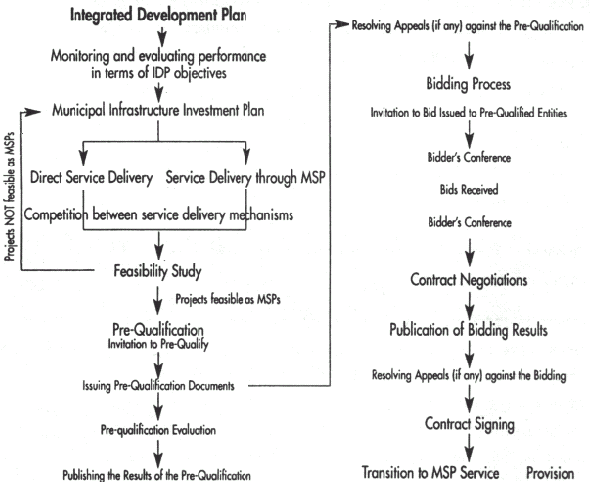
| Formal bidding | The formal competitive bidding process begins with the IDP and ends with the implementation of the project by or with the preferred service provider. The stages in the process are presented in the following flow chart. |
| - |
|
| Council ensures probity | A simpler tendering procedure is adequate for MSPs that are less complex, less demanding, and less risky and of a lower monetary amount. When a less formalised process is used than full competitive tendering, councils need to actively monitor the process to ensure that probity is maintained. Moreover, a council is always free to choose to use the more demanding formal competitive tendering procedure (or to incorporate elements of it into a competitive negotiation procedure) for these MSPs. |
| More flexible process | Proposed legislation will set out the minimum requirements for competitive negotiation. Pre-qualification of bidders will be required. However, the tendering process following pre-qualification will be substantially simpler and more flexible than formal competitive tendering. The regulations for competitive negotiation will be prescribed by the Minister. They will permit simplified tender documents to be issued by a municipal council to the pre-qualified bidders.The regulations will also allow her simultaneous negotiation with two or more of the bidders, rather than a formal bid evaluation process.The council may then select a preferred bidder and enter into contract negotiations with that bidder. |
| Process for simplest MSPs | Competitive solicitation will apply only to MSPs of the shortest duration and the lowest monetary value. Since these MSPs present the least risk and complexity, this procurement procedure will be the simplest one. Again, a council will be free to use a more complex form of procurement, or elements of a more complex form, for these MSPs if it chooses to do so. Regulations with regard to competitive solicitation for MSPs will be prescribed in terms of legislation by the Minister.These regulations will require that a council solicit proposals from two or more potential MSP service providers. Councils will also be obliged to specify thresholds for the duration of the contract (for example, one year or less) and the monetary value involved (for example, R 100, 000 or less). |
| Fairness and transparency | Councils should select the bidder whose proposal is fully responsive to the bid documents and offers the best value for money for residents and other users of the service in the longer term.The bid evaluation process must be fair and transparent to demonstrate to residents, bidders and other key stakeholders that MSP contracts have been awarded by the council in a manner that protects their interests. |
| Councils choose evaluation criteria | The determination of bid evaluation criteria and their relative importance are matters for the discretion of municipal councils. Municipalities are not obliged to award MSP contracts. For example, where in the opinion of the council no satisfactory bid is received, the council should not award a contract An example of this may be where the best bid proposes an arrangement that is more expensive than continued delivery of the service by the council itself. In evaluating such bids, the council should recognise that value for money would not be obtained through the proposed MSP arrangement. |
| Ministerial regulations outline exceptions | The application of a competitive procurement process will be
the normal way of selecting MSP partners. However, proposed legislation will authorise the
Minister to issue regulations that outline exceptions.These will include situations where
circumstances make the application of a competitive process impractical. Such exceptions
would be, for example:
|
| Council can elect to negotiate | An MSP contract that is derived from an unsolicited proposal
can only be awarded after to the proposal has been subject to an appropriate and relevant
competitive bidding process. The municipal council may elect to negotiate with the
proposer of the unsolicited proposal to, either:
|
| Open bidding on underlying project | The municipal council is free to offer the underlying project
for open competitive bidding if
|
| Potential for corruption | Procurement processes create opportunities and temptations for a lack of probity. Corrupt practices are totally unacceptable since they undermine democratic processes, and sacrifice the public interest for the benefit of personal interests. |
| Illegitimacy of corrupt practices | The proposal of any bidder that has engaged in a corrupt
practice must automatically be rejected. Any contract awarded as a result of corrupt procurement processes must be declared void ab initio. In addition, a bidder that has engaged in a corrupt practice in a government procurement process should be barred (temporarily or permanently) from bidding in other government procurement processes. |
| Information to stakeholders | Bidders, community residents, and other stakeholders must be informed regularly about the progress of MSP procurement activities.Transparency helps ensure that the municipal council, municipal officials, and bidders follow the procedures mandated by law and by the council. |
| No amendment for convenience | Many MSP contracts involve complex arrangements over a long period of time. During the contract period, a valid need may arise to amend or even re-negotiate parts of the contract Against this, there is the possibility that one or both parties may also seek to amend or renegotiate an MSP contract merely for reasons of convenience. In the latter instance, the resulting contract may be so substantially altered that it no longer resembles the contract contemplated by the competitive procurement process.The whole rationale for competitive bidding is therefore undermined. Moreover, this process may have damaged the interests of the other bidders, consumers, ratepayers and voters. |
| Amendment process | Amendments to MSP contracts should be limited to those circumstances in which the Amendment amendment would likely have been required no matter which bidder had won the contract contract. In addition, the council and/or the contract should establish a transparent and accountable amendment process to ensure that stakeholders can be informed of the reasons for, and scope of, the proposed amendment. Stakeholders can then make representations to the council with respect to those matters before the council decides to amend or renegotiate the MSP contract. |
| Capacity enhancement | Municipal capacity can be defined as a council's ability to perform its duties and functions in terms of the Constitution. For historical reasons, the majority of councils in South Africa require assistance with capacity enhancement so that they can fulfil their executive functions and responsibilities in line with the expectations of the society. |
| Capacity required by councils | Continuing support for capacity enhancement is essential to
achieving sustainable improvement in municipal service delivery. Whether municipal
services are delivered directly by councils, or through MSP arrangements, councils require
functional capacity to:
|
| Skills needed to enhance capacity | Municipal capacity in these areas requires many specialised
skills, including:
|
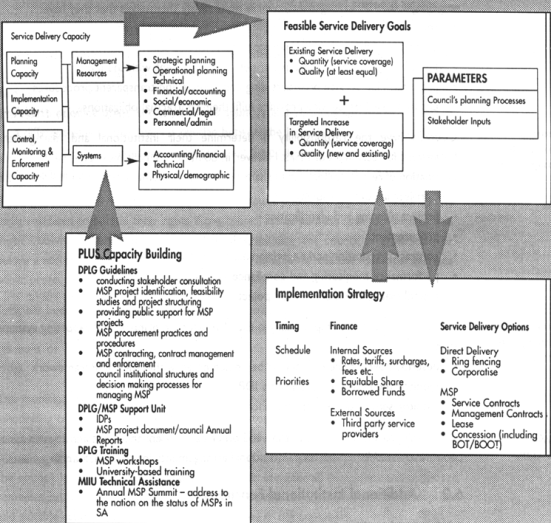
| Improving delivery | As the diagram below shows, a councilor's capacity depends on its management and systems resources. Focused attention on capacity enhancement will lead to improved service delivery by strengthening the development of feasible service delivery goals and implementation strategies. |
| Strategies for capacity enhancement | Given the importance of capacity for the achievement of a
sound MSP program, DPLG will continue to facilitate the enhancement of functional local
government capacity by:
|
6.1 Municipal Council Institutional Arrcmgements
| Considerations | Councils have the primary responsibility for electing to
utilise MSPs and for ensuring that the MSP service provider performs in accordance with
the contract. However, before engaging in an MSP arrangement, councils must satisfy
themselves that they have:
|
| Councils responsible for management | Councils have the responsibility to determine their
institutional and management framework for carrying out MSPs. However, in doing so,
councils must provide for a clear designation of responsibilities for the management and
implementation of each stage of the MSP project life cycle, including:
|
| Effective planning and reporting | Councils also have the responsibility to establish effective
planning and reporting systems that
|
| DPLG Guidelines | DPLG will provide advisory guidelines and other capacity enhancement activities to assist councils to establish satisfactory institutional arrangements her their MSP arrangements. |
6.2.1 Municipal Services Public Protector
| Participatory democracy | Municipal councillors are elected to represent the interests of their constituents and are accountable to them through the democratic process of local elections. However, the White Paper on Local Government advocates augmenting the process of representative democracy with a more accessible and day-to-day system of participatory democracy. Councillors and officials should Therefore advocate and practice the batho pole principles. |
| Role of public protector | Residents require timely and effective ways to
express their opinions regarding service delivery and to obtain redress.This applies to
services delivered directly by the council and those delivered through MSPs. Such
mechanisms promote resident empowerment, help curb possible abuses of monopoly positions
by service providers and give effect to participatory democracy. Municipal councils, in
consultation with Their residents, should therefore consider creating the position of a
municipal services public protector.The functions of this position should include:
|
| Terms of office | The position should have robust terms of
reference that insulate the incumbent from council interference to a great extent. Such
terms of reference should include the following
|
| Assistance for redress | A possible additional role for a municipal services public protector would be to advise and assist residents to pursue their rights if the council Ails to address their complaints.This might involve assistance in a variety of forums, including the courts, in arbitration or before a sector regulator, such as NER. However, to fulfil this role the municipal services public protector should be appointed independently from the council. |
| Resources required | Sufficient budgetary resources need to be made available to permit the execution of the municipal services public protector's functions.These may come from general municipal revenues or from earmarked surcharges on tariffs for municipal services or municipal rates. |
| Relationship with council | The municipal services public protector is intended to complement and support the functioning of the council and judicial and regulatory institutions, not to be a substitute with council for those institutions.To preserve the processes of democratic governance, the municipal services public protector would therefore not be empowered to overturn a decision of the council. In stead, councils would be obliged to consider all complaints and proposed remedies put to it by the municipal services public protector and to decide on appropriate and suitable actions that would remedy the causes of the complaint. |
6.2.2 The Municipal Infrastructure Investment Unit (MIIU)
| Accessible information | The MIIU is providing support to municipal councils in the areas of preparation, obtaining suitable expertise for municipalities in tendering and structuring financial deals, and contract negotiation.The large body of information and expertise being developed by the MIIU needs to be made more accessible, both to the public and to policy making and/or regulatory authorities such as DPLG, the provinces, and SALGA. |
| Information analysis | Information provided by municipal councils and subsequent
analyses of this data by the MIIU will:
|
6.2.3 Technical Assistance Co-ordination
| Monitoring | Without an effective network technical support for MSP
contract management and compliance, those municipalities that lack experience in
performance monitoring run the risk of being unable to sustain their MSPs. Until a
substantial volume of ongoing and successful MSPs has been established, municipal councils
will need a network of technical support mechanisms, including
|
| Role of DPLG, universities, SALGA and ILGM | DPLG will continue to take the lead role in co-ordinating technical assistance activities and liaising with donor organisations. The role of implementing these technical assistance activities should however be increasingly assumed by institutions of higher learning, especially universities, the South African Local Government Association and the Institute of Local Government Managers. |
6.2.4 Information Dissemination
| Ongoing information exchange | SALGA and/or ILGM should also increasingly assume the responsibility for information dissemination. Additional funding will be required for the on-going management of conferences, workshops, meetings, newsletters, web pages and so on. Donors should be consulted about supporting a portion of the costs for the establishment and initial operation of this portion of the MSP contract compliance support network. |
6.2.5 Policy Monitoring and Evaluation
| National & provincial | The Constitution requires that the national and provincial
spheres monitor and evaluate the performance of the local sphere in order to:
|
| Authority of council decisions | However, the above means that the national or provincial spheres cannot pre-empt or of second-guess the decisions of councils, where such decisions conform to relevant policy and legislation. Only where a council fails to conform to these requirements should the other spheres intervene. |
| Communication on performance | An appropriate system for local governments to communicate their performance (via reporting and other means) needs to be established. This system should be focused on ensuring that the requirements of the MSP Policy and legislative framework are being discharged satisfactorily, but at the same time, should not impose an undue reporting burden on municipalities. |
| Role of DPLG | DPLG, in consultation with provincial governments, will have the primary role and responsibility for monitoring the performance of municipal councils and for specifically monitoring the application of the MSP Policy. In discharging this role, DPLG will continue to work closely with other national departments, provincial governments and agencies such as SALGA and ILGM. DPLG will also prepare an annual report about MSP transactions and host an annual summit to report on implementation of MSPs, review the status of the Policy Framework and disseminate best practices |
| ab initio | A Latin term, meaning from the outset |
| capital investments | In order to deliver services, municipalities need appropriate infrastructure, such as roads, sewerage systems, buildings and so forth. Spending capital (money) on the construction of such infrastructure is seen as an investment because it leaves the municipality with fixed assets that it can use in an on-going way. |
| contractual safeguards | Within any contract between two or more parties, specific clauses can be included that specify what is to be done should the contract not run its normal course as planned. Contractual safeguards typically outline what action should be taken if one or more parties do not or cannot comply with the contract They may also specify what obligations or rights the parties each have if the fulfilment of the contract is impossible due to external circumstances. |
| cost-benefit criteria | Using cost-benefit criteria to evaluate a project or course of action is a process of comparing the inputs you need with the outputs you will produce. The primary consideration is whether the costs involved in a particular undertaking are in balance with the benefits that can be achieved. |
| cost-effective | Something is seen to be cost-effective if it achieves an impact that warrants the amount of money spent. |
| cross-sectoral | Cross-sectoral programmes or issues are those involving two or more social sectors, such as health and education. |
| debarment | When an individual or organisation is debarred, they are excluded from the right to participate (in tendering, for example). |
| earmarked surcharge | A surcharge is an amount of money, added to the basic price of a particular service or product, paid by consumers using that service or product.A surcharge is earmarked when the added amount is to be used for a specific planned purpose. |
| economies of scale | When operating on a large scale, service providers can often reduce the per unit cost of service delivery because they are offering that service in bulk. For instance, supplying water to two municipalities can reduce the per litre cost of water delivery by making use of shared piping and other large equipment. |
| environmental sustainability | If a practice or project wastes or abuses natural resources, it will eventually not be able to continue because the resources it requires will be exhausted.An undertaking is said to be environmentally sustainable if it makes appropriate use of natural resources, and will therefore be able to continue into the future. |
| executive authority | Executive authority is the power to make policy and to implement laws in a particular sphere. Municipalities, for instance, have executive authority in the local sphere. |
| incentive payments | A structured system of incentive payments can be included in a service contract between parties, or in an employment contract Typically, such additional payments would be made (to a service provider, for instance) for achieving over and beyond the minimum requirements of the contract. |
| incumbent | An incumbent is a person holding a particular position or office. |
| insolvency | Individuals may be declared insolvent if they are unable to honour their debts when called upon to do so. |
| institutional framework | Every institution has a particular system of structures, roles and procedures within which it operates to achieve its objectives.A supportive institutional framework is one that is designed in such a way that it eases and assists the achievement of institutional objectives. |
| intellectual property rights | Individuals have the right to be recognised as the owners of their own original work. If their original ideas, plans or written work are used by other parties, the owner has to be recognised and compensated in accordance with intellectual property law. |
| legislative authority | Legislative authority is the power to make laws and by-laws in a particular sphere.The Constitution sets out which bodies have this power in each sphere. |
legislative reform |
South Africa's first democratic government inherited a large body of laws from the pre-1994 era. Each law needs to be reviewed, amended or replaced to bring legislation in line with new public policies. Legislative reform is the process of changing existing laws or replacing certain existing laws with new laws. |
| ministerial regulations | Laws generally set out the broad policies and rules to be followed in a certain area, rather than the detailed procedures. When new legislation is passed, its implementation generally falls within the mandate of a particular sector or department.The relevant Minister may then issue a set of regulations, which set out the precise rules and procedures to be followed for the law to be implemented. |
| multi-jurisdictional service areas | A jurisdiction is the area within which an authority has powers and responsibilities. For example, the jurisdiction of a council extends throughout its own municipal area. Multi jurisdictional service areas are those that extend across municipal boundaries and therefore involve more than one local authority. |
| municipal backlog | The municipal backlog is made up of the total amount of municipal infrastructure and services that should exist in terms of minimum standards, but have not yet been established. |
| municipal infrastructure | Municipalities need certain basic fixed facilities in order to deliver services. Municipal infrastructure includes all the built or constructed things that a municipality has at its disposal, such as roads, buildings, bridges, dams, water pipes, railways, and so forth. |
| operating assets | Assets are things owned (by a municipality for example) to which a monetary value can be attached. Municipalities generally have fixed assets and operating assets. Fixed assets include things that cannot be moved, such as land or buildings. Operating assets include everything that a municipality owns and uses in its operations, such as vehicles, computers, construction equipment and so forth. |
| polity alignment | Within a system of co-operative governance, it is important to ensure that the different spheres and departments of government complement each other in achieving nationally accepted policy goals. Policy alignment is a process of ensuring that the rules and procedures of various policies do not contradict one another, but rather support one another and work in the same direction. |
| probity | Probity is seen to be upheld when agreed procedures are followed and implemented with openness, honesty and integrity. Probity is the opposite of corruption. |
| procurement | Procurement is the process of successfully establishing a contractual arrangement (for instance, between a municipality and an external service provider) to fulfil a particular objective. |