 |
Department of Public Enterprises
Abridged Business Plan |
|
Department of Public Enterprises
Abridged Business Plan |
South Africa stands at an important juncture in realising the fruits of a hard fought new democratic order. In its second term of office, the government has shifted its focus from the development of political, policy and administrative frameworks to the delivery of services to achieve a better life for all. The restructuring of State Owned Enterprises (SOEs) is a critical engine in realising economic growth, empowering the historically disadvantaged, as well as creating international competitiveness that are pre-requisites to delivering on the new strategy. The Department of Public Enterprises is tasked with driving and managing the restructuring program to realise maximum shareholder value which in turn benefits the citizens of our country. Performance based management within the context of good corporate governance is the point of departure for the department in working with the SOEs. These are the two pillars that will ensure that the objectives of the restructuring program are met in a manner that is consistent with the developmental needs of the country.
The enormity of the task cannot be overstated, however we believe that a good foundation has been built to ensure success. The Department seeks to work with all stakeholders to ensure that outcomes are both desirable and sustainable. To this end we invite all parties to join us on this journey of restructuring that will yield a further democratisation of our economy and the creation of globally competitive enterprises.
|
|
 |
|
|
Jeff Radebe Minister of Public Enterprises |
Sivi Gounden Director-General: Department of Public Enterprises |
|
Table of Contents
Skills and Capabilities
Situation Analysis
Changing from an Office to a Department
Operating Constraints
Change Imperatives
Strategic Objectives for DPE
Organisational Design
DPE Modus Operandi
The Ministry viewpoint on the Modus Operandi of the Department
Organisation Culture
Cascading DPE strategic objectives into action plans
Required Capabilities
Critical Success and Risk Factors
Business Plan - Programme 1: Management and Administration
Introduction
Strategic Objectives
Project Plans, Outputs and Responsibilities
Organisational Framework
Capabilities Required
Critical Success and Risk Factors
Business Plan - Programme 3b: Strategic Analysis and Policy Development
Introduction
Overarching Objective of Program 3b:
Strategic Objectives
Project Execution Framework
Project Plans, Outputs and Responsibilities
Organisational Framework
Capabilities Required
Business Plan - Programme 2: Restructuring of State-owned Enterprises (SOEs)
Introduction
Strategic Objectives
Project Execution Framework
Project Initiatives
Project Plans, Outputs and Responsibilities
Organisational Framework
Skills Capabilities
Critical Success and Risk Factors
Programme 4: Alternative Service Delivery
Introduction
Strategic Objectives
Project Plans, Outputs and Responsibility
Organisational Framework
Capabilities Required
Critical Success and Risk Factors
Business Plan Programme 3a: Performance Monitoring and Benchmarking
Introduction
Strategic Objectives
Project Execution Framework
Project Plans, Outputs and Responsibilities
Organisational Framework
Capabilities Required
Critical Success and Risk Factors
Annexure 1: DPE Business Planning and Human Performance Management Process Manual
South Africa (SA) stands at the threshold of significant economic growth. Whereas the level of inflation was 12.5% during the period 1990-1994, it had come down to 5.2% for 1999 and is projected to come down further during 2000 to 5.0%. At the height of the Asian crisis, the interest rate rose to 25.5% but is now currently down to 14.5%. For the years 2000 and 2001 respectively, the revised Reuters January 2000 survey projects growth in GDP of around 6.5% for both years.
In the opening Parliamentary address for the year 2000, President Mbeki reiterated, amongst other things, that steps would be taken to further enhance the partnership between the public and private sectors with a view to reinforcing the growth and development of our economy.
To this end the Department of Public Enterprises is well poised to play a pivotal role in furthering the economic growth of SA. Our Vision for the next four years is to have Restructured (SOEs) in a globally competitive environment, promoting economic growth and a better life for all. Our Mission, to direct and manage the accelerated restructuring of SOEs to maximise shareholder value, will provide the driving force for achieving our vision.
To enable the department to meet its vision, the DPE has proceeded in a systematic way to translate this vision into action. We believe that achieving balance in what we do is imperative given the vestiges of our past. The DPE has formulated a number of strategic objectives to guide it through the next four years. These strategic objectives have been formulated with checks and balances to ensure such economic imperatives are not solely achieved at the detriment of other important social and political transformation objectives of government. Whilst this has solicited an approach of caution and circumspection, accelerated delivery is nevertheless the primary focus of the DPE.
The translation of the DPE vision and mission has lead to a balanced set of strategic objectives grouped into four “perspectives”:
|
Economic |
Stakeholder/Partner |
|
Maximise shareholder value to realise the economic and social objectives of the State |
Develop stakeholder management plans to promote the DPEs restructuring program |
|
Manage DPE financial / costs / expenditure |
Develop communication plans to promote the DPE’s restructuring program |
|
|
Create restructuring programs for strategic SOEs |
|
|
Promote SOE capabilities into Africa to promote the African Renaissance |
|
Innovation and Learning |
Internal Processes |
|
Develop strategic management capability within the DPE |
Ensure sound financial management of the DPE |
|
Develop the DPE human resources to enable delivery on the restructuring program |
Ensure adequate DPE resourcing and support systems to deliver upon the DPEs mandate |
|
Develop a sourcing strategy for specialist skills required by DPE |
Introduce enabling IT systems to interface with the SOEs and other strategic stakeholders |
|
|
Develop an appropriate organisational framework and culture to foster internal efficiencies and effectiveness |
|
|
Adopt globally recognised practices by launching the DPE’s benchmarking process |
Table 1. DPE Overall Balanced Scorecard
All the strategic objectives are inextricably tied to each other in a “cause and effect” relationship providing the checks and balances referred to previously. Each strategic objective has in turn been further translated with the intention of arriving at a set of projects, action plans, roles, responsibilities and performance contracts for all managers within DPE. Human performance management will be in alignment with the Department of Public Service and Administration‘s practices. The strategic objectives will come to “life” as each is operationalised by a set of action plans.
Given the set of strategic objectives and the concomitant action plans, the DPE has developed an organisational design that will position it to deliver against the vision and mission:
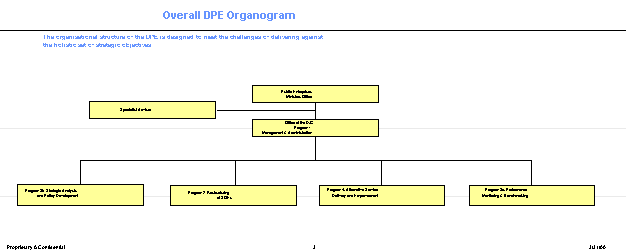
Figure 1. Department of Public Enterprises Organogram
In accordance with its mandate, the department has chosen to concentrate the bulk of its efforts primarily in four industry clusters. These are Energy, Telecommunications, Defence and Transport. The modus operandi for these four clusters within the organisational programs has been carefully constructed.
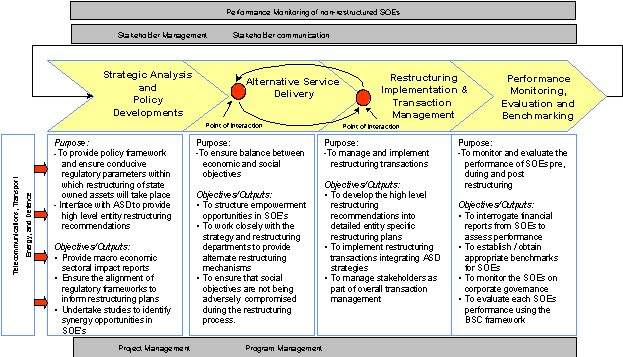
Figure 2. DPE Process Activity
The immediate focus of each of the programs will be in the four clusters. Where restructuring of other enterprises in other clusters has begun, this of course would be overseen by the DPE. The modus operandi and process activity map represents an ideal execution framework. In reality, exogenous factors may cause activities to be completed in a non-sequential manner. In order to mitigate against these exogenous factors, the DPE resolved that the Programs would interface with each other in a structured, consistent manner.
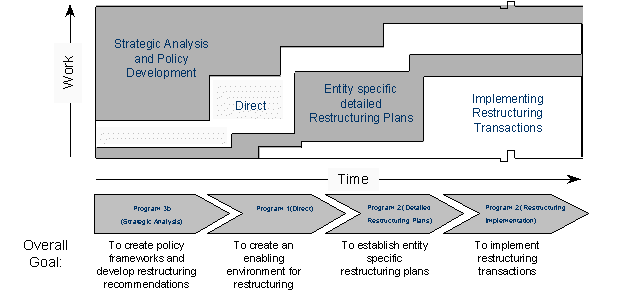
Figure 3. Overall DPE Modus Operandi
Effective restructuring is largely dependent upon the programs working with each other in an integrated manner using the resources of the entire department in a flexible way. The significance of the integrated methodology is to reduce the otherwise iterative nature of the restructuring undertaking given the tight time constraints. However, where successive iterations would lead to a more informed restructuring plan, this would be encouraged.
The change in the department’s mandate, the new organisation structure and new modus operandi have lead to an increase in the DPE’s internal management and professional capability. The focus on four industry clusters requires the department to possess more focused and specialised skills. The full extent of the competencies and capabilities required is currently being confirmed and candidates with the correct set of skills are being recruited in a phased manner as projects begin to unfold. Professional capacity in the form of legal and consulting services will be solicited to augment the skills requirement of the DPE as and when the need arises.
The DPE is well poised to take advantage of the prevailing positive investor sentiment and the general public optimism in the transformation of our country and attract top private sector financing. Restructuring SOE’s such as Telkom, Transnet, Eskom and Denel will have considerable impact on the economy as a whole.
We are confident that we would enjoy the support of key stakeholders because the DPE is committed to a restructuring approach that is characterised by transparency and integrity. Our approach is informed by a commitment to dialogue with key stakeholders with the view to developing common approaches to restructuring and considering the social impact emanating from issues such as employment, empowerment and pricing policies. We will endeavour to highlight the public policy and strategic dimensions of particular restructuring initiatives to facilitate public debate and social consensus.
In conclusion, the DPE believes that having Restructured SOEs in a globally competitive environment promoting economic growth and a better life for all is a vision worthy of our aspiration. Although challenging, it is within the grasp of reality.
This version of the business plan has been abridged and prepared for dissemination to the broader public. There is a more detailed business plan with time lines and finer details of the various SOE restructuring process which at this stage cannot be released to the public. The DPE envisages that its business plan would be revisited on a continuous basis as the restructuring agenda for the different SOEs unfolds.
Signed

SM Gounden
Director General - Department of Public Enterprises
The Office for Public Enterprises was originally established in 1994 as a Schedule two organisation. At the time the primary objective of the Office was to champion and direct the restructuring of State Owned Enterprises (SOEs) to ensure optimum economic and development impact. In the term of the last government (1994-1999) some progress was made in the restructuring of SOEs but clearly the next four years requires an acceleration of the process. On 1st August the Office for Public Enterprises was upgraded to a Schedule 1 Department with the central aim of ‘accelerating the restructuring of State Owned Enterprises, to ensure maximum economic impact.’
One of the key operating constraints that had been identified within the Office of Public Enterprises was that of under resourcing particularly in the area of professional human resources. The staff complement stood at around 41 of which 50% were administrative. In the past this had contributed to the inability of the organisation to ensure that the interests of the shareholders were represented in the restructuring initiatives. Thus far, the SOEs have primarily driven the restructuring process with the result that in certain cases the outcomes constituted a departure from broader government policy and transformation objectives. This in turn led to sub-optimal outcomes.
To overcome this operating constraint, the DPE has increased its staff complement by 75 to a total of 116 with a special emphasis on obtaining high calibre professional staff possessing specific capabilities to enable the department’s accelerated restructuring program. The Department has developed performance contracts with each manager so that work outputs can be efficiently measured, monitored and managed.
The need to accelerate the restructuring of SOEs stems from decisions taken in a Cabinet Lekgotla in November 1999. There were three primary objectives of the Lekgotla that paved the way forward for the restructuring of SOEs:
The Cabinet Lekgotla also resolved that the Department of Public Enterprises should lead the restructuring of SOEs.
Aligned to the current government broad policy objectives, the aim of the DPE is to accomplish its goals within the term of the current government.
How the department envisages to operationalise these intentions are outlined in the rest of this document.
To decide on the future possibilities for restructuring state owned enterprises, and their likely impact on the economy, the Cabinet Lekgotla reflected on two things. Firstly, what is the estimated size of the public portfolio and what experience was gained from the past five years.
Currently the Department of Public Enterprises has oversight over six state owned enterprises. Without a proper audit of all SOEs it is at this stage difficult to assess the total value and output of the entire portfolio of public enterprises. It is also difficult to estimate the market value of the governments portfolio since this can change with market perceptions of each asset when and if the enterprise or some part of it is taken to the market place.
|
Firm |
Total Assets (Rm) |
Turnover (Rm) |
Net Income (Rm) |
Employees |
|
Eskom |
69 975 |
21 071 |
2 750 |
37 311 |
|
Transnet |
42 779 |
21 680 |
2 165 |
100 592 |
|
Telkom |
27 107 |
20 160 |
2 427 |
57 496 |
|
IDC |
17 049 |
3 567 |
765 |
502 |
|
DBSA |
12 002 |
925 |
423 |
465 |
|
Land Bank |
5 775 |
2 377 |
371 |
98 |
|
Denel (1997) |
4 253 |
3 013 |
82 |
14 200 |
|
Impofin |
3 297 |
220 |
9 |
- |
|
Rand Water |
3 212 |
1 900 |
258 |
4 000 |
|
Findevco |
2 770 |
485 |
21 |
- |
|
Konoil |
2 337 |
82 |
180 |
- |
|
Post Office |
1 793 |
2 469 |
-272 |
29 195 |
|
Airports Co |
1 695 |
710 |
228 |
1 718 |
|
SABC |
1 617 |
2 474 |
105 |
3 217 |
|
Foskor |
1 323 |
1 297 |
135 |
2 163 |
|
Safcol |
808 |
569 |
9 |
5 362 |
|
Atlantis |
683 |
907 |
80 |
2 275 |
|
Sapekoe |
201 |
119 |
0 |
11 000 |
|
Alexcor |
200 |
175 |
-23 |
1 078 |
|
Abakor |
115 |
290 |
-55 |
2 200 |
|
Aventura |
111 |
146 |
-8 |
1 610 |
|
Total |
174 102 |
84 636 |
9 650 |
274 482 |
|
Total (non-financial) |
130 872 |
76 980 |
7 881 |
273 417 |
Table 2. Financial Profile of Top 30 Public Sectors (Source: Financial Mail. Top Companies 1999)
The Cabinet Lekgotla noted two issues. Firstly, the most significant of state owned enterprises are Eskom, Transnet, Telkom, and Denel (hence the focus in the four primary sector). They comprise approximately 91% of estimated total assets, provide 86% of turnover, provide 94% of net income and employ 77% of all employees in the top thirty state owned enterprises. While it can be expected that the estimated three hundred other public enterprises can obviously contribute to meeting Government objectives on restructuring, it is envisaged that focusing on these four enterprises will have the maximum economic impact.
In order to put into perspective the importance of these enterprises, a brief outline of what each entity entails is given below:
Eskom directly or indirectly supplies electricity to nearly 98% of South Africa’s market. In 1998/9, it produced a turnover of R21 billion with a net profit of R5.9 billion. Eskom’s restructuring was initiated with the passing of the Eskom Amendment Act in 1998 that vested ownership in the state and removed its exemption from taxes. Eskom has the following portfolio of businesses, Distribution, Transmission, Generation and Eskom Enterprises. Apart from Electricity generation, Eskom has significant capability in IT and Telecomms.
Transnet is a multi-modal transport and logistics company that has under its portfolio the following major businesses: South African Airways, Petronet, Autonet, Spoornet, Portnet and Metrorail. Transnet has shown a significant improvement in its financial situation for the year 1999/2000. Its turnover increased from R 23.9 billion in 1998/9 to R27.1 billion in 1999/2000. It showed a profit of R779 million this year as opposed to a loss of R476 million the previous year.
Denel’s main business is military aerospace and ordnance. Denel’s financial position has worsened over the past two years due to an overall decline in the demand for defence procurement. Its turnover increased by 2% between 1998 and 1999 to R3.3 billion. However, it registered a loss of R541 million in that year. Restructuring will see the introduction of strategic equity partners in a number of these business entities that should provide access to new technologies and international markets. A key challenge for Denel in the coming financial year will be to conclude some major weapons deals.
Telkom became a public company on the 1st October 1991. The vision of the company is to become an internationally competitive, world-class telecommunications company through transformation to deliver excellent service to customers while meeting world-class telecommunication performance standards and achieving an acceptable return for the shareholders. For the year ended on 31 March 1999, the company reported attributable profit of R2, 3 billion on a revenue base of almost R23 billion representing a 4 year annual compound growth rate of 23.84% and 20.22% respectively from 1995. Growth rates in fixed assets and investments as well as current assets were set at 23.05% and 16.62% respectively. For the same year, it reported main telephone service lines at about 5,1million. The average number of employees in the company is just below 61,000. Some of the restructuring challenges that face the company include the floating of some of the remaining percentage of government shareholding and the introduction of a second fixed line operator in FY 2002.
Turning to the restructuring experience over the past five years, the Cabinet Lekgotla resolved that in order to accelerate the restructuring of SOEs, the following imperatives had to be addressed by the DPE as a matter of urgency:
Although significant progress was achieved over the past five years, each restructuring initiative was approached on a case-by-case basis in the absence of an integrated policy framework. This approach unfortunately contributed to uncertainty in the market place as investors were confronted with changing conditions in each instance. It also meant that the Government’s policy on key questions such as black economic empowerment, procurement and ‘unsolicited bids’ were addressed in an ad-hoc manner depending on the advice of specific transaction advisors. More importantly, the absence of a clear framework for restructuring led to an ambiguity of the roles of different public officials that could be exploited by different stakeholders in the process.
The resolution of the Cabinet Lekgotla therefore provided the basis for the formulation of the overall DPE strategy. In the section that follows the DPE strategy for the accelerated restructuring of SOEs is discussed in more detail.
The department’s strategy has been formulated on a clear understanding of where it is coming from and where it needs to go. Where it needs to go, in terms of restructuring, is outlined in the organisation’s mandate which is as follows:
Whilst the organisation’s responsibility for restructuring and transforming SOE’s has primarily focused on the designated SOEs, the organisation will play a greater role in the restructuring of other SOEs.
Given that the above is the magnitude of the task facing the Department, we asked the question, how best should the DPE proceed in fulfilling this mandate?
The Department feels that it is important to have one common, shared understanding of where it is going as an organisation. That a clear vision would provide the rallying cry and spirit of camaraderie needed in order to enable it to deliver on its mandate. The Department has formulated the following organisational vision to guide it through the next four years:
The vision can only be accomplished if it is translated into actions that people can engage in and having done so can be measured in terms of how well their efforts contributed towards achieving the vision. Therefore the next level of operation of the vision is the mission. The Department has formulated the following organisational mission to guide it through the next four years
The vision and mission together provide the DPE with the broad guidelines to deliver on its mandate. Using this as a basis the Department has systematically translated its vision and mission statements to arrive at a holistic set of strategic objectives. The development of the strategic objectives have consciously been couched on the premise of balancing economic and social objectives which we believe is key given our skewed past. As sketched out in the situational analysis, the restructuring of SOEs in SA would be different from other countries due to the strong need to fulfil certain important social and transformation objectives.
The DPE has translated the vision and mission into the following strategic objectives that are spread across four “perspectives” as shown below.
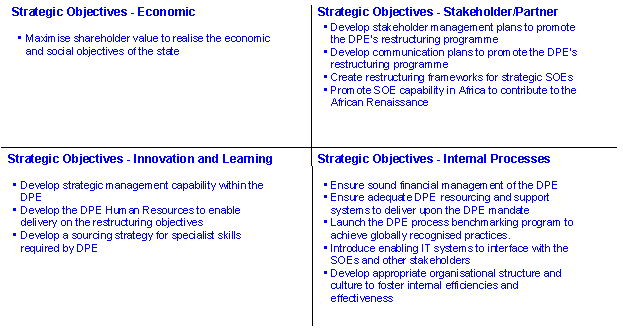
Figure 4. Overall DPE Balanced Scorecard
In going forward the DPE will always take cognisance of balance when executing its mandate. The concept of balance has also been key in the design of the organisation (see Figure 5). The above strategic objectives outline “what” the Department would have to do to deliver upon its mandate. The DPE has taken the process further by asking the question, how should this be done?
In order to operationalise each DPE strategic objective, a number of projects and action plans have been formulated. The projects and action plans have lead to the design of our organisation. The DPE believes that in order to operationalise the strategic objectives, the following organisation structure would be required:
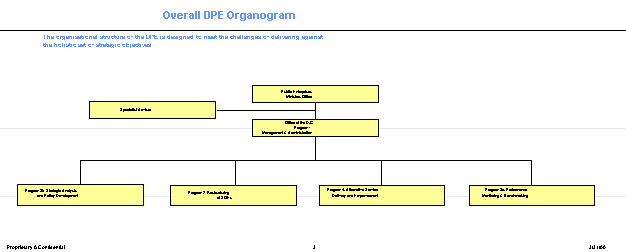
Figure 5. DPE Organogram
The projects that need to be executed have been packaged into “units” which have lead to the formation of the above Programs. Each of the Programs has a distinct role to play in the department. A brief description of the functions for each program is provided below. More detailed information pertaining to these programs are supplied in later sections.
The Management and Administration program includes the overall management of the Department and the Ministry. This program’s objective is to ensure efficient administration and management of the Department and Ministry in delivering upon the restructuring mandate. Its other key role is to provide the leadership and create an enabling environment where all its employees can learn and grow in an informed manner whilst unfolding the restructuring process.
This program is responsible for creating sector specific policy and to interrogate the regulatory frameworks provided by respective line departments to ensure alignment with the overall restructuring program. On the basis of a Macro economic review and sectoral analysis, it would provide a range of restructuring recommendations or possibilities for the restructuring of SOEs in that particular sector. These recommendations would be used by the Restructuring Program as a basis to construct detailed SOE specific restructuring implementation plans. The program would help ensure alignment with other Departments concerned with similar sectors.
This program is primarily responsible to develop detailed enterprise specific restructuring plans, together with the enterprises involved, and to thereby direct the implementation of these plans. The key input into this department comes from the Strategic Analysis and Policy Development Program. In developing detailed entity specific restructuring plans, the program would take cognisance of achieving the objectives of enhanced competitiveness; wider ownership in the South African economy; mobilisation of private sector capital; effective provision of services and reduction of fiscal contributions from the State to SOEs.
Alternative Service Delivery (ASD) is responsible for ensuring a balance between economic and social imperatives by advocating alternative service delivery mechanisms and developing best-practice guidelines for ASD. The program objectives are to develop policy frameworks and appropriate guidelines for ASD strategies to feed into the restructuring of SOEs. This program is also charged with formulating Black Economic Empowerment (BEE) strategies and to monitor BEE interventions in the various SOEs so as to ensure protocol and consistent application of the government’s empowerment strategies.
This programs primary role is to monitor financial performance and adherence to corporate governance practices in SOEs pre, during and post restructuring. The Program is also charged with advocating performance management best practices in the different SOEs. It is to undertake rigorous performance monitoring and evaluation of SOEs using the balanced scorecard methodology.
The DPE processes are essentially divided into the three inter-related activities of policy/regulatory frameworks, restructuring implementation/transaction management and performance management. Although these processes are intuitively chronological, the inherent dynamic nature of the environment demands that there be continuous feedback loops and cooperation between the programs. This is explained further under modus operandi.
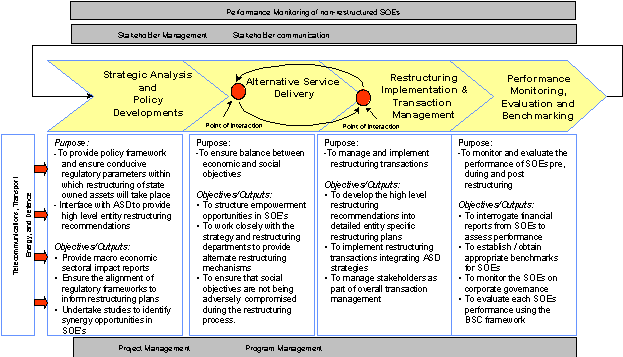
Figure 6. DPE Process Activity Map.
The working processes of the DPE are organised on the principle of resource sharing between the programs. There is sufficient flexibility between the programs to cater for different career aspirations. For instance where strategy is being formulated, there would be a certain time lag before that strategy could be executed. Employees that are “assigned” to the Restructuring Program would therefore have the opportunity of being involved in the strategy formulation of Program 3 and vice versa.
To an extent, there would be demand for a certain employee’s skill and that demand would be negotiated with the respective Program Leader in order to ensure that the employee has the time to undertake the work and handle the work load. The program leads would have to be involved in resource scheduling when large restructuring plans are to be implemented.
All ‘operating’ programs including the Restructuring of SOEs (Program 2), The Strategy Analysis and Policy Development Program (Program 3b), Performance Monitoring and Benchmarking Program (Program 3a) and Alternative Service Delivery Program (Program 4) will be impacted by this modus operandi. As part of the processes, all personnel have primary and secondary responsibilities within and between programs respectively. Resource sharing can take place in a number of contexts:
The programs must follow a resource buying and selling agreement which is in turn reflected in the performance agreement of seconded personnel. As part of this agreement the expected deliverables of the seconded resource must be specified by the ‘buying’ program. The ‘selling’ program will manage the deliverable of their resource according to the very same ‘expected deliverable’ terms of reference. Sign off on the output must be provided by participating programs on completion of the deliverable. The DPE believes that this modus operandi would lead to an efficient use of resources.
In terms of project execution, the DPE must work towards project outcomes in an iterative process with successive ‘loops’ of activity rather than sequential processes which delay downstream actions due to upstream dependencies. The diagram below illustrates this concept of parallel activities between programs towards a shared outcome.
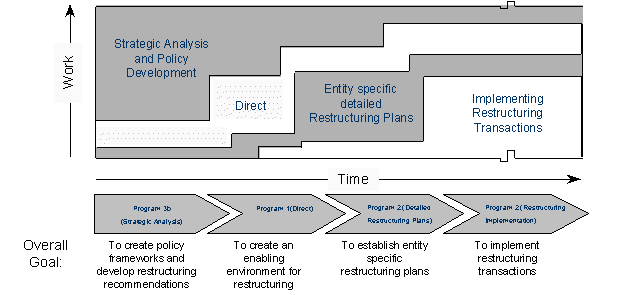
Figure 7. Overall DPE Modus Operandi
The process presents Strategic Analysis, as a quick diagnosis and direction setting phase where the high level business architectural options are established and handed to the Restructuring Program. However, their involvement does not end there. They would also be involved when the detailed enterprise specific restructuring plans are being constructed by the Restructuring Program as they would be when the plans are being implemented. The same principle of integration would apply to the Restructuring program whereby they would be involved (to a lesser extent) in the development of the high level business architecture. The above diagram illustrates that the directing role of the Director General would pervade all stages of the restructuring cycle. This modus operandi would require each programme lead to develop a resource schedule to manage the supply and demand of his/her team. The principle is that people would not be fixed to one business unit but would have the freedom to move from, for instance, Strategic Analysis (Program 3b) to Restructuring Implementation (Program 2), in line with their career aspirations but of course when the demand for that skill is required in the respective programs.
A number of working guidelines have been put forward by the Ministry to the DPE.
A non-traditional culture relative to that typically found in the public service, is being created where the concept of project based teams is allowed to manifest. The definition of power within the organisation centres around expertise i.e. professional power rather than office position or control over resources. The structure of the organisation should provide a framework within which professional expertise can thrive. The challenge is to create an environment in which people can generate ideas while at the same time ensuring that the organisation moves toward achieving it objectives. This organisation has a number of defining characteristics:
The leadership of the DPE expects the department to be the centre of excellence in the restructuring of SOEs in the public service.
Each DPE strategic objective has been decomposed into a number of projects. The performance of these projects would be closely monitored to provide appropriate direction to the strategy embarked upon. This would inform the strategic objective in an iterative manner. These action plans are depicted under each Program below.
From the lists of projects outlined over the next four years the DPE believes that the following capabilities would be required to enable it to deliver against its mandate:
A number of critical success factors have been identified. These factors are to be seen mainly within the context of the restructuring mandate:
A multifaceted approach is required by the DPE to cater for the unique conditions that exist between sectors and enterprises. In addition to these, the DPE needs to keep in mind the following in achieving success.
|
|
FY’00/01 | FY01/02 | FY02/03 | FY03/04 |
|
Expenditure |
|
|
|
To be finalised |
|
Admin |
32.2 |
25.8 |
24.33 |
|
|
Strategy & Policy |
4.1 |
5.1 |
4.5 |
|
|
Restructuring |
10.5 |
11.7 |
11.0 |
|
|
ADS |
2.1 |
2.3 |
2.2 |
|
|
Performance Monitoring and Benchmarking |
5.1 |
5.1 |
5.1 |
|
|
Total Expenditure |
54 |
50 |
47.1 |
|
The management and administration program provides the tone of the department by setting the direction of the restructuring program. By being in closest proximity to the Minister’s Office, it serves as a 2-way link on the needs and objectives of the stakeholder and activities being carried out by the DPE in the name of restructuring. The Management and Administration program is ultimately accountable for the success of the restructuring initiatives and therefore needs to ensure that projects undertaken by the other DPE programs meet their objectives. This program also needs to ensure that the external environment and internal operations are conducive to the achievement of these objectives. The responsibilities of the program are summarised in the following overarching objective:
The Management and Administration Program has the following strategic objectives.
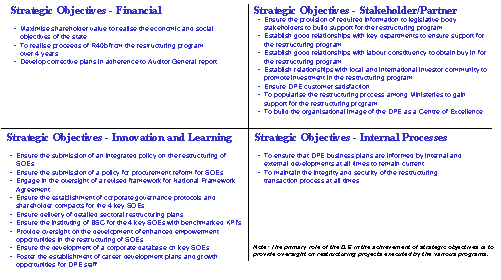
Table 3. Management and Administration Strategic Objectives.
Because of the significant impact that external factors have on the ability of the DPE to fulfill its mandate, these strategic objectives are focused on influencing and managing relationships with key restructuring stakeholders to create a conducive operating environment for the DPE. In addition to this, these objectives emphasise the building of the required internal capacity to drive the restructuring process.
The above strategic objectives are cascaded into projects and activities which in turn are allocated to specific individuals responsible for the completion of the activities.
| Outputs: Program 1 |
Projects / Initiatives | Activities required | Person(s) Responsible | Comments: Contstraints/Risks |
|
|
|
|
It is important that various programs of the DPE are mindful of the objectives of the shareholder in terms of maximising value and use these to guide their outputs |
|
|
|
||
|
|
|
|
|
|
Stakeholder management and Communication Project |
|
|
Key stakeholders included are:
|
|
Integrity and transparency of restructuring process |
|
|
|
|
|
|
|
|
|
|
|
|
|
|
|
|
|
|
|
|
|
|
|
Alignment with corporate governance alignment |
|
|
|
|
|
|
|
|
|
In order to fulfill the objectives and execute the projects mentioned above, the following organogram has been designed.
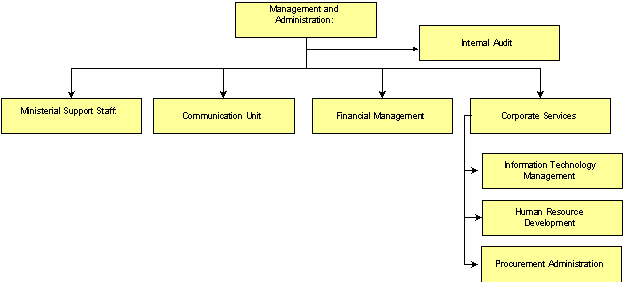
Figure 8. Management and Administration Program Organogram.
The Ministerial support staff provides the DPE with a link to shareholder interests and concerns to feed these through to restructuring initiatives. The communication unit is critical to managing stakeholder relationships and creating an enabling external environment within which the DPE can fulfill its mandate. Financial management and Corporate services are geared towards establishing internal support systems that meet the requirements of both internal staff and concerned external stakeholders.
There are a number of capabilities that are required within the Management and Administration Program to enable it to achieve its objectives:
In developing the business plan for this Program (and the others), the DPE level strategic objectives and projects have been cascaded down into the unit. As the name suggests, the role of the Program is two pronged. The first is strategic analysis where the purpose is to lead the restructuring process by undertaking a macro economic review to identify those trends that would have a material impact on the restructuring initiatives in each of the four sectors. These macro economic reviews would inform the analysis in each sector with a view to developing an overall sector strategy. Having formulated an overall sector strategy, the Program would then move into establishing restructuring recommendations and high level business architectural options for entities identified for restructuring. The second leg of the Program consists of reviewing current regulatory regimes and developing policy frameworks to ensure that there are no obstacles to the restructuring of specific entities. The restructuring recommendations and business architectures would form the basis for the development of a more detailed entity specific restructuring plan. In arriving at the restructuring possibilities cognisance of the sector strategy, the regulatory regimes and synergies between entities would need to have been taken into account. This provides the foundation for the development of detailed restructuring plans which would be the responsibility of the Restructuring Implementation and Transaction Management Program.
The strategic objectives of the Program have been arrived at by “unpacking” the overarching objective into the four perspectives shown below:
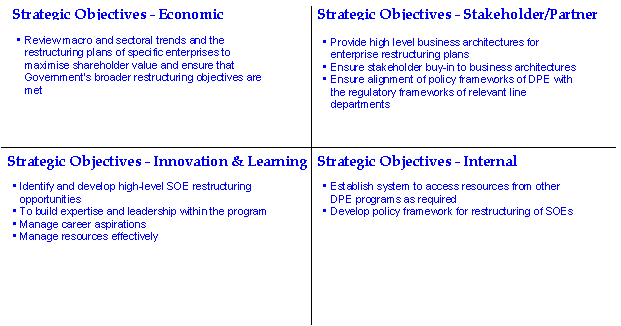
Table 4. Strategic Analysis and Policy Development Balanced Scorecard
In order to arrive at a holistic set of projects for Program 3b to execute, each strategic objective has been decomposed. Below is an overall execution framework to handle a restructuring project within the four key sectors with the corresponding enterprises contained therein. The framework illustrates the various activities within the program and continuous interactions with other programs within the DPE. These programs provide inputs to the activities carried out by Program 3b to inform the reviews and business architectures as they are developed.
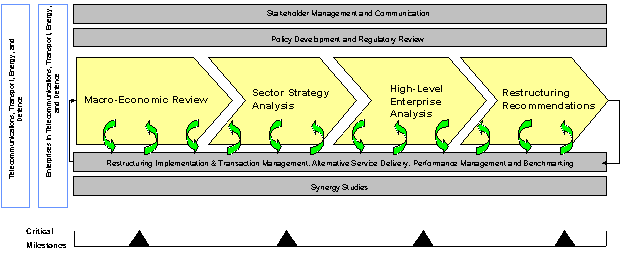
Figure 9. Strategic Analysis and Policy Development Modus Operandi
The unpacking of each strategic objective has lead to the following lists of projects for the Program to execute:
| Outputs: Program 3b |
Projects / Initiatives | Activities required | Person(s) Responsible | Comments: Contstraints/Risks |
|
|
|
|
|
|
|
|
|
|
|
|
|
|
|
|
|
|
V. Lipman |
|
|
|
|
|
|
|
|
|
|
|
To execute the identified projects, Program 3b would require the following organisation structure:
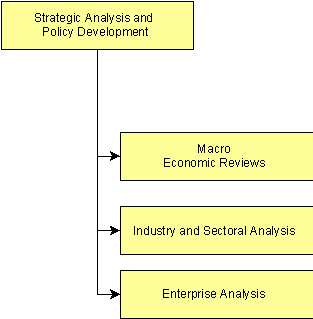
Figure 10. Strategic Analysis and Policy Development Organogram
The capabilities required for this Program are outlined below. They have been derived on the basis of what needs to be delivered from the Program. It is not expected that every person will possess all these skills, however, they must have the ability to interrogate details especially where external consulting services have been contracted to undertake analysis on behalf of the Program.
A macro economic economic review would consider the following:
Critical Success and Risk Factors
The activities of the restructuring program are primarily conducted within the 4 key sectors of Energy, Transport, Telecommunications and Defence. The normal or ‘ideal’ approach to restructuring would include the following sequential steps:
The first three steps would be the primary responsibility of the ‘Strategic Analysis and Policy Development Program’ but the ‘Restructuring Program’ and other DPE programs would provide inputs on an ongoing basis. In reality; the restructuring plan and transaction implementation processes can be in place prior to policy development in which case they would proceed in parallel.
The overarching objective of the program is as follows:
The strategic objectives of the restructuring program are listed in the table below.
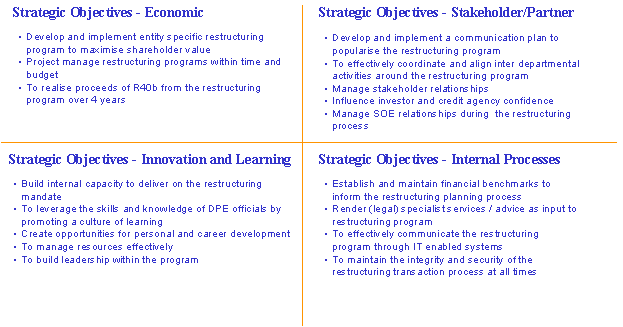
Table5. Restructuring Implementation Program Balanced Scorecard
The modus operandi of the program is depicted below. Although Performance Management is located as an activity, it is important to note that in reality an iterative process takes place with PM having inputs prior to project completion as indicated by the arrows.
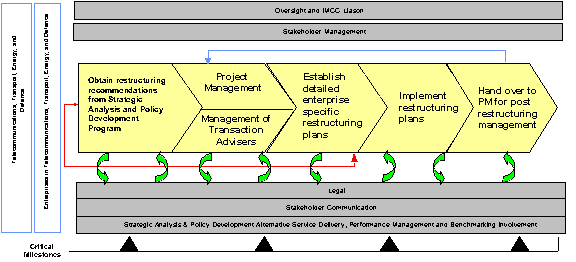
Figure 14. Restructuring Implementation Program Modus Operandi
The execution of restructuring transactions depends on buy-in from a number of critical stakeholders who need to be managed in an appropriate manner. The stakeholders critical to the success of the implementation program and required management style is shown below:
| Stakeholder | Type of Stakeholder Management |
|
Parliament: Portfolio Committee on Public Enterprise |
Proactive |
|
National Council of Provinces: Select Committee on Public Enterprises |
Proactive |
State Owned Enterprises
|
Proactive |
|
Potential Investors |
Proactive |
| Nedlac
Consumer Interest Groups e.g. Shippers Association, Import & Export Groups, Rail Freight users |
Proactive |
|
Regulators: eg, NER, ICASA |
Proactive |
|
NGO’s and General Public |
Proactive |
|
Line Departments – Critical to obtain buy-in and alignment of restructuring plans and provision of updates on progress of restructuring |
Proactive |
|
Media |
Proactive |
Table 6. Restructuring implementation program stakeholders
There are a number of projects in various stage of implementation within the Restructuring Implementation program. The table below groups these projects into those currently in process and those that have been identified for action.
| Sector | Current Projects | Persons Responsible | Prospective Projects |
|
Defence |
|
|
|
|
Energy |
|
|
|
|
Transport |
|
|
|
|
Telecomms |
|
|
|
|
Other |
|
|
|
| Outputs: Program 2 |
Projects / Initiatives | Activities required | Person(s) Responsible | Comments: Contstraints/Risks |
TRANSPORT
|
|
|
|
|
|
|
|
|
|
|
|
|
|
|
|
|
|
|
|
|
|
|
|
|
|
|
|
|
|
|
|
|
||
|
|
|
|
| Outputs: Program 2 |
Projects / Initiatives | Activities required | Person(s) Responsible | Comments: Contstraints/Risks |
TELECOMMS
|
|
|
|
|
|
|
|
|
|
|
|
|
|
|
|
|
|
|
| Outputs: Program 2 |
Projects / Initiatives | Activities required | Person(s) Responsible | Comments: Contstraints/Risks |
ENERGY
|
|
Phase I
Phase II
Phase III
|
|
|
| Outputs: Program 2 |
Projects / Initiatives | Activities required | Person(s) Responsible | Comments: Contstraints/Risks |
DEFENCE
|
|
Phase I
Phase II
|
|
|
|
Phase I
Phase II
|
|
||
| DENEL |
|
|
|
| Outputs: Program 2 |
Projects / Initiatives | Activities required | Person(s) Responsible | Comments: Contstraints/Risks |
OTHER
|
|
|
|
|
|
|
|
|
The organisational framework for the Restructuring Implementation and Transaction Management Program is as follows:
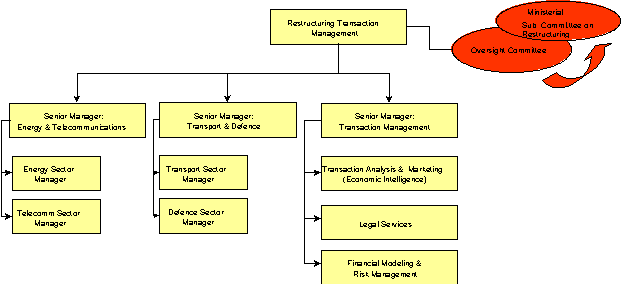
Figure 15. Restructuring Implementation and Transaction Management Program
The key capabilities required in the program include:
Upon completion of the restructuring program a number of factors must follow for the program to be adjudged a success:
The Alternative Service Delivery (ASD) program informs both the Strategic Analysis and Policy Framework and Restructuring of SOEs programs in terms of possible processes and mechanisms that can be used as part of the restructuring process. There are a number of variations on the definition of ASD:
ASD offers innovative ways of optimising the delivery of services and needs to be integrated into high level restructuring recommendations and restructuring implementation projects of the DPE. It also offers the opportunity to realise empowerment objectives as potential service delivery partners can be drawn from previously disadvantaged communities. The overarching objective of the program is as follows:
A number of strategic objectives can be formulated to achieve the overarching objective. These will be further refined once managers are appointed to the program. The preliminary set of strategic objectives is provided in the table below.
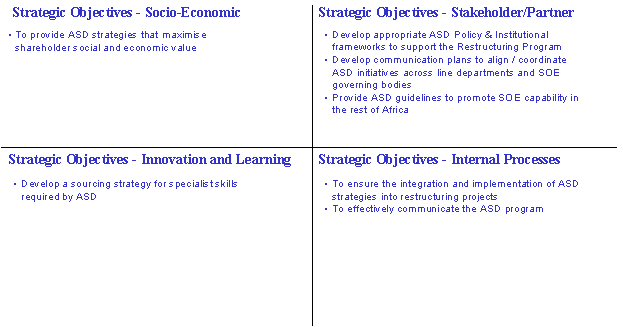
Table7. Alternative Service Delivery Program Balanced Scorecard
The strategic objectives cover the span of ASD engagement within the restructuring program. Firstly, the drafting of appropriate policy and institutional frameworks needs to take place in tandem with overall restructuring policy frameworks and restructuring recommendations. ASD strategies then need to be integrated as part of the restructuring transaction implementation process. Running in parallel are elements of communication to stakeholders and building of internal capabilities to manage ASD initiatives. The Performance Management and Benchmarking Program must monitor and evaluate the outcomes of ASD strategies proposed as part of overall restructuring projects.
| Outputs: Program 4 |
Projects / Initiatives | Activities required | Person(s) Responsible | Comments: Contstraints/Risks |
|
ASD Policy & Institutional Frameworks Project |
|
|
|
|
|
|
|
|
|
Stakeholder Communication Project |
|
|
|
|
|
||||
|
DPE Specialist Skills Project |
IF BUILD
IF BUY
|
|
|
The organisational structure of ASD is shown below:
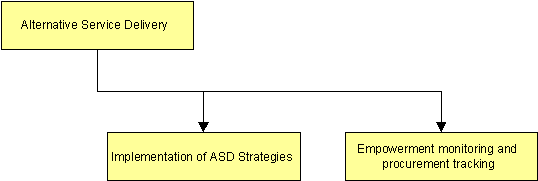
Figure 16. Alternative Service Delivery Organogram
In arriving at the business plan for Program 3a, The DPE level strategic objectives and projects have been cascaded down into Performance Monitoring and Benchmarking. This role did not previously exist at the DPE and the main reason for creating this Program is to ensure that a performance driven culture is perpetuated in all SOEs and to hold them accountable for performance. Where SOEs are not being restructured, within the next four years, the Program would ensure that government transformation objectives are being adhered to through balance scorecard driven performance monitoring. For SOEs undergoing restructuring, Program 3a would essentially monitor how effectively such restructuring is proceeding and to report back progress to other Programs within the DPE so that remedial action could be taken if necessary. The Department envisages that Program 3a would constantly interact with the Strategic Analysis and Restructuring Implementation programs keeping both informed about the effectiveness of their chosen strategies and the need to alter strategic direction if warranted.
The Program also has other responsibilities such as the monitoring of Corporate Governance practices in SOEs with a view to recommending changes that would further enhance corporate governance practices in these SOEs.
The mechanism through which performance monitoring would take place is benchmarking. The Program is expected to compile a comprehensive data base of best practices containing relevant benchmarks by which the performance of SOEs could be measured.
Overarching Objective of Program 3a:
As with the other programs the strategic objectives of Program 3a have been arrived at by unpacking the overarching objective into the four perspectives as shown below
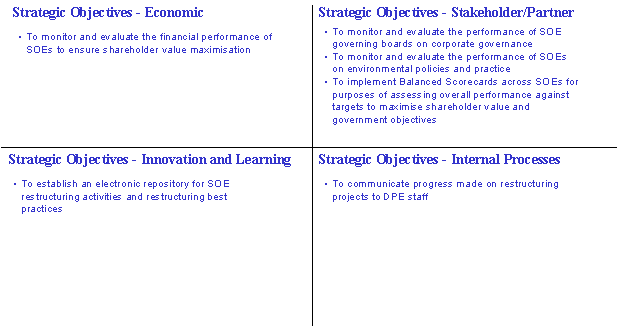
Table 8. Performance Management & Benchmarking Program Balanced Scorecard
In order to arrive at a holistic set of projects for Program 3a to execute, each strategic objective has been decomposed in a cause and effect way. Below is an overall execution framework to handle a restructuring project within the four key sectors with the corresponding enterprises contained therein.
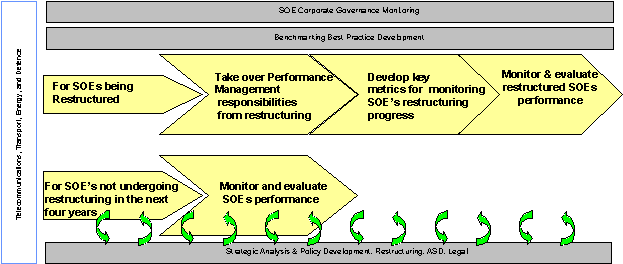
Figure 17. Performance Monitoring and Benchmarking Modus Operandi
The strategic objectives are further decomposed into projects that the program must execute. These projects and activities entailed, are provided below.
The unpacking of each strategic objective has lead to the following lists of projects for the Program to execute:
| Outputs: Program 3a |
Projects / Initiatives | Activities required | Person(s) Responsible | Comments: Contstraints/Risks |
|
SOE Performance Review |
|
|
|
|
SOE Corporate Governance |
|
|
|
|
SOE Policy Review |
|
|
|
|
SOE BSC Project |
|
|
|
|
Electronic PM & Benchmarking repository |
|
|
|
In order to execute each project, Program 3a would require the following organisation structure
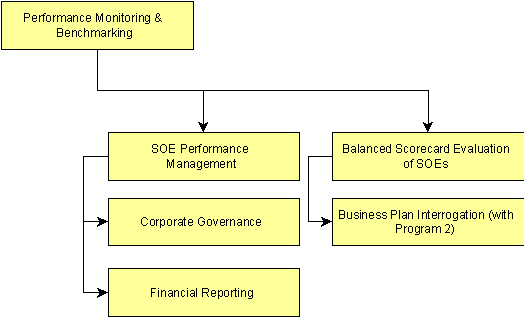
Figure 18. Performance Monitoring and Benchmarking Modus Operandi
The key capability required in the program is that of performance management. Staff should have in-depth knowledge of the uses, processes and mechanisms required for performance management. In addition, knowledge of the implementation of performance management systems within large organisations is also important. A working knowledge of Key Performance Indicators and Benchmarks used across the entities impacted by restructuring will be critical.
A number of factors can be identified for the success of this program:
Establishment of electronic repository containing current status data on SOE performance against targets set out in balanced scorecards
|
August 2000 |