This chapter starts by setting out essential requirements for effective environmental governance. It goes on to present three models for restructuring governance institutions. People need to consider whether these models will meet the essential requirements set out at the start of this section and how effective they will be in implementing environmental policy.
| Debate
The current draft of the Constitution(1) states that environment is a concurrent competence of national and provincial government. This means that central and provincial governments are responsible for managing the environment. The Constitution also makes local government responsible for some areas of environmental management. Some argue that the allocation of competencies between levels of government should be revised in view of the need to maintain national standards of environmental management and to avoid competition at the expense of the environment. A second concern relates to the capacity to implement effective environmental management at different levels of government. |
Effective environmental management requires cooperation across all three levels of government (national, provincial and local) as between departments and sections within each level. It will be necessary to formalise relationships, perhaps through the drafting of agreements specifying:
Although the Constitution gives a commitment to the basic principles of sustainable development, at present environmental issues are not well integrated into development planning and implementation. A number of existing constraints must be overcome. They include:
To give effect to the Constitution, government at all levels must carry out its functions effectively and commit itself to good governance. In order to do this the institutional model chosen must meet the following requirements:
The implications of these requirements are set out below.
To achieve sustainable development and improve environmental governance, government must ensure that:
In enforcing regulation, the role of government is to:
To ensure effective enforcement, government must:
Government institutional structures must provide for effective inter-ministerial and inter-departmental coordination and integration at all levels in order to give support to the national environment policy. A key mechanism in this respect is the negotiation of cooperative agreements through relevant state organs and integrating structures such as MINMEC, the committee of central and provincial government ministers and members of the executive councils responsible for the environment.
Central Government must work cooperatively with the provincial governments. Clear assignment of duties and allocation of powers between levels of government must be a priority.
Achieving effective environmental management and improving decision making requires good science and good information. Government must commit itself to collecting and disseminating information in an accessible manner. It must also support relevant ongoing research.
The effectiveness of governance structures depends on the capacity of civil society to work with government. Government must initiate the creation of structures to foster stakeholder participation in defining environmental problems and seeking solutions. This will require an ongoing commitment to capacity building both within and outside the government structures. The direct involvement of all stakeholders in environmental governance will give it greater legitimacy and acceptance by society as a whole.
In keeping with international trends and Agenda 21, the government will affirm, strengthen and establish partnerships with stakeholders. Stakeholders include:
In particular, government must commit itself to strengthening the current role of NGOs and CBOs, giving them timely access to data and information, and where necessary, providing practical assistance, including financial support for capacity building. This will enhance their role as partners and stakeholders in policy formulation, decision making, implementation, evaluation, determining research priorities, setting standards and legislation.
Central government must fulfill its Constitutional obligations by:
Central government will be responsible for:
Government will ensure that standards, policy and legislation address current problems and provide proactive solutions. These standards, policies and laws will be regularly reviewed and updated.
Central Government must report regularly to the international community in terms of its international obligations. It must ensure adequate opportunity for civil society participation by all relevant stakeholders in negotiating, entering and implementing international agreements.
South Africa must adopt a proactive approach in international relations dealing with environmental issues. In doing so it should prioritise its engagements and relations according to the following hierarchy:
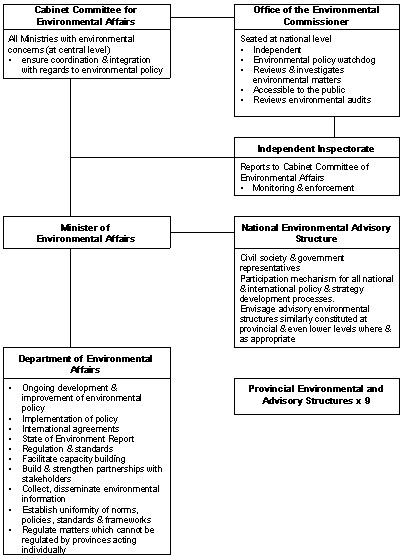
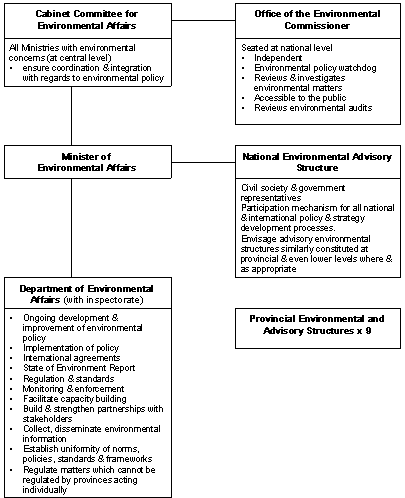
This model provides for:
At central government level the model has:
Option A provides for an inspectorate separate from the Department of Environmental Affairs.
Option B incorporates the inspectorate function into the Department.
A brief description of the functions of these structures follows.
The Minister of Environmental Affairs will chair this committee composed of all central government Ministers whose portfolios impact on, or are affected by the environment portfolio. The Cabinet Committee will provide for greater coordination and integration by ensuring:
It will also facilitate the resolution of conflicts between the different ministries concerning environmental matters.
The Environmental Commissioner will sit at the national level of government, reporting directly to the proposed Cabinet Committee for Environmental Affairs and will be accessible to the public. The Environmental Commissioner will serve as environmental ombudsman and act as an environmental policy watchdog. The office will receive and review objections, initiate investigations and beresponsible for reviewing state environmental audits.
The advisory structure will be composed of government officials from different departments and representatives from key sectors of civil society such as non-governmental organisations (NGOs), community based organisation (CBOs), business and industry, and labour. The advisory structure will:
The structure will have an integrative and consensus-seeking mandate.
These structures will be responsible for policy development, regulation, monitoring and enforcement. Both options strengthen central government's environmental management role and capacity.
The Inspectorate will be multi-skilled and adequately resourced by central government. It will report directly to the Cabinet Committee for Environmental Affairs but stand outside of ministerial and departmental bureaucracies. It will be an integrated enforcement and monitoring authority with an holistic brief to ensure cross-sectoral and uniform compliance at all levels of government with environmental standards and norms and to safeguard environmental quality.
The Department of Environmental Affairs will be responsible (with the participation of other stakeholders) for initiating the development and ongoing improvement of:
The Department will be responsible for identifying key areas and target sectors for immediate attention. It will formulate broad national environmental strategy and ensure that functional economic considerations do not override environmental policy objectives.
The functions are identical to those in the option A. The only difference is that the inspectorate is included in the Department and reports to the Minister.
The effective and efficient administration and implementation of environmental policy depends on the clear and unambiguous definition of the roles and responsibilities of the different levels of government to avoid duplication. Cooperation agreements could provide a key mechanism for achieving this through integrating structures such as the current Council of Environmental Ministers (MINMEC) and its Technical Committee.
The model envisages advisory structures similar to the National Environmental Advisory Structure at provincial and local level where and as appropriate.
Model One Option A
Model One - Option B
The responsibilities and interests of the national government in safeguarding and accommodating national environmental matters include:
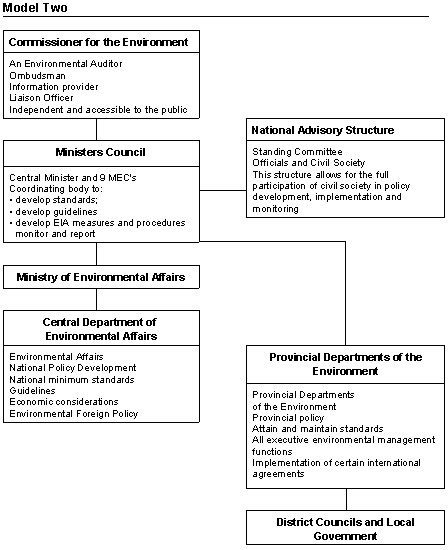
A Ministers Council should be established composed of representatives of national and provincial government and chaired by the central government Minister for the Environment. Decisions should be made by a simple two third majority.
The Minister's Council should be assisted by:
This Council should coordinate measures to protect the environment for the benefit of South Africa's people such as:
It must monitor them and report on their implementation and effectiveness.
The provinces will be responsible for attainment and maintenance of agreed and jointly set national standards or goals and compliance with national guidelines in the area of their jurisdiction through appropriate mechanisms.
The measures established and adopted in accordance with the above procedure will not prevent a province from introducing more stringent measures to reflect specific circumstances or to protect special environments or environmental values located within its jurisdiction.
It is proposed that a Parliamentary Commissioner for the Environment be appointed whose office will be responsible for monitoring the activities of the executive branches of government. The commissioner will act as an:
International environmental issues have in the past been an area of dispute between the central and provincial governments and this requires attention.
National government must exercise its responsibility for negotiating and entering into international agreements in consultation and cooperation with the Provincial governments.
Responsibilities and Interests of the Provincial Governments
The provincial governments are responsible for environmental management at the regional / provincial level. In principle the authority vested in the provincial governments must be wide ranging, including:
The institutional capacity for environmental management at the provincial level remains weak. This can be remedied by the devolution of functions, authority and responsibility (and corresponding expertise and finances) from national to provincial levels of government. This may require the redefinition of the legal mandate for a number of agencies, the creation of new agencies and significant changes in the financial relationships between levels of government. It will also require a concerted effort to involve local community groups and the private sector in the environment and development process.
Responsibilities at provincial level should include:
Local governments have a responsibility for the development and implementation of locally relevant and applicable environmental policies within their jurisdiction in cooperation with the provincial governments and the local community.
The environmental management system must establish a system or mechanism and procedures for accommodating the interests of the various levels of government in environmental issues. These procedures should emphasise timely consultation, a greater streamlining of intergovernmental processes and the need to avoid duplication of decision making.
A mechanism should be put in place to handle issues involving national and provincial governments, such as the cooperative setting of targets and standards
Where responsibility for an issue is not readily apparent, the agreement will establish a consultative process between central government and the provinces to determine the nature of the interest and how it should be handled.
With a view to eliminating functional duplication where the interests of different levels of government are accommodated, the relevant levels of government will review the need and justification for retaining any comparable processes or institutions.
Where some duplication or overlap of interest between levels of government is unavoidable, the relevant levels of government will seek clear and distinct liaison and consultative procedures to coordinate and harmonise actions to avoid dispute.
It must be accepted that all levels of government have a responsibility to ensure that matters of national interest are properly taken into account in their activities.
Certain trends suggest that environmental policy is moving away from centralised decision-making, costly proliferation of structures, detailed regulation and command-and-control approaches towards the setting of objectives, clear standards and the provision of information appropriate to an effective facilitated, participatory self-regulation system.
The appropriate institutional arrangements, structures and issues relating to environmental decision-making should be separated from those relating to environmental management.
The public, NGOs and CBOs have important watchdog roles to play in ensuring responsible environmental management on the part of the government and the private sector. However, government has a role, at the appropriate level, of ensuring that the pressure of public opinion never results in an inappropriate balance between the needs of environmental protection and economic development.
The governance model presented does not specifically indicate an institutional role for NGOs, CBOs, industry and commerce and the public. At local levels, environmental and developmental community forums should be established which form the fundamental basis for interaction between institutional and political structures and civil society. These forums provide a clear and focussed method for communities to communicate and participate on environmental issues and the entire decision making process.
A well defined appeals process, managed by local, provincial and national governmental structures provides the opportunity to communicate dissatisfaction with the decision making process. At each level, elected political structures play a decision making role. In cases of dissatisfaction, decisions can be referred up to the next level with national Cabinet being the ultimate political level of decision making and appeal.
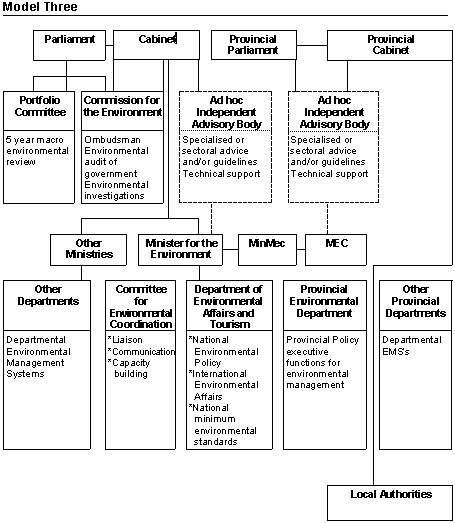
Cabinet is the key senior political coordinating link at national level for environmental matters. A recommended route for managing environmental issues would be to establish a cabinet committee of ministers with responsibilities for environment, tourism, nature conservation, water, forestry, minerals and energy, land and agriculture, finance trade and industry and planning. Cabinet or the cabinet committee would be advised by an ad hoc independent advisory body.
This body is convened, when required, from a standing list of candidates competent to advise national and provincial cabinets on environmental matters. The list is drawn up through an appropriate consultative process involving stakeholders. A transparent selection and screening process will be established and the ultimate choice of nominees will be through the parliamentary Portfolio Committee.
The advisory bodies will function at both national and provincial level. The bodies will play a role in the appeal process by advising and guiding the provincial and national cabinets on specific cases. As ad hoc bodies called for specific reasons and constituted with the relevant skills and expertise, they will adequately and effectively advise the appeals process.
The Commission reports to the national Parliament and is responsible for monitoring and auditing the environmental performance of government departments. It has an 'ombudsman' function, receiving complaints and initiating investigations on environmental matters. The Commission also acts the 'convenor' and secretariat for the national ad hoc environmental advisory body to the Cabinet.
All Ministers can seek advice and input from the Commission and/or request it to undertake investigations.
The department is responsible for setting and auditing national environmental policies and standards. It is the link with international institutions and all global environmental issues and communicates and coordinates responses after liaison and consultation with local structures and frameworks.
They are responsible for setting provincial policy, in consultation with national structures, and for the executive environmental management function.
The Committee for Environmental Coordination ensures communication and liaison on environmental matters between government departments. It plays an important role in the smooth functioning of departmental environmental management systems.
MINMEC acts as a coordinating structure for environmental matters in the provinces and as a link, through the Minister of Environmental Affairs, with national environmental structures.
In a sectoral approach, all departments should have a well defined and auditable Environmental Management System (EMS) for regulating the environmental impact of activities in their sectors.
Provincial departments of the environment and local government authorities play significant roles in the monitoring programmes of sectoral departments.
Sectoral departments need to develop sufficient internal capacity and structure to avoid 'conflicts of interest' between sectoral responsibilities and environmental management and protection.
The process of decision-making should be subject to clear procedures including well defined time scales and communication mechanisms.
The institutional framework must have a well defined process of appeal that is readily accessible and integral to the environmental decision making process. Appeals should commence at the lowest possible level and pass on to provincial and, if necessary, national level. Community forums will have access to the appeals process and will be encouraged to use it to satisfy concerns with the environmental decision making process.
Various environmental departments administer the appeals process with political structures taking responsibility for decision making.
Footnotes:
1. At the time of writing, the draft Constitution has been referred back for further consideration by the Constitutional Assembly