Published in the Government Gazette, Vol.400, No.19397, 22 October 1998
1. Summary
This is a discussion document to initiate the process of defining Universal Access and Universal Service in Telecommunications in South Africa. The Universal Service Agency (USA) is mandated by the Telecommunications Act (1996) to develop such definitions, and the USA is doing this work in collaboration with the South African Telecommunications Regulatory Authority (SATRA).
Will the amazing advances in telecommunications systems, and related information technology, only be of benefit to a minority in South Africa, increasing inequity between an "information elite" and a majority living in "information poverty"? Or will these new technologies promote information literacy throughout our country and work as an infrastructure to promote development? Both are technically possible. What will decide how the "Information Society" evolves in South Africa is policy, regulation, the market and a number of projects from government, business and communities.
One part of this is establishing national definitions for Universal Service and Universal Access in South Africa. This should not be seen as an academic exercise to come up with a dictionary definition. The process should engage all those involved in this sector to set national goals that are achievable.
This document aims to start this discussion. It outlines the context of these issues and the current status quo of telecommunications in South Africa - especially the inequality between rural and urban areas and white and black citizens. Then the different issues around Universal Service (a phone in every home) and Universal Access (largely through community access points, such as telecentres) are discussed. The key question of affordability next is discussed, and the document closes outlining this process and the question that will have to be addressed.
This is to be seen as an open and ongoing process. While we intend to develop definitions and targets that can be implemented by March 1999, this process will continue. There may well be annual reviews of the progress made, and redefinition of targets - it is to be hoped that as South Africa meets universal access targets, they will be redefined to provide a higher level of service. We would like to stress that this document is not intended to be a definitive report - quite the opposite, this is an initial attempt to raise some of the issues that we hope will be answered through this process. This is an invitation to you, the reader, to give your comments.
2. Introduction and Background to Process
This paper seeks to raise the issues around Universal Service and Universal Access to Telecommunication and other information services in South Africa. The Telecommunications Act (103 of 1996) states in section 59 (2) (a) that "The Agency shall, … after obtaining public participation to the greatest degree practicable, make recommendations to enable the Minister to determine what shall constitute -
- Context of the Information Age and Development
- South African Initiatives
- Introduction to this Process
- Overview of the Issues
- Outline of Chapters
2.1 Context of the Information Age and Development
As the Information Revolution has increasing impact around the globe, the issues of who
has access to these technologies has great importance. Connection to these networks and
services influences a people's access to jobs, education, health care and full
participation as a citizen. The convergence of telecommunications, computers, information
production and broadcasting is largely determining how societies are structured. The
Africa Telecomm Conference held in Johannesburg in May 1998 demonstrated the significance
of these systems to Africa.
There is a major question throughout the world: will these technologies and systems lead to increasing disparities between the connected information elite and a large majority of 'information poor', or can they be used to support widespread development and a more just society? These communication and information networks are often now referred to as the "Information Infrastructure", as important to the development of a country as the road and water networks.
2.2 South African Initiatives
South Africa has been one of the leading nations calling for these technologies to be used
for economic and social development in developing countries, for example at the
Information Society and Development Conference (May 1996, Midrand) and at Global Knowledge
(June 1997, Toronto). The Telecommunications Act (103 of 1996) makes providing access to
telecommunications to all a key priority of the sector. This commitment is demonstrated in
the license conditions of Telkom of rolling out 1.8 million lines in rural areas; and in
the Community Service Obligations of the cellular phone operators.
Despite the fact that South Africa has the best telephone network in Africa, there are major inequalities with the cities having generally excellent service while in many rural areas there are no phones at all (see chapter 2).
2.3 Introduction to this Process
This paper, and the process that it supports, aims at setting definitions for Universal
Access and Universal Service to telecommunications and information systems. These
definitions should serve as targets for South Africa to work towards. But first, these
terms need to be explained.
Universal Service refers to all households in a country having a telephone, so that all individuals can make a telephone call from home. Universal Access refers to all individuals having reasonable access to a telephone that they can use. This could either be in their own home, at a business, or some public facility. While Universal Service has a fairly clear meaning, Universal Access is a very flexible concept - what does "reasonable" mean? Devising a coherent definition is an aim of this process.
South Africa already has a number of policy initiatives, and different related definitions, in this area. The Community Service Obligations (CSOs) of the cellular phone operators refers to "disadvantaged areas"; Telkom's license has firm targets for roll out and 'priority customers'; and the Telecomms Act refers to "needy people" that has been well researched by Aki Stavrou in a report to SATRA. South Africa's existing definition (Partnership for the Future, May 1997, Department of Communications) is: "Universal access is defined as living within 30 minutes travelling time of a telephone; universal service is more than 50% of economically eligible households with a telephone and service for 24,000 priority customers". One of the aims of this process is to bring together the different definitions used in South Africa.
However, this process should not been seen as an academic process leading to a dictionary definition. As the International Telecommunications Union states in their World Telecommunications Development Report, 1998: "Technology that theoretically provides telecommunication access from anyplace on the surface of the Earth is already available. Universal access is now not so much an engineering or supply-side problem but rather a regulatory and policy challenge."
South Africa certainly has the wealth and the political commitment to meet this challenge. The question is whether there is the will to combine the public and private sector resources available to provide universal access early in the 21st Century to all South Africans. Rather than this being a process to produce a document, it should be seen as using the drafting of a document to support the co-ordination of a national effort to meet the targets set. In the words of Harmeet Sawhney, the aim is to develop 'overlapping consensus' to develop universal access in South Africa.
2.4 Overview of the Issues
Universal Service and Universal Access measure different things, and require different
policy measures to promote. The longer term goal would be to provide telecommunications
service to all households in South Africa, but realistically this will not happen for many
years. Universal access is a realisable goal within a few years.
Universal service is an issue in many European and North American countries, with universal service figures of over 80%. Here the main considerations are around cost of usage as opposed to providing the network. Universal service is seen to have 3 elements: availability, accessibility and affordability. In South Africa, currently the main focus is on extending the network into areas currently with no service. However, there is a major issue of people who had a service now not subscribing due to high cost (this is referred to as "churn"), so affordability is also important in SA.
The Universal Service Agency was established to promote access to telecommunications throughout SA. The main project to do this is through establishing "Telecentres". However, there are many other initiatives from the public and private sector - Phoneshops, dial-inns, phone kiosks, Schoolnet, Multi-Purpose Community Centres as well as public pay phones. The national goals can be a mix of different elements, for example China has a policy of "One family, one telephone" in urban areas and a telephone in every village by the year 2000.
Do we still mean only voice telephones when we talk of Universal Service? There are a wide range of other services now, such as digital lines, tone dialling, broadband, fax/modem capacity, operator services, directory enquiries, call line identification, emergency services, itemised billing, call forwarding, multi-party lines and voice mail. In short, focusing simply on voice will not bring South Africa into the Information Age. So the scope of the services we are discussing also needs to be defined in this process.
The ITU makes the suggests these steps in addressing universal service:
2.5 Outline of chapters
This document is as follows. Above there is the executive summary and this introduction,
section 1. The next section 2 outlines in greater detail the telecommunications situation
in South Africa, both the statistics of usage as well as the industrial, legal and
regulatory environment. Section 3 and 4 deal in more detail with the issues of Universal
Service and Universal Access. Section 5 discusses the crucial issue of affordability and
economic sustainability. Section 6 then outlines the process that is being launched.
3. The Telecommunications Status Quo
While policy goals and regulatory approaches naturally vary from one country to another; reflecting differences in political and economic doctrines; and practical circumstances, most countries recognise the concept of Universal Service as a policy goal. In South Africa the Telecommunications Act 103 of 1996 provides the primary objectives for the regulation and control of the telecommunication matters in the public interest. These objectives include:
In terms of the Telecommunications Act 103 of 1996 the Universal Service Agency was established. The Universal Service Agency was established to :
3.1.1 Telkom SA
Until November 1996 Telkom's operating mandate stemmed from the Post Office Act of 1958 as
amended. However, the promulgation of the Telecommunications Act of 1996 in November 1996
changed that scenario. In May 1997, Telkom received three 25 years licences i.e. the PSTS
licence to provide public switched telecommunication services, radio communications and
value added network services (VANS). The PSTS licence gives Telkom an exclusive right to
provide national, international and local telephony services for five years. During the
exclusivity period Telkom is required to install 2,8 million new lines, including 120 000
payphones. Approximately 1,7 million lines should be installed in under-serviced areas.
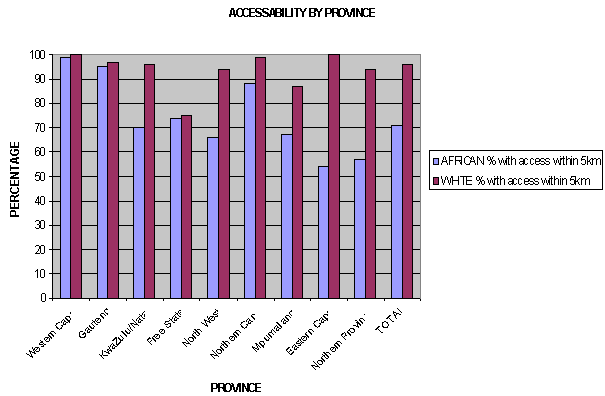
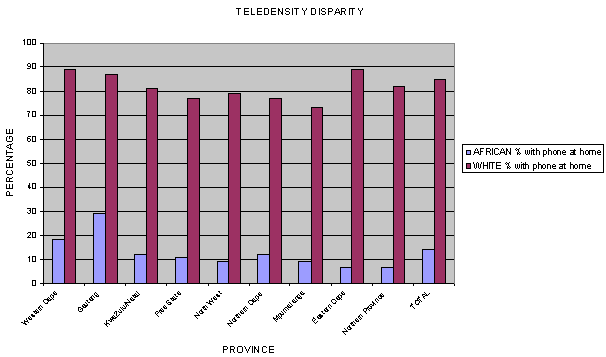
Currently Telkom has over 4,5 million lines including 127 000 payphones that have been installed throughout the country. The average telephone tele-density (main telephone services per 100 people) stands at 10,05 per hundred inhabitants. In South Africa there are 8.7 million households of which 2,8 million has a telephone. The percentage of households with telephones greatly varies - amongst white households it generally exceeds 85%, Asian households 74%, Coloured households 37% and Black households 14%. The graphs on the next page show the household penetration rate and accessibility in South Africa, by race and by Province.
| DEFINITIONS | |
| Teledensity: | Number of main phone lines per 100 people. |
| Penetration: | Percentage of people with telephones in their house (similar to Universal Service figures) |
| Accessibility: | Percentage of people with telephones they can use within 5 km (similar to Universal Access figures) |
3.1.2 Cellular communications
In 1993 MTN and Vodacom were licensed to provide cellular telephony. In terms of the
Multiparty agreement, MTN and Vodacom were required to install the community service
telephones (CSO) to under-serviced areas for a period of five years. Vodacom and MTN are
obliged to deploy 22 000 and 7 500 Community Service Telephones respectively. Since 1994,
the South African cellular telephony market has continued to grow rapidly, building on the
incredible success achieved since the service was first offered. The industry has
contributed vastly to South Africa's economy in terms of fixed investment, licence fees,
tax revenues and employment, not to mention the positive effect that cell phones have had
on the other sectors of the economy.
Cellular subscriber growth has far outstripped initial expectations, and the industry continues to grow, attracting 1,9 million subscribers by March 1998 which represents 4% of the population. This is a lucrative field, with as many as 10 million users expected by year 2010.
The South African Telecommunications Regulatory Authority (SATRA) has commissioned a study into the economic feasibility of introducing two cellular network providers. It is envisaged that the effect of the entry of the new operators is going to affect the present duopoly, and cellular phone ownership extends to the lower socio-economic groups. The market share of Vodacom and MTN is estimated to be 56% and 44% respectively. Both cellular operators have invested R7 billion in network installation. The ownership of cellular telephony in South Africa is concentrated on the white population. The distribution of cellphone by area-type and race is:
| URBAN | NON-URBAN | |
| Black | 3% | 1% |
| Coloured | 3% | Nil |
| Asian | 4% | Nil |
| White | 14% | 5% |
Source : ITC Consortium Report
3.2 The Constitution
The constitution of South Africa is the fundamental defining document, which establishes
the human rights and political perspectives of the country. The important issue that is
contained in the Preamble states, inter alia: We therefore, through our freely elected
representatives, adopt this constitution as the supreme law of the Republic so as to
establish a society based on democratic values, social justice and fundamental rights;
Improve the quality of life of all the citizens and free potential of each person.
The Bill of Rights spells out some of the fundamental rights of individuals and collections, and the necessary individual or collective behaviour expected towards individuals and collectives. Moreover it enshrines the rights of all people in our country with respect to the environment, health care, education and access to information; and affirms the democratic values of human dignity, equality and freedom.
The constitution has a particular relevance to communications as discussed by reference to the Bill of Rights. It could then be argued that access to telecommunications services is a basic right to all citizens to communicate, which is essential for full participation in the community and as a basic element of the right to freedom of expression.
The concept of Universal Service has gone through several stages of evolution over the past 90 years. In telecommunications, Universal Service was first brought into use in America in 1907 by Theodore Vail, President of AT&T. After 1920 telecommunications regulations were focused on the development of a single integrated network and were not directly linked to a policy of promoting household telephone penetration. Universal Service as a concept of a telephone in every house, underpinned by policies to make services available and affordable for residential and rural subscribers did not emerge until the mid 1960's.
However, the concept of Universal Service was extensively canvassed at the International Telecommunications Union's (ITU) second colloquium in December 1993, with a consensus "that there is no fixed and uniform definition of 'Universal Service'". This concept may mean different things in different countries and regions, and different things in different contexts within each country. It has been a changing concept over time as technology develops and expectations consequently change. The ITU's Second Regulatory colloquium showed that Universal Service policy operated on three dimensions:
Many developed countries have over 90% of households with a telephone, which is generally taken as a major of universal service. However, it has taken over 90 years in most of these countries to reach, and only became an issue when most people already had service, so policy could focus on the minority. The Universal Service definition is normally phrased as a requirement of the telecommunications service provider to meet these criteria. In these countries, Universal Service is now taken to refer to 3 things: availability, accessibility and affordability (ITU: World Telecomms Development Report).
| Availability: | There should be nationwide coverage of telephone service, wherever and whenever required. | |
| Accessibility: | Users should be treated alike; there should be non- discrimination in terms of price, service and quality, irrespective of location or race, sex or religion. | |
| Affordability: | Telephone service should be priced so that most users can afford it. |
The ITU's World Telecommunications Development report of 1998 suggests that developing countries should focus on Universal Access rather than Universal Service. This is because contemporary Universal Service is not a single concept but, rather, a composite, comprising nationwide coverage, non - discriminatory access and widespread affordability. Pursuing availability, accessibility and affordability can be in conflict to each other i.e. extending the network geographically requires major investment, that the affordability criteria could work against coverage, and can instead be seen as different priorities as the telecoms infrastructure develops. Page 66, Table 4.3 of the ITU report provides five stages of Universal Service policy formulation.
4.1 A definition of universal Service for South Africa
The green paper for telecommunications policy in South Africa provides some useful
information with respect to Universal Service. It states that the provision of Universal
Service means putting a telecommunications line in every household wanting the service, at
affordable prices. The achievement of Universal Service and the provision of a wide range
of services are, in the long term, complementary objectives.
However, the process of achieving each of these will require responses to identified needs at particular times both to achieve a balance between the two and also to redress the imbalances caused by apartheid. The process will require, in turn, innovative and clear policies, careful planning and hard decisions in order to chart a path towards thriving, sustainable and equitable economy both within the telecommunications sector and nationally.
The study that was undertaken by DRA-development to define the Universal Service Policy on categories of needy people in South Africa expresses the concept of Universal Service this way: A definition of Universal Service in South Africa is enshrined in the countries first democratic socio-political and economic development framework, the Reconstruction and Development Programme (RDP). In this document it is stated that "the aim of the South African Telecommunications Sector will be to provide universal, affordable access to all as rapidly as possible within a suitable and viable telecommunications system".
The above statements form the foundation upon which a definition of Universal Service in South Africa can be constructed. In South Africa a majority of the population are not connected to the telecommunications network because of apartheid, and the inability to afford a telephone which remains a barrier. Moreover South Africa is regarded as a middle to upper income group country economically. Therefore it is recommended that we pursue two policy goals with regard to Universal Service, namely, Universal Service and Universal Access.
QUESTION: What is the best way of defining universal service in South Africa?
4.2 Under-Serviced Areas
The Universal / Community Service Obligation (USO or CSO) is generally defined as the
primary prescribed carrier obligation placed by the government upon telecommunications
carriers to provide services to under-serviced and un-served areas. Without a workable
definition of under-serviced areas, there can be no workable definition of Community
Service Obligations. In South Africa there are two definitions of under-serviced areas in
the telecommunications context. The first definition resides in the Telkom licence. This
definition, defines a township and a base line of 50% of households with a telephone
service. The 50% penetration, as a "yard stick" raises a question of "what
yard stick is used for rural areas"? Moreover this definition is so generous that
positioning of community service telephones is flexible and the objectives of these
services could hardly be satisfied.
The second definition is found in the National Cellular Telecommunications Services licence for Vodacom and MTN. The under-serviced area is defined as a city, town, township, shantytown, location, village or human settlement or any part thereof as prescribed by the Postmaster General from time to time but in any event the areas listed in the Implementation Timetable. This is based on the nominated locations by the cellular operators which could be subjective. Moreover this definition is too broad and cumbersome to be used and satisfy the objectives of community service telephones.
QUESTION: How should an "under-serviced" area be defined in South Africa to satisfy the objectives of universal service obligations?
4.3 Impact of different technology
The development of telecommunications technology will have a major impact on both
universal service and universal access provision. This process of definition must look at
the existing and emerging technologies, and how that could affect the targets South Africa
can set itself.
For example, Wireless Local Loop (WLL) technology such as DECT can greatly impact the cost effectiveness of rollout in rural areas, providing greater access and service. However, there are issues of whether WLL will be able to support broadband applications. Also, satellite technology, particularly Global Mobile Personal Communications via Satellite (GMPCS) could benefit remote areas though at a high cost. Full Internet access requires more bandwidth than standard telephony. And should include other services be included, such as tone dialling, broadband, fax/modem capacity, operator services, directory enquiries, call line identification, emergency services, itemised billing, call forwarding, multi-party lines and voice mail?
5. Universal Access
Universal access refers to allowing everyone in the country to have access to a telephone that works within a reasonable distance and at a reasonable cost. It is seen as an interim step that should be realisable for South Africa within the first decade of the 21st Century. The longer term goal would be to achieve universal service.
5.1 Universal Access in developing countries
Universal access has been defined in many different ways, such as a phone for every
settlement with over 'X' population (500 people in Ghana); a phone a certain distance of
everyone (20 km in Burkina Faso). In South Africa we have usually talked of a phone within
30 minutes travelling distance.
A key point is that these targets change with time - as one target is met, universal access is redefined at a higher level. For example, in India the principle is, "easier and quicker and increasing access to a public telephone for people who can not take a private subscription" - and the definitions changes as the network increases, currently any village over 2,500 or a distance of 5 km qualify for a public telephone.
In many countries, public payphones are the main way of doing this. For example, in many Latin American countries, the (newly privatised) telephone operators were set payphone targets. Also, licensing public call offices has been very successful in many countries, such as Indonesia and Senegal where there are over 5,000 "Telecentres prives" that are heavily used. In Bangladesh, Grameen Telecom are working to establish 68,000 Village Pay Phones (VPP) using cellular technology that will provide access to over 100 million rural inhabitants. It will cost US$450 per VPP that is being financed by the Grameen Bank SMME loans, and is very successful. Other countries focus on getting at least one line into all villages and localities, such as Mexico, Thailand and Poland.
QUESTION: How should South Africa define Universal Access?
The International Telecommunications Union stresses the role of Multipurpose Community Telecentres (MCTs). These are centres that provide telecommunications services (often including internet connectivity), and have a large degree of community involvement or ownership. A key point is that to ensure their sustainability they offer a range of development related services, linked for example to health, education, agriculture or government information services. The International Development Research Centre is running the Acacia programme supporting telecentres in Uganda, Senegal and Mozambique as well as South Africa.
5.2 Initiatives in South Africa
In South Africa there are many projects involved in providing access to telephony.
Telkom's payphones certainly are the largest number of telephony access points in South
Africa. The largest national project to provide universal access to telecomms currently is
the Universal Service Agency's project to establish Telecentres. These are funded by the
Universal Service Fund, and currently there are six established, with many more planned
before the end of 1998.
From the Community Service Obligations, Vodacom has established many Phoneshops. MTN have also set up a number of community access points. Telkom also is setting up Dial-Inns. The Department of Communications also has a number of projects in the Info.Com initiative, such as setting up Internet labs in universities. Also, Personal Internet Terminals (PITs) are being established in Post Offices throughout the country.
As well as primarily telephony centres, there are many hundreds of Multi-Purpose Community Centres (MPCCs), the majority of which have computers and telephone lines. These, and other community centres, could be useful bases for more developed telecentres. There are many other individual project of setting up community information or computing projects, run by universities, companies, NGOs and others.
All of these projects to increase access to telecomms are dependent on the telephone network - the roll-out of Telkom, as well as the cell phone networks of Vodacom and MTN. There is some experimentation with satellite systems, but as yet they are not many such systems. The rollout of the electricity network also has a major impact on the potential of centres in South Africa.
5.3 Issues in community access
Many of the project named above have showed the benefits that come from a phone centre or
a multi-purpose centre. The point now is to go beyond individual demonstration projects
and develop mechanisms for national coverage - to achieve universal access. There are
different levels to this goal. This discussion will consider computerised information
systems as well as telephone centres.
| Infrastructure: | Access to the telephone system (network roll-out) as well as computer equipment (many computers could be sourced from recycling) | |
| Education & training: | Training the operators of these centres and the users in the systems, especially computerised and network systems. | |
| Information: | Arranging links to local and national information sources, and developing local information creation (e.g. community directories) | |
| Social sustainability: | Ensuring the services are used in the local area and are responsive to social needs. | |
| Economic sustainability: | This is the key test to whether these centres can survive on a major scale. |
Individual projects that are run as pilots with donor funding can be excellent schemes, but these lessons must be turned into models that can be rolled out throughout South Africa, and are not reliant on continuing donor funding. In the period of Telkom's exclusivity we must develop models for telecentres that can be shown to be sustainable. These models will be different depending on the situation, e.g. township or rural.
There already have been a number of hard lessons that should be learnt - centres where the equipment has been stolen, where community tensions have closed down centres, where incompetent or fraudulent management have made centres fail. These lessons must be shared so that future centres have more chance of success. A key task is to test a number of business models for Multipurpose Community Telecentres, and over time see which are effective and which fail. It is clear is that this must be developed in partnerships - public, private and community.
QUESTION: How should access points be developed to offer services that meet wider development needs, and tie into other national priorities such as the fight against AIDS?
Networks and linkages
No one organisation will be able to achieve universal access in South Africa by itself. A
primary objective of this initiative must be to link the number of different projects so
that there is a reasonable national coverage of centres. This includes links to libraries,
schools (especially through the SchoolNet initiative), health clinics, churches and other
religious organisations and other community projects. Information projects should link
with the work of the Government Communications and Information Service (GCIS).
Questions
6. Economic Issue of Universal Service
6.1 General
Affordability of services is central to the concepts of Universal Service and Universal
Access. Conventional studies have often overlooked the challenge of expanding
telecommunications to rural areas due to a false belief of this being uneconomic. These
studies have only accounted for traffic from rural areas rather than traffic in the
opposite direction.
Most marginal users are kept off the network usage related costs rather than access related costs. A study from the Benton Institute in the United States suggested that basic telephony should cost no more than 0.7% of a household's total income. However, figures for South Africa indicate that the total spent by households on telephony is 2.87% of its monthly income. This calculation is based on: 0.65% on rentals and installation and 2.22% on calls
If the cost of a basic telephone does not exceed 2% the monthly income of households, even then 44% of all households would not be able to afford a basic telephone. (DRA Development Document Defining the Categories of Needy People).
Affordability levels by differing costs of telephony per month*
| R30 | R40 | R50 | R60 | R70 | |
| H/h not able to afford more than 2% on income spent on telephony | 44% | 53% | 60% | 65% | 69% |
| 3 829 | 4 648 | 5 215 | 5 642 | 6 017 | |
| H/h not able to afford more than 3% of income spent on telephony | 30% | 40% | 48% | 53% | 58% |
| 2 616 | 3 445 | 4 142 | 4 648 | 5 067 |
* All estimates are done in 1997 Rands
Table from the DRA Development Document Defining the Categories of Needy People
A study done in Camden, New Jersey by the Benton Foundation revealed that 8 out of 12 families interviewed who were disconnected from the network cited high costs incurred from call usage as the reason for non payment of the bill and subsequent disconnection. While only three of the families interviewed found the rental unaffordable. This is true of South Africa as well.
Costs begin escalating at this point, making it unlikely for such households to rejoin the network until the initial bill is settled, with the addition of a reconnection fee.
6.2 Rate of Churn
Many people fall victim to a situation where they obtain a telephone on the basis that
they can afford it and lit its use to levels which they can afford. Later difficulties are
encountered, when beyond the households means are encountered, inability to settle bills
and subsequent disconnection. In many instances these bills are not incurred by the owner,
who is nevertheless responsible for payment. In 1996 the churn rate was 16%. Telkom was
required in terms of its licence conditions to install 250 000 new lines. Instead it had
to install 700 000 to reach its target.
Would flexible billing and packages influence affordability, especially in low income households and allow more people on the network? If such packages were introduced, especially by the Public Switched Telecommunications Network (PSTN) Operator, do you think this would positively influence a household's ability to remain on the network?
Currently, only 3.7 million (42%) households can afford to install and maintain a telephone without assistance. It is expected that the introduction of new technology and flexible billing system could add a further 420 000 to 1.6 million (19%) households to the network. (DRA Development document Defining the Categories of Needy People).
6.3 Eligible Categories of People
The South African Telecommunications Regulatory Authority (SATRA) have identified the
following groups of people to be eligible for subsidies from the Universal Service Fund:
Questions
Should these be the only categories of people in terms of the Universal Service that
should be considered?
Is the Universal Service Fund the only mechanism for addressing these needs, or are there
other possibilities for responding to these needs?
Should people with a total household income less than a specified amount (to be
determined) and students also be included, as well as other groups to be realised by this
process?
In terms of South Africa's high levels of unaffordability of telephony, is it feasible to
include such a varied groups?
6.4 Telephony a Right or Privilege
While considering the feasibility of including a variety of groups that should be
eligible, one needs to consider whether telephony is accepted as a right. If it is
accepted as right then the cost benefit equation should become a secondary consideration
as is the case for other essential services and it becomes society's obligation ensure
that everyone has the service. However, economic considerations cannot be excluded.
6.5 Considerations and options for Universal Service Packages
Therefore, innovative alternatives need to be sought to ensure the greatest degree of
telephone penetration.
6.5.1 Pre-paid phones
Telkom's recent introduction of prepaid phones raises a series of questions
6.5.2 Lifelong connection to the network, subsequent to payment installation fees?
Studies show that most marginal users are driven off the network as a result of usage related costs. These users then develop a pattern of being on the network followed by periods of exclusion. Therefore, the ability to control costs is imperative to break the on-again, off-again pattern.
Should users be given the choice of changing to a pre-paid system or toll-blocking or could this be at the discretion of the operator?
The Benton Foundation suggests a three-tier system of Universal Service whereby all subscriber's especially low-income users assured of continuous access to at least essential services.
OPTION A: Universal Service Package … full basic service This should include the following services:
This package should be able to the subscriber so long as the total bill can be settled. In the event that only part settlement is possible, then local call charges should be deducted first, followed by long distance and toll charges. While a payment plan for long distance calls and toll charges is negotiated the services could be suspended.
Should the user be given a period of grace before being demoted to lower level of service? Or should the lower level of service be immediate?
Should all of the above be services offered within this level of the Universal Service Package - should other services be included or some excluded? Which services and why?
OPTION B: Limited Basic … no long distance or toll charges allowed This layer of the Universal Service Package should be limited to:
Should toll blocking and the blocking of out-going calls be negotiable at this level of the Universal Service Package? On failure of the subscriber to pay the total bill at this level of service should they automatically be put onto the next level without disconnection? On settlement of the full account Should the subscriber be reinstated to the full basic service mentioned above?
OPTION C: Essential Services … access to emergency services At this level of service the subscriber would be allowed:
If the user were left at this level of service they would at least have access to essential emergency services and income would be generated for operator with traffic to that user. Should the subscriber be left at this level of service for a limited time only or indefinitely? If left at that level indefinitely what should be the minimum costs accepted from that user?
QUESTION: What mechanisms can be devised so people do not 'fall out of' the network and can maintain a 'life-line' service?
6.5.3 Flexible billing
The introduction of a flexible billing system is more than likely to influence affordability for low-income households, allowing the individual household to chose a package to suit their needs.
The national fixed line operator could be encouraged to implement systems similar to that used by the GSM operators: high rental, low usage or low rental, high usage costs. In addition to the rental and call tariff options should the operator introduce a system whereby the user is able to cap charges on that line, allowing the user to limit telephone usage to affordable levels.
6.5.4 Low User Schemes
Discounts on the line rental could be offered to subscribers using less than a specified "x" number of units in a billing period. Should this scheme be limited to low-income users as is done in Spain or should this be available to all subscribers regardless of income as is the case in France and the UK?
However, in countries where these schemes are offered lines that generate no calls in a billing period do not qualify for this rate. Should the same be applicable within the South African context? Consideration, needs to be given to what does "lines that generate no calls" means? Is it to that user or away from that user? Should special packages for disabled people be considered?
6.6 Period of post exclusivity
An impediment in the provision of universal service in South Africa is the availability of
infrastructure. The local loop is a large component. The white paper of Telecommunications
Policy states that the two central purpose of the period of exclusivity are:
Presently the Telkom is compelled to increase access to telephones and install 2,8 million lines during its period of exclusivity. However, after this period the issue of who's responsible for universal service is re-opened.
Questions
After exclusivity, how should Universal Service then be addressed?
Should this be part of the licence conditions of operators?
Should the technologies be determined by the Regulator & Policy makers or by the
services that it should be able to support?
Should community driven projects such telephone co-operatives focus heavily on Universal
Service Obligations?
7. The Process Defining Universal Service and Universal Access
A task team consisting of representatives from the Universal Service Agency (USA) and the South African Telecommunications Regulatory Authority (SATRA) was established in mid August after the approval to begin the process. The Universal Service Agency is mandated in terms of the 1996 Telecommunications Act to define Universal Service and Universal Access but invited the joint participation of SATRA. In early September the process plan and budget were approved by the USA.
By late September the process was well underway with the USA receiving initial drafts for approval. Subsequently by late October an announcement will appear in the Government Gazette to announce the commencement of the process and invite comment, The document will be available at the USA's offices and on the website - http://www.usa.org.za
In late November the public hearings will be held in the following provinces , ensuring community participation: KwaZulu Natal, Eastern Cape, Northern Cape, Western Cape, Mpumalanga, Northern Province and Gauteng.
The process will culminate in a national colloquium in Gauteng in mid February where people especially from communities at the grassroots level will be invited. Limited funding will be available, early applications are therefore required.
The process will be concluded by early March 1999.
For further information, please contact:
Katharina Pillay
Universal Service Agency
Tel: (011) 726 5241
Fax: (011) 726 5313
Email: kathrina@usa.org.za
Web: http://www.usa.org.za