





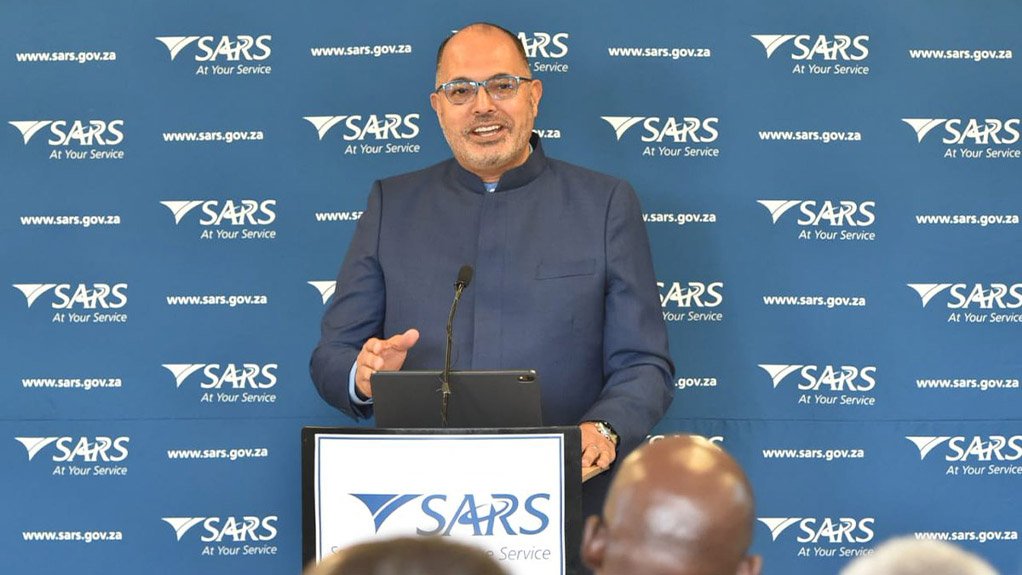
On April 30, 2026, Edward Kieswetter stepped down after seven years as Commissioner of the South African Revenue Service. The headline numbers are telling: R2-trillion collected in the 2025/26 financial year, R11.8-trillion across his tenure, public trust in Sars lifted from 48% to 75%, and service levels above 90%. Reducing his legacy to a ledger, however, misses the point. The more important story — and the one South Africa most needs to absorb — is how he did it, and what that means for the dozens of other public institutions that remain in varying states dysfunction.
On our most recent Espresso Briefs, we had the privilege at Nortons Inc. of speaking with the Commissioner. Four threads from that conversation deserve to be put on the record.
1. Institutions are rebuilt from the inside out
Kieswetter inherited an organisation which, in his words, “had been deliberately captured to serve a corrupt intent”. The Nugent Commission had already exposed the wreckage. But his first priority was not structure, nor technology, nor policy. It was people. “The most important work was reclaiming, regaining the trust of the men and women at Sars, starting a process of internal healing by listening”, he told us. That re-humanising of the workforce, combined with a clinical assessment of senior leadership, in which approximately six senior executives exited in the first few months, is what allowed everything else to follow. The rebuild, he emphasised, was “definitely not a miracle, but an intentional, clear plan of institutional rebuilding from the inside out”.
He also set out five criteria for public-sector leadership: good character; the hard competence required for the role; a track record of delivery; an unrelenting work ethic; and incorruptibility. The South African pathology, he observed, is not political appointment itself — every democracy practises some form of it — but the collapse of merit within it: “The problem is often making that the only criteria for appointment”.
2. The compliance trap
One of the Commissioner’s sharpest observations concerns the perverse incentives that govern the South African public sector. Parliamentary scrutiny rewards clean audits above all else, and, as Kieswetter put it, “the best way to get a clean audit is to do nothing, because failure is not rewarded. It’s punished.” In a state that needs to take measured risks, to reform, to experiment, to modernise, a compliance-first culture entrenches precisely the paralysis it is designed to prevent.
3. The illicit economy demands a systemic answer
On a threat now variously estimated at between 10% and 15% of GDP, the Commissioner was unsparing. “[T]he illicit economy may be illicit, but it is highly organised. It is well functioning. It acts and performs and behaves like a business.” The state, by contrast, has responded “in a transactional and functional way, not in a systemic way”: Sars, SAPS, the Border Management Agency, the SANDF, the Hawks, the NPA and the SIU each pursuing narrow mandates without shared intelligence or shared scoreboards.
The answer that has now been taken to the Presidency is a national illicit-economy disruption programme, housed in the Presidency because only the President can command across ministries. The proof of concept is Lebombo, the country’s highest-risk border post, along a manageable stretch of the Mozambican borderline, to be re-engineered as an intelligence-led, single-command border system, and then scaled. For competition lawyers, economists and policy-makers who work in and around the fuel, tobacco, alcohol and clothing value chains, this is a structural shift worth watching.
4. AI is coming for the professions — and for tax administration
Kieswetter did not hedge. “In the next three years we will build AI agents to be better than the best lawyer. Better than the best engineer”, he told us, warning that anyone whose livelihood rests on a narrow subject specialisation “will not be able to compete with an equivalent AI agent”. Sars’s own roadmap is instructive: six million individual taxpayers auto-assessed; assessment outcomes returned in under five seconds; an AI tax advisor embedded in the Sars mobile application; and a proof-of-concept agentic contact centre. The destination is what the Commissioner calls “tax just happens”, obligations fulfilled so seamlessly that the act of compliance itself becomes invisible.
The compounding fiscal dividend
Finally, a fact every South African should internalise. Sars has grown revenue approximately 1.5 times faster than nominal GDP since the Covid period, a tax buoyancy of 1.5, which, on the Commissioner’s own counterfactual, has spared the fiscus an estimated R800- to R900-billion in additional borrowing and approximately R80-billion a year in debt service costs, in perpetuity. Sovereign debt peaks just under 79% of GDP instead of between 88% and 90%. A 2% VAT increase — approximately R3 600 per average household per year, forever — has been avoided. These are not rounding errors. They are the compounding dividend of functioning institutions.
The point
What Commissioner Kieswetter leaves behind is not a miracle. It is a method. The method begins with people and leadership, treats compliance as a by-product of performance rather than its substitute, frames emerging harms as systemic problems requiring collective responses, embraces technology with a clear sense of mandate, and measures success by the compounding good that accrues to future generations. The question for the rest of the public service is whether they can replicate the formula.
The full interview with Commissioner Kieswetter can be viewed here: https://www.youtube.com/@NortonsIncLaw
Submitted by Nortons Inc., a South African competition and commercial law firm. Nortons hosts Espresso Briefs, a monthly one-hour live webinar on topical public-interest issues, on the last Friday of each month, chaired by Managing Director Anthony Norton. The April 24, 2026 edition featured Commissioner Edward Kieswetter in conversation with Anthony Norton and in-house economists Marylla Govender and Avias Ngwenya.
EMAIL THIS ARTICLE SAVE THIS ARTICLE ARTICLE ENQUIRY FEEDBACK
To subscribe email subscriptions@creamermedia.co.za or click here
To advertise email advertising@creamermedia.co.za or click here


