





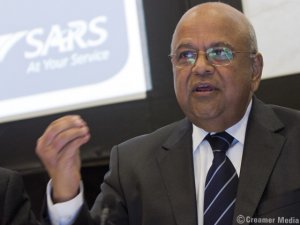
Finance Minister Pravin Gordhan on Monday stated that South Africa’s tax base, which comprised citizens and business engaging in taxable activities, such as excise tax, personal income tax, value-added tax (VAT) and corporate tax, was not wide enough.
Speaking at the official opening of the 2012 tax season, in Pretoria, he said that to ensure sustainable economic growth, larger revenues were required; however, the only way to ensure increased revenue was to grow the economy and create tax-paying-level jobs.
South Africa also required the establishment of more businesses, particularly with an increased commercial base, and an increased production base, especially in manufacturing.
The South African Revenue Service (Sars) is expecting to collect over R827-billion in revenues from the entire South African tax base in the 2012 tax season and R927-billion in 2013.
Total revenue collection grew from R114-billion during the 1994/95 tax season, to over R742.7-billion in 2011. Of this, 12-million South African individual taxpayers, last year, accounted for R251.6-billion, or 33.8% of all revenue collection. Business activities, excise tax, corporate tax, VAT, capital gains and dividends, besides others, contributed the remainder.
At March 2012, South Africa held 13.7-million registered individual taxpayers, a jump from 1.7-million in 1994 and 6-million in 2010.
The number of companies that have registered for income tax had increased from 422 000 in 1994, to more than two-million in the 2011/12 financial year.
There were currently 664 000 registered for VAT in South Africa, up from 397 000 in 1994 Further, the number of registered employers grew from 177 000 in 1994, to a current 385 000.
Gordhan said the country aimed to invest in significant infrastructure projects and other activities to stimulate growth, with R845-billion earmarked for energy, transport, water and telecommunications infrastructure over the coming three years.
“If there is no growth plan accompanying a fiscal [plan], then economies will not be able to work their way out of economic difficulties,” he noted.
The Finance Minister also said that the relationship between government and taxpayers was important for South Africa to host a viable and meaningful democracy.
Every citizen was a part of growing South Africa and ensuring that the country maintained the financial strength and stability to absorb the “formidable” impact of the financial crisis of 2009.
“We have managed over the last ten years to maintain a low debt load, and while gross debt may migrate to 42% or 43% over the next three years, we are still better off than most countries as far as the debt load is concerned,” Gordhan said.
However, he pointed out that the R60-billion revenue lost during the recession had not yet been recovered and that government was working on sustaining its low debt while attempting to deliver services to citizens.
By last year’s deadline a record 4.86-million individuals and trusts had submitted their tax returns on time – 23% higher than the previous year.
About 300 000 people were currently being charged penalties to the value of R1.7-billion for not filing tax returns.
EMAIL THIS ARTICLE SAVE THIS ARTICLE FEEDBACK
To subscribe email subscriptions@creamermedia.co.za or click here
To advertise email advertising@creamermedia.co.za or click here


